


Richard Staples*
I have used stand-alone solar power at home since 1990. To use an analogy, being off the grid is a bit like sailing overseas on a small boat instead of booking onto a cruise ship, more challenging, sometimes less comfortable, requiring personal input (sometimes at an inconvenient time) but rewarding, even fun.
It has also given me a perspective on what have become major issues, the price of electricity, and climate change. Are people being economically rational on a personal level but irrational as a society?
In the late nineteenth century Thomas Edison developed, after numerous attempts, a reasonably reliable light bulb, and went on to install low voltage, direct current (DC) electricity distribution networks in the New York-New Jersey area so that the bulbs could be lit.
Despite the challenges installing the networks (Tammany Hall not the least), electric light had big advantages over gaslight.
Problem was his low voltage (around 100 volts) required very thick wires to reduce ‘line losses’ and consequent voltage drop (Ohm’s Law). That meant a lot of relatively small, local, coal fired generating plants.
Another inventor, George Westinghouse, realised that if electricity was distributed at a higher voltage, less current would be required to distribute the same amount of power, and thinner, cheaper wires could be used.
This high voltage, distributed as alternating current (AC) would be ‘stepped down’ to a lower, usable voltage near the point of use.
Consequently fewer but larger generating plants would be built, and bigger profits made.
There were true economies of scale, and this is a true American tale.
In his delightful book Edison and the Electric Chair Mark Essig relates how authorities (in a flash of inspiration?) almost immediately hit upon a novel application for electricity, a perhaps less messy way to dispatch condemned convicts.
This led to a legal struggle involving Edison and Westinghouse over whether DC or AC was more appropriate for this task: there were wider implications regarding the safety of the rival technologies. This debate has been eerily echoed in recent times regarding methods of lethal injection for capital punishment.
For less gruesome applications, the economics were in Westinghouse’s favour, even though there are losses every time voltage is stepped up or down, and still significant line losses.
So a pattern was in place for the 20th century, ever bigger power plants and networks worldwide (note that the successors of companies that both Westinghouse and Edison founded are major manufacturers of nuclear power plants).
It all made good economic sense while there was no cheaper way of generating electricity than in a big thermal power station.
Economies of scale
Nikola Tesla helped by developing a motor that could run on AC. So the networks grew, electricity became cheap enough to use not only for lighting, but as a way to produce low-grade heat for cooking and heating buildings, energy for motors and a multitude of industrial uses.
Economies of scale meant appliances could be bought cheaply. However, as with railway gauges, once a standard is adopted it is difficult to change.
I’ll use another analogy. A goat carves out a winding pathway through the hills. Later a horse and cart use the same pathway, and so on until it is paved and improved and a mega highway follows a ridiculously circuitous route because no one ever decides to re-route.
The electronics revolution introduced clever (high utility) new ways of using electricity.
It’s ironic that electronics use low voltage DC (hence the little adaptors we use to plug in our mobile phones, computers, etc. to rectify and step down the supply). Every time electricity is transformed there are losses.
Case study: East Timor (where I am working) has just spent some US$600 million building a 120 megawatt, centralised electricity system.
That’s $5 per watt of installed capacity. It will require on-going imports of heavy oil to fire its clunky, Chinese-supplied generators and there is no coherent plan to get consumers to pay for electricity usage.
Many people illegally tap into the system, I’m not sure how many get electrocuted.
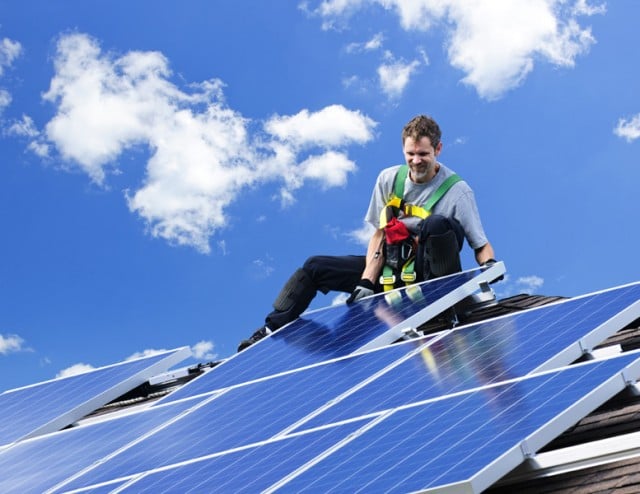
Solar panels cost less than $2 per watt these days. For less than half the capital cost of the system, the new nation could have gone totally solar.
Solar panels produce low-voltage DC and an inverter is required to match the old, high voltage AC appliances or to feed power into the grid.
Of course there is an excuse, try buying a 12-volt telly for instance and see what it costs compared with the 240 volt one!
It’s not that 12-volt electronics are inherently more complex (in fact they are simpler, not requiring a rectifier); it’s about economies of scale.
So with a stand-alone solar set-up using 240 volt appliances and lights, the electricity is transformed twice at home, with significant energy loss. As with water, it’s vital to address the demand side as well as the supply side.
On the supply side, we see proposals for vast arrays of solar panels saddled with a distribution and administrative network along the same lines as the old power stations.
Inefficient networks
This model ignores the fact that there are virtually no economies of scale involved, rather there are diseconomies since the network and administration costs remain, along with the conversion and line losses previously discussed.
In other words, it’s smarter to put 10 solar panels each on 1,000 roofs than to connect 10,000 panels in Woop Woop to 1,000 houses through a network.
But of course people, especially politicians, love to boast about big things! Many of these schemes are merely tokenistic such as the solar array installed at our local tip.
However, others may have more complex motives. In a somewhat Orwellian way, Michael Fraser, chief executive of AGL, recently unveiling his company’s plans for two solar power plants in western NSW, stated ‘The most cost-effective way to develop solar is with large-scale projects, you get the economies of scale’. How?
We are seeing some well-intentioned but quite dumb attempts to adopt solar power. Grid-interactive systems are being marketed aggressively at the moment.
My theory is that power companies like them (or at least don’t feel threatened by them) simply because they keep consumers on the grid, and people are not forced to look at demand management.
The standard argument in favour of them is that it’s difficult to store power for night-time use, true enough; battery technology, though improving, hasn’t changed that much in the last century.
If you Google ‘stand alone power’ Wikipedia will warn you of the ‘toxic’ lead-acid batteries that are commonly used, ignoring the fact that the lead in these batteries is virtually 100 per cent recyclable.
On the demand side, a major revolution is underway in the application that Edison pioneered, lighting.
Light emitting diodes (LEDs) are dramatically more efficient than incandescent or fluorescent lights, so very little power needs to be stored to supply them at night, hence less battery capacity needed.
Similarly, computer and TV screens now use LED technology, again, massive savings on the demand side.
A stand-alone power system is an obvious way to achieve privatisation, but more importantly, independence. It frees the owner from manipulation by the centralized power and fossil fuel industries.
It is relevant to note that during many natural disasters, mains power is vulnerable and often fails at the worst possible time, when communication is vital.
Stand-alone is far more resilient. The current (no pun intended) political debate about privatisation of state-owned electricity assets (and the price that may be realised) rests on assumptions about what is actually being offered up for sale, is it an ‘essential’ service? (note the recent re-badging of a local electricity retailer).
If I was on the board of a big energy company, I would feel as threatened as someone on the board of a metropolitan newspaper in the face of the digital revolution. The king has no clothes!
So, what way forward? A recent report has shown NSW electricity prices rose as much as 64 per cent between 2009 and 2013.
Electricity retailers are warning that abolishing the carbon tax is unlikely to lead to a price fall of nine per cent, as claimed by some in the federal government.
Meanwhile, solar panels cost about a third of what they did five years ago. No doubt these trends will continue.
I recommend that anyone building a new dwelling install 12v, stand-alone solar, with a small inverter for those few 240v appliances that can’t be replaced in the short term.
The capital cost of a stand-alone system is often lower that of establishing a grid connection.
Retro-fitting low-voltage into an existing house need not require total re-wiring, as existing lighting circuits are adequate for the extremely low wattage LED lights now available.
Phones, computers etc can recharged from a low-voltage supply using ‘car adaptors’.
There is a problem in that most electricians are busy making a lot of money out of the status quo, don’t understand stand-alone systems and will probably advise you not to try this at home.
Fair enough, if you want to use a welder in your shed you might need to keep a grid connection; you might reconsider whether you really need a vacuum cleaner, and air-conditioners, electric stoves, dishwashers and other devices requiring electric heating are inappropriate.
It may also be tricky installing your own electric chair.

* Richard Staples was a Byron shire councillor from 1995-2012.
 For four decades The Echo has printed the stories some people loved, some people hated, and some pretended not to read. If you want us to keep telling the truth, the real truth, not the sugar-coated version. We’ll need your support to keep the presses rolling.


