


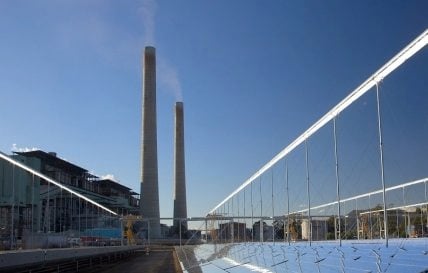
- Running behind schedule: Kogan Creek, the world’s biggest solar-thermal plant, in Queensland.
Giles Parkinson, RenewEconomy
Australia’s largest solar thermal energy facility – and the world’s biggest solar integration with a coal-fired generator – is experiencing problems and is facing a delay of a year or more before commissioning.
The 44MW ‘solar boost’ project at Kogan Creek in Queensland was supposed to have been completed at the end of last year.
However, a series of problems – including an equipment supplier going into receivership – have caused a delay, with the $104 million project now likely to be completed by the end of 2014 at the earliest, and commissioned in 2015.
The solar thermal plant is using Compact Lineal Fresnel Reflector (CLFR) technology developed by Australian-founded Ausra – its two founding members David Mills and Graham Morrison received Order of Australia awards just a week ago. The CLFR technology, which uses mirrors to reflect solar energy to heat up liquid and generate steam – is now owned by French nuclear giant Areva.
The Kogan Creek project is being partly funded by a $35 million Renewable Energy Development Program grant now managed by the Australian Renewable Energy Agency. The REDP has had a chequered history, with several projects either cancelled or having their funding removed, such as the Solar Oasis concentrated solar PV project at Whyalla in South Australia.
Areva revealed in its 2013 profit results released last week that it had suffered a fall in revenue owing to ‘the difficulties encountered at the Kogan Creek project in Australia’. It did not expand and the company did not respond to RenewEconomy’s inquiries. The 15 per cent fall in revenues suggests that costs may have blown out.
Kogan Creek is run by state-owned generation company CS Energy. In a statement, CEO Martin Moore said the project had experienced some delays, but was continuing and 5,460 (locally made) solar reflectors had been manufactured.
‘We have experienced some delays; however, the project is well advanced,’ Moore said. ‘The majority of civil works and Phase 1 of mechanical construction have been completed. The major proportion of the equipment for the project, including the 5,460 solar reflectors, has been manufactured.
‘Project commissioning is expected to start in late 2014, in preparation for the commencement of commercial operation in 2015. On completion, it’s believed the solar thermal addition will be the world’s largest solar integration with a coal-fired power station.’
Moore said a ‘combination of factors’, including the receivership, had flowed into scheduling and commercial issues that CS Energy and Areva Solar are working to resolve. Onsite works had been halted while those issues were resolved.
‘We expect to proceed with Phase 2 of mechanical construction soon,’ he said. ‘This phase involves the assembly and lifting of receivers, installation of the remaining reflectors, interconnecting foundations and pipework, the tie-in of SSGs and the interconnection to the power station.
‘While we are disappointed that the project is taking longer than expected to complete, the issues we’ve been working through are not uncommon for commercial-scale projects.’
The solar thermal addition will supply steam to the existing 750MW Kogan Creek power station, reducing the amount of coal it needs to burn. CS Energy was to take part in a consortium that won federal and state government funding for a 250MW standalone project using the same Areva technology, but it withdrew in early 2012. That project ultimately did not go ahead because the government funding was withdrawn.
There is a major debate among solar thermal energy proponents about whether the technology should be deployed as a ‘booster’ in hybrid plants, or as standalone operations. Arena has made hybrid plants a focus of its funding plans in coming years, arguing that it is the best way to deploy the technology. Detractors say it could needlessly extend the life of coal plants.
Areva is currently building a 100MW standalone plant for Reliance group in India using the same technology. It has other smaller solar booster projects in the pipeline.
CLFR is just one of a number of solar thermal technologies currently being deployed. Parabolic trough plants and solar tower projects, some with storage, are being rolled out in the US, South Africa and northern Africa at the moment.
Arena, meanwhile, has released a new study that shows solar thermal could eliminate the need for network augmentation in 70 per cent of cases that it examined – a cost-effective alternative to network enhancements.
‘The study found that solar thermal could eliminate the need for network augmentation in more than 70 per cent of the cases examined. It said solar thermal can provide power 24 hours a day thanks to storage solutions and offers ‘easy hybridisation’ with other energy sources.
‘This is significant, as most of the rise in electricity prices over recent years can be attributed to investment in network infrastructure to meet Australia’s peak power demands,’ Arena CEO Ivor Frischknecht said in a statement
This article was first published in RenewEconomy.
 For four decades The Echo has printed the stories some people loved, some people hated, and some pretended not to read. If you want us to keep telling the truth, the real truth, not the sugar-coated version. We’ll need your support to keep the presses rolling.


