


Darren Coyne
Police are targeting drug driving in a statewide blitz amid claims that motorists are being wrongly targeted because of ‘imprecise legislation’.
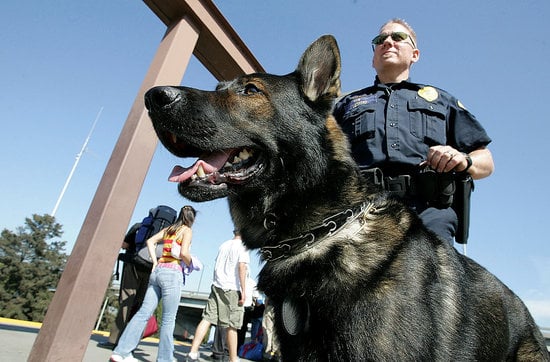
They are also continuing to use sniffer dogs in Nimbin and other centres despite studies showing that the dogs’ success rate of detecting drugs is less than 50 per cent.
One Nimbin resident stopped this week by a drug detection dog believes the ‘positive detection’ was a result of a ‘subtle command to do so from its handler’.
Police searched the man’s personal belongings and his body, spending ‘just a little too long looking down the crack of my hairy bum, in a very public place’, and recorded his personal details.
‘The mutt “detected” drugs on me freshly showered in clothes fresh from the hot water laundromat, when it’s been literally many, many months since I’ve used my preferred medicine.
‘The dog is useless, it responded to a signal from the handler, period.’
Lismore solicitor Steve Bolt told Echonetdaily that despite being used for more than 10 years, sniffer dogs were ineffective.
‘The starting point should be that people should be able to go about their business without being subjected to a police search,’ Mr Bolt said.
‘There’s been a lot of scrutiny of sniffer dogs and the figures show that they detect drugs less than 50 per cent of the time so that’s a lot of dog indications that lead to a search where no drugs are found.’
‘When drugs are detected it’s almost always a very small amount of cannabis so the system is picking up ordinary people, cannabis users, but is yet to detect anyone with a significant amount.’
Meanwhile, police are halfway into a statewide blitz on drink driving, and are also targeting drug drivers.
Traffic and Highway Patrol Commander, assistant commissioner John Hartley, said the operation was run to take those under the influence off the roads.
“Despite the amount of random breath tests that police do throughout NSW each year, there are those that still run the risk of drinking, then either driving, or riding a motorcycle,’ he said.
The announcement of the police operation made no mention of drug driving, other than it was also being targeted.
Mr Bolt said the roadside drug detection regime had the potential for people to be convicted just for the presence of cannabis, despite their driving ability being unimpaired.
He believes drug-driving laws needed significant changes to prevent innocent people being caught up in the imprecise legislation.
‘The issue is that the current testing regime does not measure impairment; it simply detects the presence of the drug in saliva,’ Mr Bolt said.
‘This is an issue because cannabis, for example, can be detected for two days. ‘We’ve had a number of clients who assured us, and it was accepted by the court, that they had taken the drugs more than 24 hours before they were tested.’
Echonetdaily has reported previously that Lismore magistrates David Heilpern and Jeff Linden have both questioned the effectiveness of the testing regime given that THC can be detected days, if not weeks, after use.
Mr Bolt said laws on drug driving should closely mirror drink-driving laws, which measure an acceptable level of intoxication.
‘There needs to be more sophisticated testing around the levels of THC because at present even the smallest amount is being detected, including people who have been eating hemp seeds,’ he said.
‘Yet there is no testing for people taking strong prescription medications, such as codeine, that might effect their driving ability. It doesn’t make sense.
‘If the point is road safety, then there should be consistency across the board,’ Mr Bolt said.
 For four decades The Echo has printed the stories some people loved, some people hated, and some pretended not to read. If you want us to keep telling the truth, the real truth, not the sugar-coated version. We’ll need your support to keep the presses rolling.