


Bernard Keane, Crikey politics editor
There’s one phrase that guarantees anyone who uses it in relation to a tragic event is either a fool or the most vilely cynical manipulator: ‘the day Australia lost its innocence’ – or Monday’s variant, ‘the day Sydney lost its innocence’. The people inclined to use that phrase regularly deploy it in association with tragedies. The Bali bombings were, according to politicians and the media, ‘the day Australia lost its innocence’. But then, so was the Hilton bombing, and it was used about the string of gun massacres in the 1980s and 1990s that John Howard brought to an end with his gun laws. Australia losing its innocence has thus become a constantly repeated process, as if somehow we regain it between tragedies, only to be deprived of it next time.
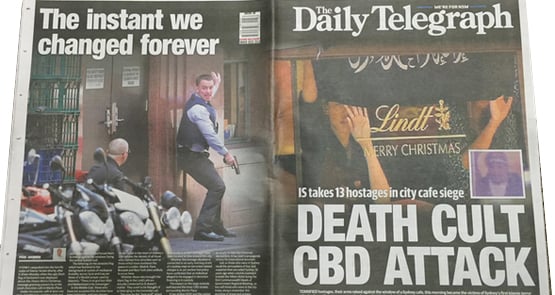
That the media would be able to resist its use proved a forlorn hope, although the first mainstream media offender turned out to be Rupert Murdoch’s Fox News; Murdoch’s Sydney rag, in its repulsive ‘afternoon edition’, complete with commemorative wraparound (something to show the grandkids!), settled for the variant ‘the instant we changed forever’. But having erroneously described a mentally ill violent criminal, who had been a Shia for almost his entire life, as ‘IS takes 13 hostages’ – a statement wrong in every possible way – the Telegraph had already set a new low, at least until its geriatric reactionary owner tweeted his delight at his employees’ caperings this morning.
Meantime, Fairfax, where the Financial Review also went with an Islamic State connection despite having longer to realise it didn’t exist, was today running the absurd typing of an American journalist who insisted Monday was Australia’s ‘9/11 moment’ – and 9/11 of course was famously the day America lost its innocence, a description that requires almost complete historical ignorance, or at least a healthy sense of sarcasm, for use.
The assumptions loaded into such ‘lost its innocence’ statements merit entire theses; indeed, many have doubtless already been written. That Australia, established as a prison colony and forged in dispossession, genocide and gleeful participation in the long wars of imperialism throughout the 20th century, could be ‘innocent’; that it is such a fragile culture that a single moment of violence, however atypical, could comprehensively alter its very nature. There’s almost a sense of pride in it, the sort of pride that welcomed the casualties of Gallipoli as a proper ‘blooding’ of the young nation, pride that Australia has now joined the big league of nations targeted by terrorists. It’s a sentiment that underpins the visible, fawning delight of much of the media that events in Sydney have merited global media coverage. The cultural cringe may have long been replaced with reflexive nationalism, but we still love it when them sophisticated furreners pay us attention.
But that was merely one of the cliches that journalists, hosts and commentators reached for Monday. With a dearth of information from police about such basics as how many gunmen or hostages there were and nothing happening across the day, the rolling media coverage quickly surrendered to hackneyed phrases, rampant, ill-informed speculation and rumour-spreading, exactly like social media. Terrorism experts were hastily summoned to explain what was happening, or not happening, that this was a lone wolf or part of a bigger attack, that this had been carefully planned or badly bungled. Blatant inaccuracies were peddled. Sydney airspace had been shut down, outlets reported, when it hadn’t. A precautionary evacuation of the Opera House became an ‘incident’ there, with suspicious packages being reported. The ‘National Art Gallery’ had been evacuated, one journalist tweeted, possibly alarming the staff of Canberra’s National Gallery of Australia, the gallery with the nearest name to the apparently deserted, but fictional, institution.
And above all, there was the hysterical tone, the claim of a ‘city under siege’, as if Sydney had never witnessed such things before – events like the Hilton bombing (thank you, ASIO) or 1984’s bank hostage drama, in which Hakki Atahan emerged from a George Street bank surrounded by hostages, walking in close formation to a getaway car to begin a pursuit that ended in a shoot-out on the Spit Bridge.
Not all of the coverage was irresponsible, certainly. The Guardian’s live blog was sensibly circumspect and avoided the trap of recycling what other outlets were claiming as ‘unconfirmed reports’. Most outlets, including News Corporation, refused to disclose information communicated to them from the perpetrator via hostages, although that led to some bizarre tweets, in which journalists declared they knew information but would not be disclosing it at the request of police, and they hoped others wouldn’t either. The much-maligned Ray Hadley wisely rejected efforts by the perpetrator to go on air. But the identity of interests between the mass media and terrorists (assuming for a moment Man Monis was engaged in terrorism, despite having no explicit ideological agenda in his acts of violence Monday) was on vivid display throughout the hours and hours of ‘rolling coverage’ that sought to keep viewers and readers glued to their screens despite the lack of anything happening or new information.
In contrast, both Prime Minister Tony Abbott and NSW Premier Mike Baird conducted themselves entirely appropriately – calm, unwilling to engage in speculation, leader-like. Abbott correctly judged the Mid-Year Economic and Fiscal Outlook release should proceed – having urged Australians to go about business as normal, the best way to encourage that was to show that the business of government would go on. It’s rare that the Prime Minister can provide a lesson in communication to the media, but he did so Monday, in spades.
It wasn’t the day Australia lost its innocence, or changed forever. It was a day that much of Australia’s media again demonstrated it’s not up to the challenge of providing mature coverage of terrorism.
 For four decades The Echo has printed the stories some people loved, some people hated, and some pretended not to read. If you want us to keep telling the truth, the real truth, not the sugar-coated version. We’ll need your support to keep the presses rolling.


