


By Giles Parkinson and Sophie Vorrath, reneweconomy.com.au
April has been an extraordinary month for climate and clean energy policy in Australia. Even more extraordinary than the previous months. As the rest of the world accelerates their individual and collective push towards globally agreed climate targets, Australia is stubbornly refusing to budge, or even to acknowledge that there is an issue at all.
In the Orwellian world of the Abbott government, coal is good and has a great future, even when analysts call for nearly all reserves to be left in the ground; a cut in the renewable energy target is not a cut at all, it is actually an increase; and spending one-quarter of its carbon budget on just 15 per cent of its target is not so much a failure as a resounding success and a blueprint for the world to follow.
So, to help with your understanding of the issues at hand, here’s a brief summary.
1. Direct Action in action
Thursday delivered the results of the first auctions by the government’s Emissions Reduction Fund, the centrepiece of the Direct Action plan. The first auction blew one quarter ($660 million) of its total budget ($2.55 billion) to buy just 15 per cent of its 2020 target. (Nearly half the abatement ‘bought’ will not be delivered until after 2020).
Analysts such as The Climate Institute and Reputex say it is proof that the ERF will not meet its targets, is incapable of meeting any more ambitious target, and will not send a price signal for decarbonisation. Labor is even more damming, dismissing it as a ‘slush fund’ and noting that the $14 price is higher than any emissions trading scheme. Greens leader Christine Milne said it was a ‘sham’, and ‘just an excuse to do nothing about global warming’. While the government is paying one lot to plant trees, she said, it is opening the way for others to cut down forests.
2. The government response
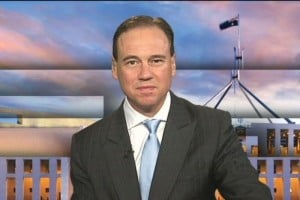
Hunt, a former university debater of note, and arguing for the positive, was undeterred. The first auction was a ‘stunning success’, he insisted, and a triumph that would provide a blueprint for the world to follow (an echo of his comment last year that Australia’s climate policy was a great ‘gift to the world’. This, despite news this week that most of the world’s major economies had lodged formal queries with the UN, which, broadly summarised, amounted to ‘This Direct Action program, wtf?’
Hunt forged on. The abatement price, he said, was not double the price of a market scheme, it was one/90th the cost of labor’s $26 carbon price. (We asked them to explain this but they didn’t, but it probably came from counting costs – $15 billion – not revenue). Hunt said the European carbon price would achieve just one per cent abatement from now till 2020 (Well, that would be because the targets have already been largely met).
3. Renewable Energy Target
The government wanted it removed, and then it wanted it cut. After a more than six-month long impasse following the Warburton Review, Labor has (reluctantly) suggested the 41,000GWh target be cut to 33,500GWh (and raise again if they get elected). The Abbott government is not having a bar of it, insisting on a further cut to 32,000GWh. This, say Ian Macfarlane and Hunt, is actually not a cut at all, it’s an increase! Hooray! Huh?
That’s because the renewable energy target was so successful it was going to deliver way more than the ‘at least’ 20 per cent it was designed to. So that makes the scheme an abject failure, because it was working beyond expectations. And if you don’t understand that then you are all a bunch of sillies.
4. Climate targets
The Climate Change Authority, the independent body that the Abbott government wishes was neither independent, nor a body, delivered its assessment of where the country’s emissions targets should be. It has already said that the 5 per cent target for 2020 is pathetic, and should be 19 per cent. Now, it says the 2025 target should be 30 per cent and the 2030 could be anywhere from 40-60 per cent. Hunt is not keen, saying such a target would be ‘onerous’ – presumably for Direct Action, and the government’s budget. The mining council says the world, or at least the thermal coal industry it lobbies for, would come to a halt if such targets were imposed.
 5. Carbon budgets
Hey, by a stroke of coincidence, that is exactly what most experts say should happen. If the world is going to meet the 2°C target, then it has to realise that it cannot go on emitting ad infinitum. Hence, the concept of a carbon budget. New research this week suggested that Australia would have to leave 90 per cent of its coal reserves in the ground as part of its share of the global carbon budget. Australia’s response? Introduce a ‘safeguards’ mechanism that allows emitters to continue emitting, and even increase their emissions, without penalty.
6. Don’t mention the 2°C target

The best way to protect against action to achieve a 2°C target is to not mention a 2°C target. This, the government has managed to do in its own discussion paper about the targets, that it will take to the Paris climate talks which are designed to agree on collective action to meet a 2°C target. The 2°C target was also not mentioned by Australia at the Major Economies Forum, hosted by France, because it didn’t attend. The scenarios entertained by the government point to global warming of 4°C, which would be a bit of a sweat for a PM in lycra. The energy white paper made the same assumption, and the intergenerational report got around the whole issue by not mentioning it at all, which means it doesn’t have to try and calculate messy concepts such an intergenerational debt, unless it’s about Medicare and pensions.
7. Independent advice
So, where is the government getting its advice? From people like Bjørn Lomborg, who is to receive $4 million to establish his notorious think-tank at the University of Western Australia. Lomborg’s recipe for success: Stop solar, push nuclear, pretend climate is not an urgent issue. Hunt, though, is full of praise, noting Lomborg is a very nice man who once compiled a report with a bunch of like minded people that concluded that emissions trading schemes are not very good.
8. Senate wind inquiry
The Abbott government wants to ‘end the uncertainty’ about renewables by striking a deal on the RET with Senate cross benchers. But they have been very busy recently, along with some Coalition Senators, nodding gravely while clearly distressed residents near wind farms explain why they can no longer complete Sudoku puzzles, and have to lift their dog into the ute. Senator Bob Day, who runs this show, says the testimony of impacts to humans and animals is ‘harrowing’, and he is very happy to let the renewable energy industry stew in its own juices for another six months while he comes up with a plan for what to do about it.
9: Technophobia
Or should it be the fear of new technology, apart from those that are ‘over-the-horizon’. Joe Hockey doesn’t like wind farms – at least, he is offended by the sight of them – and Industry minister Ian Macfarlane says he is not a fan of electric vehicles, choosing instead to hop into a fuel-cell vehicle and declare it to be the ‘perfect melding of industry and science’, and deliverer of a better future for all.
 Macfarlane, as we have noted in the past, is at his most comfortable when championing technology that is unlikely to disrupt the status quo any time soon. Hence his endorsement of hydrogen fuel cell vehicles over EVs, and his well documented admiration of Carnegie Wave Energy’s CETO systems – a fine technology but, unlike solar and wind, not one that will bother the incumbents in the next decade.
It also explains the Coalition’s support for ARENA (the $3.2 billion Australian Renewable Energy Agency) – which grants funds to R&D and admirable early-stage projects such as Carnegie’s – but not for the CEFC, which grants money for commercialisation technology. The US Republicans have a similar approach. Bjørn Lomborg is their most brazen advocate.
10: Eco-charities are bad
While the government is keen to hand over money to like minded folks like Lomborg, it has pulled funding from un-like-minded folks such as the Climate Commission. And it wants to stop other people from funding people who may disagree with its environmental agenda. Hence an inquiry into the tax-deductible status of environmental groups who, shock horror, have dared to oppose government policy. If you can’t beat ’em, de-fund them.
So, let’s just summarise. If something is a success, like the renewable energy target, it’s a failure. If something is a failure, like Direct Action, then it’s an outstanding success. If something is cheap, like a market price for carbon, then it is expensive. If something is more expensive, like purchases by the Emissions Reduction Fund, then it is really cheap. If something is bad, like coal, then it is good for humanity. And if something is good, like wind turbines, it is not just bad, it is offensive. If a target can be met, like 41,000GWh of renewables, or even 33,500GWh, then it can’t. And if a target can’t be met, like 5 per cent emissions reduction by 2020 with Direct Action, then of course it can. And if you are a politician in Australia, then…. the next election will be interesting.
 For four decades The Echo has printed the stories some people loved, some people hated, and some pretended not to read. If you want us to keep telling the truth, the real truth, not the sugar-coated version. We’ll need your support to keep the presses rolling.


