


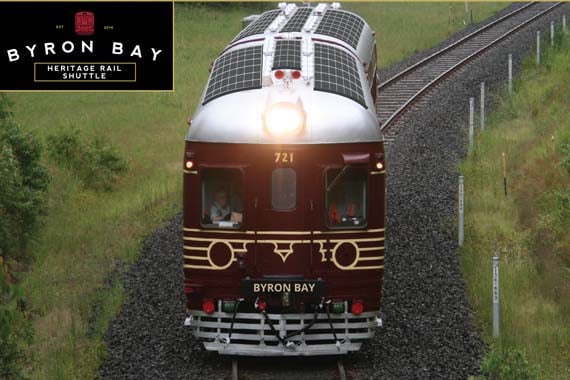
Following community interest regarding the technical aspect of how Byron Bay’s new train service will operate with a solar conversion, development director Jeremy Holmes offered to explain how it would work.
The service is planned to commence in the coming months from near the Elements of Byron resort in Sunrise Beach into Byron’s CBD.
Holmes says that solar power will be collected from the roof of the train and from the roof of the train storage shed to charge sizeable batteries on the train.
‘Energy from these batteries will drive dual electric motors and be sufficient for a number of return trips between charges. Our calculations show that the combined solar panels and regenerative braking will generate the equivalent amount of power, required daily to run the train service.
Regenerative braking
Tim Elderton, managing director of Lithgow State Mine Railway explains, ‘In regards to the amount of solar panels and batteries required, critics fail to take into any consideration the effect of “regenerative braking” (known as regen for short). Any electric vehicle would be most inefficient without regen, as it recaptures up to half of the energy used during acceleration.
‘The electric traction motor wiring circuit is reversed, which turns the electric traction motor into a generator. The generation of electricity retards the train and the electricity generated goes back into the batteries for reuse. Regen has been used on electric trains for more than sixty years, and every modern electric truck and bus has it fitted. Electric solar traction systems are available off the shelf for retrofitting into buses and trucks, and because the railcar is basically a big bus, running on a short, flat, low-speed run, this technology is very well suited.’
A further statement from Byron Bay Railroad Company reads, ‘Our intention was to get the train up and running prior to the solar conversion; however, technology has developed rapidly in this area to the stage that it is technically feasible to implement now.
‘Byron Bay Railroad Company has ordered the necessary components and materials and are awaiting their arrival in the coming months.
‘The solar-charged batteries are designed to operate all systems including traction power, lighting, control circuits and air compressors. We understand the train in India referred to by [resident] Lee Cass has the solar panels only powering the lighting and possibly the air-conditioning.
‘The custom-designed curved solar panels on the roof of the train, combined with the solar array on the storage shed roof, will generate sufficient energy to power the train when combined with the regenerative braking system.
‘The train will retain one of its two diesel engines so that in the event of prolonged inclement weather or other unforeseen issues it can still operate.
‘However, batteries and their charging off the grid supply are being designed to accommodate normal day and night operation including when, of course, the sun isn’t shining.
‘While there are specific licensing and accreditation requirements for conventional electrical infrastructure (sub-stations, feeder systems, overhead wiring etc) the use of electrically driven trains operating independently of fixed overhead wiring is commonplace.’
The statement also says the project has the support of Transport for NSW.
 For four decades The Echo has printed the stories some people loved, some people hated, and some pretended not to read. If you want us to keep telling the truth, the real truth, not the sugar-coated version. We’ll need your support to keep the presses rolling.


