


 Giles Parkinson, RenewEconomy
A major new study has underlined the crucial role played by rooftop solar in moderating energy prices: without it, the study says, the aggregate cost of electricity would have been several billion dollars higher over the past year.
The study by Energy Synapse, commissioned by the community lobby group Solar Citizens, reinforces previous estimates of the broad benefits of the more than 6GW of rooftop solar installed on more than 1.7 million household and business rooftops.
That capacity is ,often demonised by vested interests as ‘free-loading’ on the network and other consumers, but the study proves otherwise.
It notes that in NSW alone the savings from rooftop solar – by reducing demand at crucial times and challenging the dominance of the big generators in the wholesale market – were between $2.3 billion and $3.3 billion in the 12 months to April, 2017.
That’s how much the wholesale price is lowered from what they would have been if rooftop solar was not present in the market. Even though rooftop solar only provides 2 per cent of total generation, the study found it clipped prices by $29-44/MWh – up to 50 per cent higher than the actual price.
That stands to reason. Major generators have long complained about how solar is ‘clipping their margins’, and networks have also underscored the other major finding of the Energy Synapse study by pointing out that rooftop solar is narrowing and lowering the periods of peak demand.
Mark Byrne, from the Total Environment Centre, points that if the estimates are right, then the benefits to all energy consumers each year are twice the cost of the up-front support for rooftop solar, in the form of rebates and the STC market.
‘That means all consumers got a return of at least double their investment in a single year – and the beauty of solar is that it should keep delivering benefits for an average of 20 years,’ Byrne says.
‘That’s a massively good investment in constraining wholesale prices for all consumers, including those without their own PV. And the returns in respect of merit order impacts will get better as more people put solar on west facing roofs and install solar batteries.’
It is also important in the context of Australia’s energy debate. The Coalition government appears poised to release a new policy designed to inhibit the roll out of at least large scale renewables, despite even the Australian Competition and Consumer Commission finding that more competition would likely cut prices.
The ACCC report was a perfectly times riposte to the Coalition and conservative argument that renewables are forcing up prices.
‘The consumer watchdog has belled the cat. Power prices are going through the roof because big companies are gaming the system, not because of renewable energy targets,’ said The Greens energy spokesman Adam Bandt.
But the ACCC report – commissioned by the Coalition government – is breathtaking in its cynicism of what can and should be done about it.
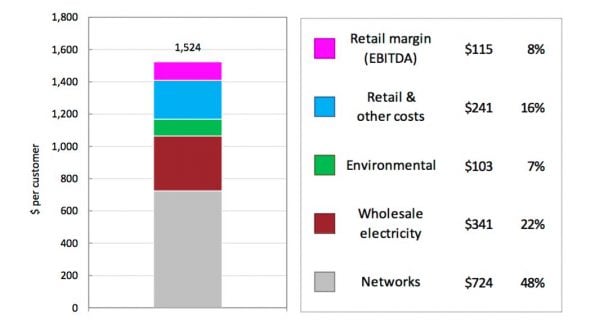 Its major findings – that the absurd cost of electricity paid for by consumers is the result mostly of the ‘gold plating’ of the network, followed by soaring wholesale prices and retail costs – is not new. Environmental schemes account for just 7 per cent of the total bills (see bill above).
ACCC chairman Rod Sims says the high costs – they have risen by 63 per cent more than the cost of inflation over the last decade – is because customers are effectively getting screwed by the networks and the generators and retailers.
But then, extraordinarily, he says nothing can be done.
He defends the actions of the big generators as ‘rational, profit maximising behaviour’ that is ‘consistent with the National Electricity Rules (NER)’.
Of the network costs (which account for half household bills and largely explain the difference between Australia and other countries) Sims says these are ‘locked in’, refusing to countenance the argument that may be the network should take a write-down on the value of what he admits are their over-inflated asset bases.
In fact, the only measure that ACCC appears to recommend is for the government NOT to introduce a Clean Energy Target, despite the pleas of the Finkel Review and everyone apart from people associated with the Coalition, the Minerals Council of Australia and the Institute of Public Affairs.
The ACCC report itself recognises that increased competition from renewables is one of the principal ways to help reduce prices and challenge the incumbents. But Sims argues against this, saying that the costs of such initiatives are ‘smeared’ across the consumer base.
This has been the argument of the incumbents for the best part of the decade, and it is truly shocking and disturbing, but not unexpected, that Australia’s main pricing regulator should repeat them.
Like so many other regulatory assessments, it ignores the considerable benefits of renewables, and rooftop solar in particular, and the fact that these considerable benefits are also ‘smeared’ across the consumer base.
Energy Synapse’s analysis shows that rooftop solar mitigates prices because of the ‘merit order effect’ – by creating electricity at zero marginal cost, it moves the ‘bidding stack’ to the left and lowers prices.
Anyone doubting the ability of small amounts of demand can influence prices need only look at the Australian Energy Regulator reports which highlights how the big generators game the FCAS markets, pushing ‘availability’ down just one MW below requirements so only high prices capacity comes into the market.

The most significant impact is felt in summer (see graph above), when the generators are at their most rampant, pushing up prices in the face of soaring demand in the summer heat as air-conditioners are switched on and gas and coal fired capacity is withdrawn or fails due to heat stress.
But small scale solar is also saving money on most days. This graph below illustrates an average day in NSW.
‘It is worth noting that small solar was able to continue to put significant downward pressure on prices in the late afternoon around 4pm, even though the output of these systems was only at about 40 per cent of max generation,’ the report says.
 There is one potential gremlin in the system – around 6pm. The report explains:
‘The other interesting point is that our lower estimate for the 6pm Trading Interval shows an average price reduction of -$12/MWh, meaning that small solar could have produced a higher price (and hence increased cost) in this interval.
‘This is due to our adjustment of bid stacks at high levels of demand to account for peaker plants operating for more hours. Despite this one Trading Interval, the overall effect of small solar PV is to significantly reduce wholesale pricing.’
Byrne points out that even if the Energy Synapse estimate is out by a factor of two, it still represents an extraordinarily good return for the rooftop solar support scheme.
One other graph from the ACCC that is worth noting is the average spot price on state-based wholesale electricity markets over the past decade.
As has often been said, but rarely recognised, South Australia’s high wholesale prices are historical, and pre-date the state’s big push into renewables. In 2007, the state’s electricity prices were nearly double that of other states – and that’s before it had any significant wind power.
That renewable capacity added in subsequent years actually helped moderate prices, and they have only jumped in the last two years – as in other states – when the big generators exercised their unfettered market power
 There is one potential gremlin in the system – around 6pm. The report explains:
‘The other interesting point is that our lower estimate for the 6pm Trading Interval shows an average price reduction of -$12/MWh, meaning that small solar could have produced a higher price (and hence increased cost) in this interval.
‘This is due to our adjustment of bid stacks at high levels of demand to account for peaker plants operating for more hours. Despite this one Trading Interval, the overall effect of small solar PV is to significantly reduce wholesale pricing.’
Byrne points out that even if the Energy Synapse estimate is out by a factor of two, it still represents an extraordinarily good return for the rooftop solar support scheme.
One other graph from the ACCC that is worth noting is the average spot price on state-based wholesale electricity markets over the past decade.
As has often been said, but rarely recognised, South Australia’s high wholesale prices are historical, and pre-date the state’s big push into renewables. In 2007, the state’s electricity prices were nearly double that of other states – and that’s before it had any significant wind power.
That renewable capacity added in subsequent years actually helped moderate prices, and they have only jumped in the last two years – as in other states – when the big generators exercised their unfettered market power
That renewable capacity actually helped moderate prices, and they have only jumped in the last two years – as in other states – when the big generators exercised their unfettered market power, or as Sims prefers to describe it – acted in an economically ‘rational’ manner.
 For four decades The Echo has printed the stories some people loved, some people hated, and some pretended not to read. If you want us to keep telling the truth, the real truth, not the sugar-coated version. We’ll need your support to keep the presses rolling.


