


Duncan Dey
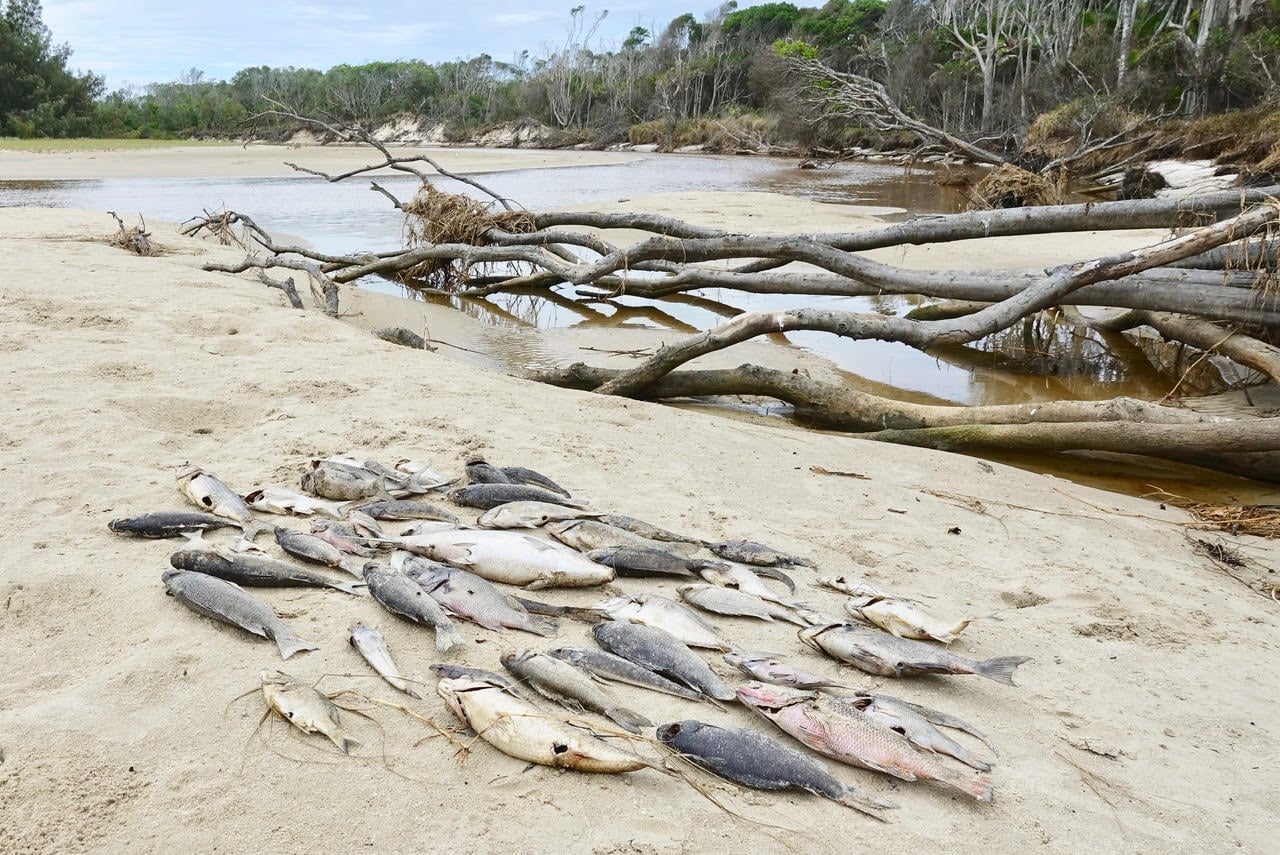
Byron Shire Council (BSC) staff used the phrase ‘natural event’ to describe the recent fish kill that saw thousands of fish die in Belongil Creek. How natural was it?
Belongil Estuary is an ICOLL (intermittently closing and opening lake or lagoon) that opens across a beach into the ocean. When catchment flow is low, the entrance closes.
When the entrance is closed the beach builds up, raising water levels in the estuary all the way back south of the Ewingsdale Road bridge. When levels there reach 1m AHD (just above high tide) council has permission to dig a channel through the sand berm of the beach and break the water out. As it flows, it washes a deeper cut in the berm and empties the estuary.
The community who benefit from the artificially lowered water levels includes farmers and residents who may otherwise be flooded in these extensive very low-lying areas of the catchment.
The community harmed by artificial openings are aquatic and can’t lobby except by turning their bellies up in death. We need to listen to them and to rethink the opening strategy.
Time to re-think
Luckily, Byron Council is doing that right now and should have a draft Belongil Entrance Opening Strategy on public exhibition this year.
Not only is the estuary interfered with by artificial opening, but the catchment has been interfered with by clearing, by having huge areas made impervious to water, and by its floodplain being criss-crossed with channels which drain those flat low-lying areas.
The areas that were historically drained to facilitate farming and grazing of cattle would otherwise have remained wet for long periods and therefore unusable for pasture.
Some of the layers of soil in those low areas are Acid Sulphate (AS) soils.
Acid Sulphate soils are innocuous when permanently wet – as they were for thousands of years – but become highly acidic when dried out (especially when drying is for the first time in geological history).
These days they are dried out in long hot summer periods due to the artificially low water table. A subsequent first flush of rain brings acid runoff into the estuary, along with decomposing organic material that strips the water of its oxygen.
First question
Investigation of the recent fish kill needs to ask first whether an acid or low oxygen event occurred.
If the fish were killed only by ‘iron bacteria’ as stated by BSC, this was an unusual event.
Either way, we also need to reconsider whether flushing huge volumes out of the estuary for our convenience and leaving the fish with far less water depth in which to survive is ‘best practice’.
Let’s keep an eye out for the draft Opening Strategy and ask for it to be made as fish-friendly as possible.
 For four decades The Echo has printed the stories some people loved, some people hated, and some pretended not to read. If you want us to keep telling the truth, the real truth, not the sugar-coated version. We’ll need your support to keep the presses rolling.


