


Hans Lovejoy
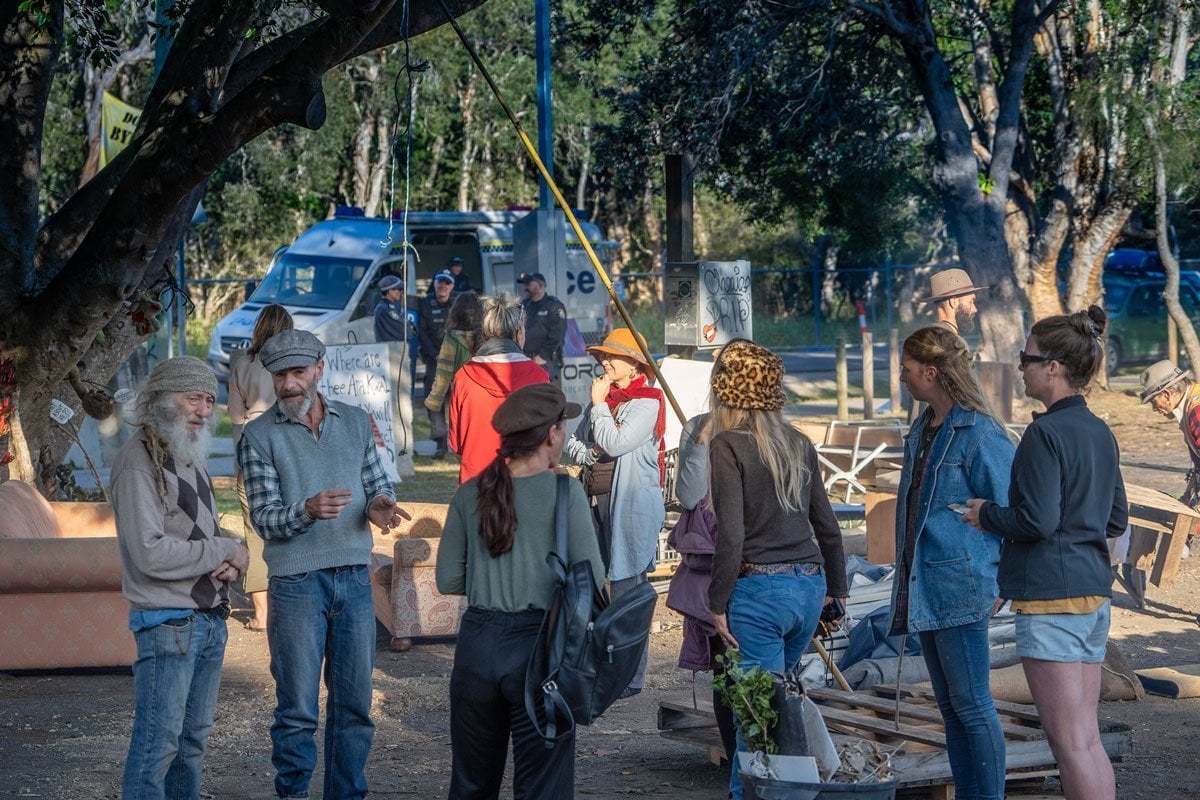
With protesters evicted from the Butler Street bypass construction site by Council staff on Monday, it’s emerged that the peak body representing ecological consultants in NSW is calling for additional surveys of the site after critically endangered species were found in its path.
And while Council are yet to provide the public with evidence that its approval requirements have been met, staff did confirm that a vulnerable Cypress and other native trees were cut down in the first stage of construction, in front of the homes of Butler Street residents.
Meanwhile, Council staff are remaining mute over allegations they failed to self-determine that a permit was required for the bypass construction.
Staff however did reply that ‘Council is currently responding to enquires from the Commonwealth Department of Environment and Energy as a result of public representations made to it’.
Greens mayor Simon Richardson has doubled down on why he won’t support a complete environmental survey of the area, which is also being requested by state Greens MP Tamara Smith.
Cr Richardson says instead the project needs to get done and delays would cost ratepayers money.
State Greens MP Tamara Smith says a complete environmental survey of the site is needed, ‘so that the flawed biodiversity offsets they are opting for are at least offsetting the correct species.’
Smith’s request comes after seeing Council’s map of the environmental species in and around the footprint of the Butler Street Bypass. She said, ‘It clearly shows a critically endangered rainforest’.
The Echo understands Council’s mapping identified the area as rainforest in 2017.
MP unaware: mayor
Greens mayor Simon Richardson replied, ‘Unfortunately Tamara’s press release indicates she is unaware of some of the details surrounding the bypass and Council remains open to providing her a briefing to share up-to-date information should she seek one’.
‘Tamara is correct in stating our map shows rainforest; however, the original Council mapping of the area as a rainforest type was based on a process based largely on desktop and photo analysis.
‘Owing to the requirements within the biobanking process, Council undertook a far more detailed assessment of the area than Council’s usual mapping process. Essentially, plot transects were completed in accordance with the required methodology in terms of location, orientation, and minimum number of plots required.
‘The application of the plot transects and the results were then independently reviewed and approved by the NSW OEH.
‘The overwhelming characteristic species identified within the plots is described in Table 3-2 of the biobanking assessment (September 2015) as paperbark swamp forest. The presence of certain species which are characteristic of lowland rainforest was noted, for example, Tuckeroo and Bangalow Palm; however, analysis of the key characteristic species obtained from plot/transect surveys showed a far stronger correlation with paperbark swamp forest, with very little of the 1.4 hectares of overall impacted wetland containing rainforest species.
‘Under the requirements, each vegetation zone must be assigned a biometric vegetation type and owing to the much stronger correlation of species, paperbark swamp forest type was assigned.
‘This approach was independently supported by OEH.
‘Council supports Tamara’s call for offsetting the correct species as this has always been Council’s position. Within Council’s banking regime, the 1.4 hectares impacted will be offset with the management and improvement of over 44 hectares of the exact type of vegetation found within the bypass – a perfect ‘like for like’ in terms of vegetation, including species found in rainforest and within the bypass footprint. In fact, we have now gone above what is required and will be outlining our additional wetland restoration plan at the next Council meeting. Again, Council is very happy to provide Tamara an extensive briefing on this should she request one.
‘The chosen route was first recommended in 1982, and resolved upon around six years ago. Any delay could escalate the project cost, which must be paid from Council and ratepayers’ road budget. Any decision to delay or reconsider the project in the final hour owing to political or ideological opposition to the road will also likely threaten our grant funding commitments and the timely delivery of the project. We have received approvals and have signed, sealed, and already begun to deliver the project.
‘Our local tradies wanting to get to jobs, our local parents wanting to get kids to school and our local community in general just wanting to avoid the town centre have waited for decades. I do not support making them wait any longer.’
Ecologists concerned
Meanwhile, the peak body representing ecological consultants in NSW have backed calls for a survey by ecologists David Milledge and Ross Wellington.
In a letter sent August 10 to Council, president of the Ecological Consultants Association of NSW, Dr Stephen Ambrose, said the pair located lowland rainforest and the Mitchell’s rainforest snail within the construction zone.
He said both entities are listed as critically endangered under the Commonwealth Environment Protection and Biodiversity Act 1999 and endangered under the NSW Biodiversity Conservation Act 1999.
Dr Ambrose says, ‘It is their professional opinion that the original bypass EIS and biobanking report were based on inadequate field survey effort and subsequent analysis of impacts on these threatened entities and, consequently, there are inadequate avoidance or mitigation strategies’.
As such, Dr Ambrose says his organisation supports additional flora and fauna survey work to determine more accurately their habitats, which would then be taken into account.
The Echo understands that GHD consultants, who did the survey and assessment work, are not members of the Ecological Consultants Association of NSW.
 For four decades The Echo has printed the stories some people loved, some people hated, and some pretended not to read. If you want us to keep telling the truth, the real truth, not the sugar-coated version. We’ll need your support to keep the presses rolling.


