


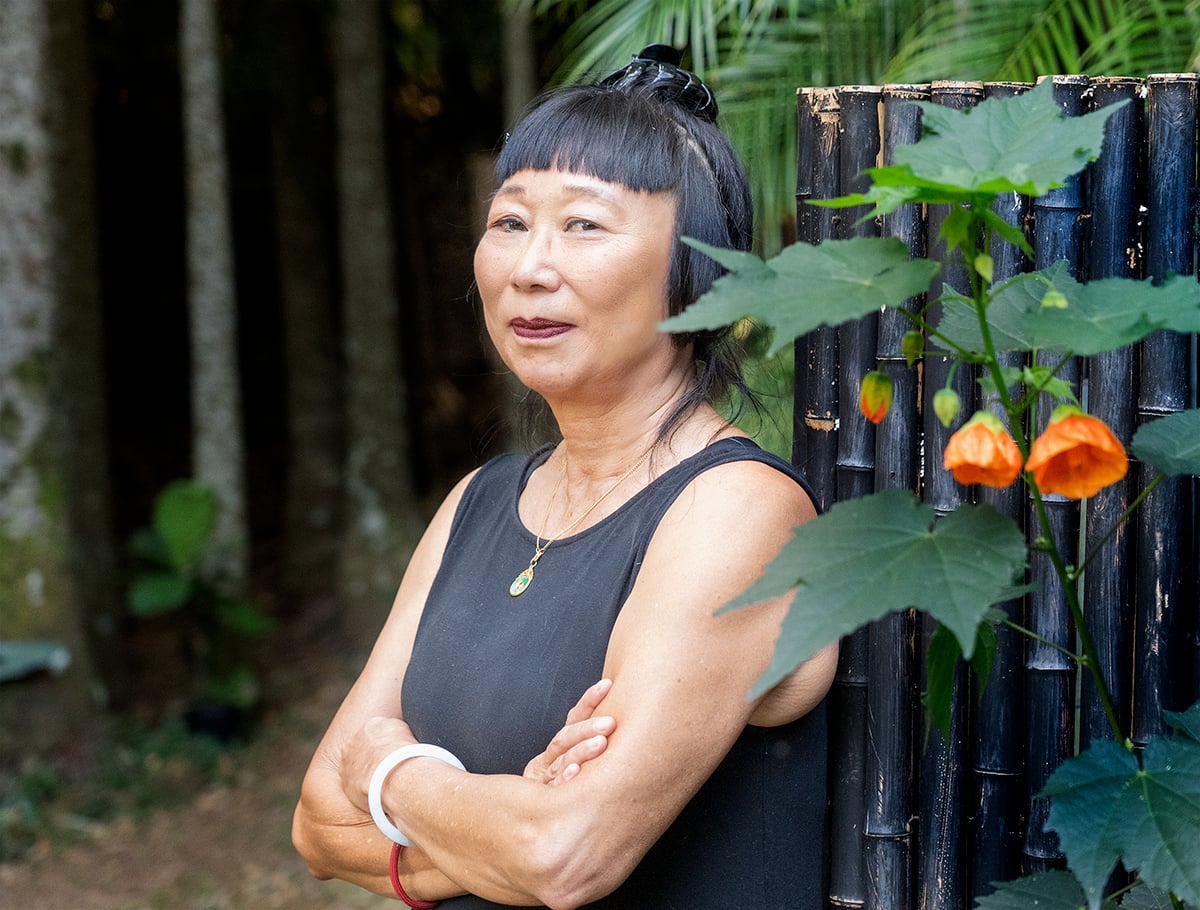
Coorabell artist Lindy Lee is about to create a huge sculpture for the National Gallery of Australia. The piece, Ouroboros, is her first immersive public sculpture.
Once complete, Ouroboros will be a 13 tonne, four metre-high torus of reflective recycled metal that will be installed in the gallery’s garden in 2024.
Commissioned by the National Gallery to celebrate their upcoming 40th birthday, Lee said she was invited to come up with the best idea she could. During the day Ouroboros’s highly polished mirror surface will reflect the moving imagery of the world, and at night it will be lit internally, a glowing beacon.

Lee says creating this type of sculpture is a long process. ‘A lot of engineering has to go into this with in the first stage. We’ve done the costing with the feasibility to make sure that the numbers add up – as you know, it’s very expensive, so we just had to make sure that the numbers were correct and that it was very transparent.’
The concept phase
Lee says she has already made a little model of the sculpture. ‘I just go through the concept phase, where you sort of try to figure out what the story of the object is going to be, and how that story is going to be embodied by that form, and then I start working on the form itself. There are thousands of drawings.
The next phase was sent to the engineers – Ouroboros can have no internal structure and a lot of the cost of the sculpture is because of that – it has to be reinforced in different invisible ways. Then it will be cast in sections and then I’m going to develop a pattern of perforations over the entire surface. I’m not quite sure how I’m going to do that yet, I normally work physically by placing each dot individually, but in this instance, because it’s so huge, I’m not quite sure when the pattern of the perforations is going to happen. It’s going to be logistically challenging. It’s certainly not impossible, but I love it – this is the fun bit.
Ouroboros – a mirrored polished surface
The surface of Ouroboros will be mirror polished and Lee says it’s arduous work. ‘You’ve got metal grinders and angle grinders, and just powerful abrasive pads and then, of course, it gets very fine and two guys with kid gloves come in.
This is not the first big thing Lee has created – her beautiful art pieces can be found across the country and the world. ‘I use really, really strong simple forms. And they’re almost like the basic building blocks of nature there. And then there’s the aspect where they’re just almost dematerialising – drifting off into stardust.

The reason for the simple, strong form is because that contrasts with the way in which perforations kind of make it look as if it’s just disintegrating – kind of form and dissolution.’
Lee says the pool is her creative space. ‘I swim a lot, pretty much every day for a good hour, or more sometimes. That’s where I just allow me – then, this thought is curious and interesting. And then you just let it gestate and see what will happen. And then you start physically experimenting with things. That’s always been my process.’
The idea that grew from an idea
Lee says Ouroboros wasn’t exactly the first idea but that the concept for the sculpture developed out of the first idea.‘The first idea was that I wanted some circular shape to indicate infinity, and I started to play with the idea of a Mobius strip, but I just couldn’t quite manage to make that an interesting form.
‘During one of my swims, I started to remember some drawings I’d done a while back with an Ouroborus – which is the snake eating its tail.
‘I thought it’s a great story. It’s a transcultural story – that if it traverses culture and millennia. Pretty much, where there are snakes and there are humans, the humans make up stories about snakes, and that following his tail is universally meant for eternal return cycles and renewal. And that’s what I wanted – to express the hope for that.’
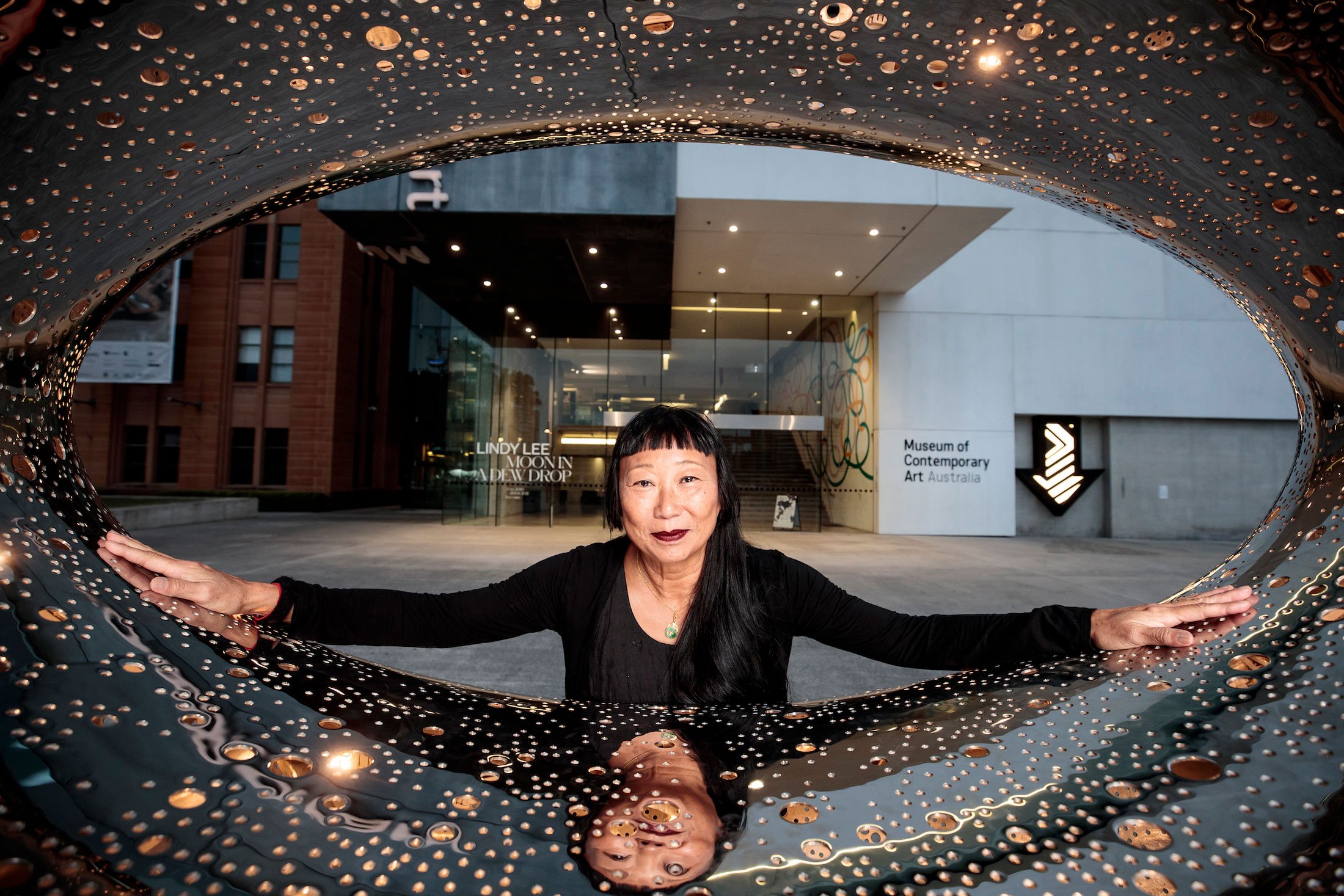
At 14 million dollars, the National Gallery has to date not spent this type of money on an art piece and several people and businesses will benefit and be employed over the next three years until the work is done, and Lee herself will have to make several trips to Canberra to work on the project.
‘I’m really happy that I have this incredible opportunity. For me, it’s always about the fun and I mean, the deep serious fun, not the frivolous fun. To me, it’s like wow! I get this opportunity to play out these ideas and how good is that?
If you would like to see more, the Lindy Lee: Moon in a Dew Drop exhibition is at the Lismore Regional Gallery until October 24.
 For four decades The Echo has printed the stories some people loved, some people hated, and some pretended not to read. If you want us to keep telling the truth, the real truth, not the sugar-coated version. We’ll need your support to keep the presses rolling.


