


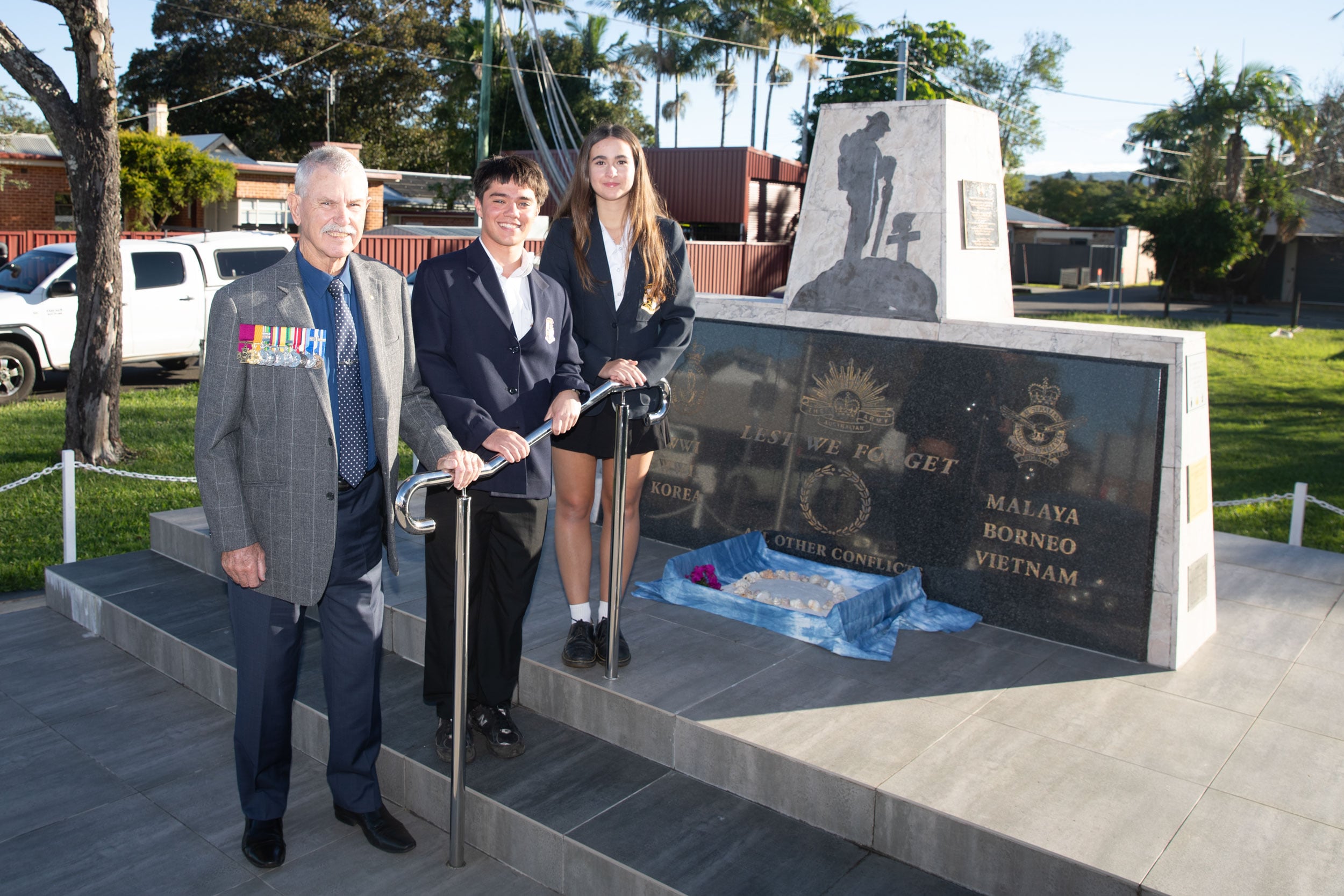
Last Friday a small group gathered at the Cenotaph in Mullumbimby to commemorate International UN Peacekeeper Day.
The gathering included a special guest, Mr Doug Baird, the father of the late Cameron Baird VC MG – Cameron served as a Peacekeeper in Timor L’Este.
The United Nations officially came into existence on October 24, 1945, following the ratification of its Charter by the majority of signatories, including the five permanent Security Council members. There were initially 51 founding members and Australia was one of them. Nowadays there are 91 member States.
Australian Bravery Association’s John Thurgar SCMBE OAM RFD, says the UN was established to prevent future world wars, maintain international peace and security, and foster cooperation among nations in the aftermath of World War II.
‘As of early 2026, the United Nations has deployed 72 authorized peacekeeping operations since the first Mission in 1948 in the Arab-Israeli war.
Over two million have served
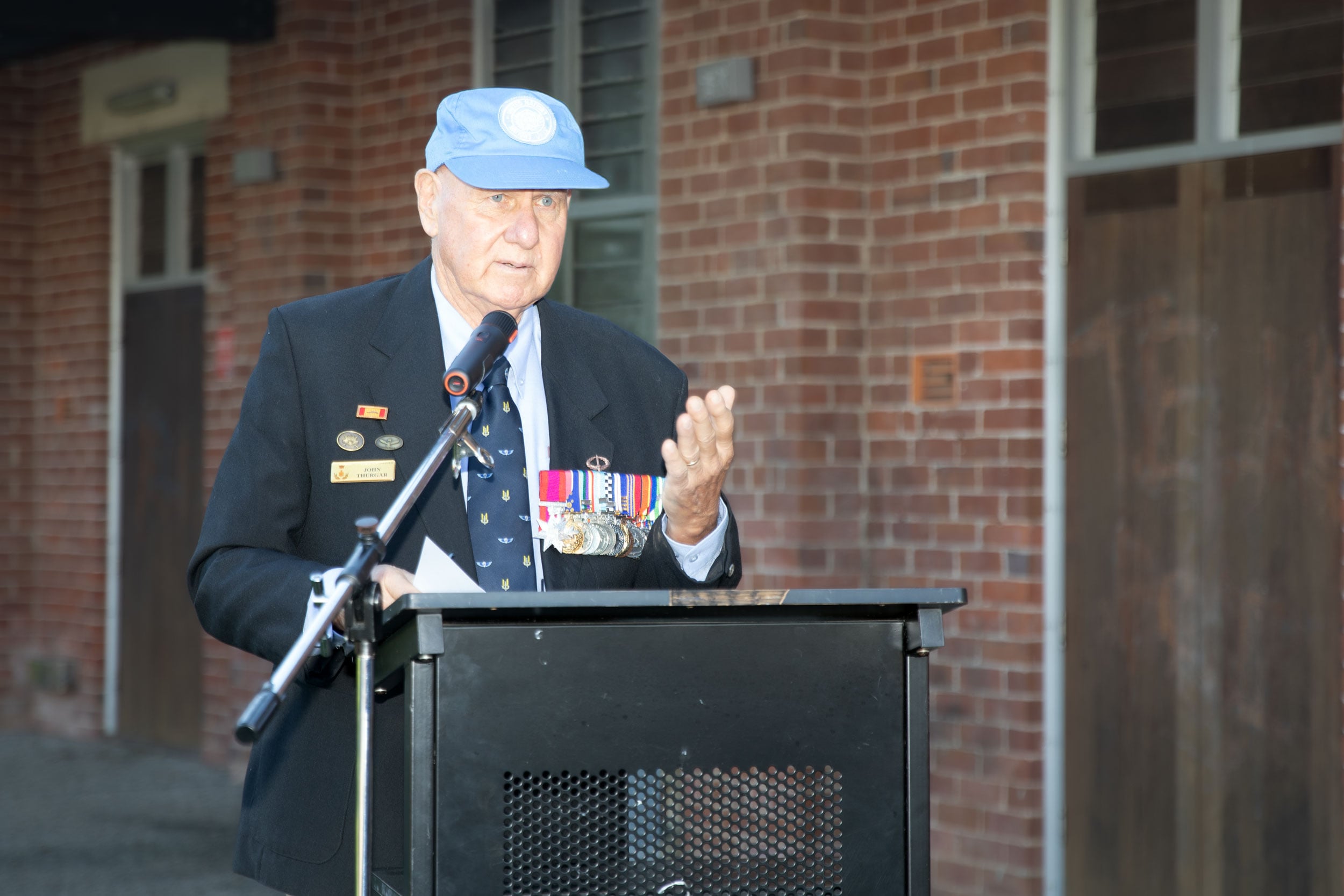
‘Over two million uniformed and civilian personnel have served in these missions to maintain international peace and security, with 11 operations remaining active as of 2026. However, Global peacekeeping missions are in jeopardy as personnel numbers hit a 25-year low.
‘Geopolitical tensions, political pressure, and funding crises are putting the viability of multilateral peacekeeping in jeopardy, with 78,633 personnel deployed falling 49 per cent since 2016. If this trend continues we could see a dramatic weakening of multilateral conflict management and the near complete side-lining of the institutions like the UN, due to a perfect storm of funding, political and geographical factors, resulting in conflicts becoming more frequent and have broader consequences especially for civilians.
‘This day honours the service and sacrifice of over 4,000+ international peacekeepers who have lost their lives in the service of Peace since 1948. It highlights their role in protecting civilians, maintaining security, and promoting peace.’
The 2026 Focus is Invest in Peace. To those at UN HQ in New York the day emphasises the need for future-focused peacekeeping operations capable of adapting to modern, complex threats.
The underlying incentives
Mr Thurgar says that in his opinion, these complex threats do not address the underlying incentives driving many of the world conflicts that the UN tries to act as the honest-broker pursuing peace.
‘For as long as volatility enriches the powerful while ordinary people pay the price, escalation will remain a politically useful tool to some nations. As I see it, at the UN HQ level the real challenge, therefore, is to sever the link between geopolitical instability and private gain.
‘UN Secretary-General Antonio Guterres warned last Tuesday of this week whilst speaking in Canada that the United Nations Charter is under “profound strain” as conflicts multiply worldwide and geopolitical divisions erode the foundations of international law.
‘Guterres described the charter as “a survival guide for humanity” created to ensure “that the force of law must prevail over the law of force.” He identified seven major threats now endangering the international system, warning that “we now face the highest number of conflicts since the founding of the United Nations”.
A shared compassion
‘But for us, the ordinary people, this day gives us the chance to express our shared compassion with those directly impacted by world unrest and state sponsored violence.’
To former peacekeepers and their families this day honours the service and sacrifice of UN peacekeepers and all those civilians who have served, suffered or died since 1948.
‘For surviving Peacekeepers, the date carries with it, deeply etched memories of the victims of extreme violence in the countries in which they served. More than 65,000 Australians have served overseas in some 45 UN Missions. Australians continue to serve today.
‘The words uncertainty and complexity are becoming commonplace in today’s global narrative a sentiment expressed by the ancient Greek philosopher Heraclitus— the only thing you can be sure of is change. This holds true today, most noticeably, and perhaps most significantly, when it comes to global conflicts’
UN Peacekeepers not exempt from impacts
Mr Thurgar says UN Peacekeepers are not exempt from the impacts of this international upheaval.
‘This is evidenced in current conflicts utilising asymetrical warfare tactics and military actions as they have morphed over time from targeting the military to now targeting civilians, including: women, children, the elderly, media and the press, doctors, hospitals, first responders and international aid agency volunteers and workers. Facilities such as Power plants, sanitation facilities, and drinking water are on the attack list. And the creation of a state of fear and panic within a target community through propaganda, misinformation, detainment without charge, torture and starvation are now part and parcel of strategic planning. Decisions.
‘Australian military and civilian police Peacekeepers/observers have served in many difficult and often unheralded overseas missions.
‘These peacekeepers were, sometimes armed and sometimes unarmed, operating in such aforementioned volatile and unpredictable environments where they were required to demonstrate courage, resilience, and impartiality daily.
‘They faced the constant threats of unmarked minefields, extreme conditions, and political tension, sometimes coming under fire while trying to enforce peace where there was often only a bitter truce.
A tactical disaster and a strategic success
‘One peacekeeper aptly described his experience overseas as a “tactical disaster and a strategic success”, strategically, they held the peace; tactically, they endured immense challenges and danger.
‘Their quiet professionalism and unwavering commitment to duty, often far from the public eye, embodied the very best of Australia’s contribution to global peace operations.
‘Many of my peers, in a moment of truth, have said quietly to me – ‘You cannot un-see what you have seen, especially when it replays in your worst nightmares”.’
‘We will always remember their service and sacrifice – as Mahatma Gandhi said: “Peace is the most powerful weapon of mankind”.’
 For four decades The Echo has printed the stories some people loved, some people hated, and some pretended not to read. If you want us to keep telling the truth, the real truth, not the sugar-coated version. We’ll need your support to keep the presses rolling.


