


Let me tell you about a beautiful little town on the coast in south-west Victoria.
It is nestled around a port, with quiet beaches and views of the ocean that take your breath away. Whales can be seen off the shore if you’re lucky. Fishing and camping can be enjoyed every weekend. There is a plentiful choice of good kindergartens and schools. You can always get a parking space. The sunsets are spectacular. The community is friendly. It is even possible to buy good coffee.
In spite of all this, the town has a big problem. They don’t have enough doctors. One by one, GPs have either retired or moved away without being replaced. This is not the fault of the doctors who have left. They are human beings with lives and families and needs of their own.
The issue is that it is getting harder and harder to recruit GPs in rural areas. And this is not just an issue for one town. It is happening all over Australia.
Why is this?
I am going to take a risk and talk about some of the reasons this is happening. I have my own perspective because I am a rural GP. The town described above is my home. I moved here seven years ago, and in this time I have seen the number of doctors and clinics gradually decline while the population has grown. The level of distress currently experienced by patients, doctors, and staff is very high. The wait for non-urgent appointments is now several weeks. For the first time ever, clinics have had to close their books to new patients. The emergency department is under even greater demand than normal. Patients are driving over an hour away to seek care in other towns.
As a GP, I find this devastating. My vocation as a doctor is to help those who are sick and in distress. It is heartbreaking to be unable to meet the needs of everyone seeking help. I worry about this constantly. The truth is that I am human and there is a limit to how many patients I can safely see in a day. General practice is a challenging job, and the risk of burnout is high. All of us at the clinic are working longer hours and fitting in more appointments, but it is never enough. There simply aren’t enough of us. The way things are headed, eventually there are not going to be enough GPs anywhere in rural Australia.
The difficulties we are facing in our town are not the result of a couple of years of bad luck. The issue is that primary healthcare has been underfunded for many years, and we are seeing the fruits of this now. Fewer and fewer graduating doctors are choosing general practice as a speciality, let alone rural general practice.
I still find sometimes that people think any doctor can graduate medical school and instantly be a GP. For many years now, general practice has actually been a speciality of its own. We have to complete years of additional supervised training and pass fellowship examinations before we can become specialist general practitioners. In spite of this, our funding has been left far behind that of hospital-based specialities.
To understand the financial pressure we are under, it helps to understand how clinics are funded. I have realised when talking to people that there is a common misunderstanding that the government pays GPs a salary, and that bulk billing just means the government pays the bill instead of the patient. It has often been thought then that doctors who charge a gap are ‘double dipping’ or just being greedy. Let me assure you this is definitely not the case!
GPs in most clinics are not employees, but contractors. Think of us as being like the tradies of medicine. We have more autonomy over the days and hours we work, but we are only paid for the time we spend face to face with a patient. We are not paid a salary, but instead charge a fee for each consultation. If we need sick leave or a patient does not attend their appointment, we don’t get paid. Any time spent on writing notes and completing paperwork is unpaid. From the fees we bill, we pay a percentage to the clinic to cover rent, electricity, reception and nursing staff, cleaning, consumables, etc. We need to pay several thousand dollars each year for insurance and registration so that we can remain working as medical practitioners. Then, like everyone else, we pay income tax. Please do not think that in telling you this I am complaining about my situation. I am just trying to explain that, like when you pay your plumber or electrician, the fee for a GP consultation does not all go into our pocket – there are a lot of expenses that need to be covered.
Bulk billing
Now what does ‘bulk billing’ actually mean? Basically, Medicare gives the patient a rebate that helps with the cost of the consultation fee. When we bulk bill, the GP accepts the patient’s rebate as the full payment for the consultation. At my clinic, which is not for profit, we bulk bill children, pensioners, and those with healthcare cards. We do this in order to make healthcare affordable for those who are most vulnerable in the community. But this is not without cost for us. Every time we bulk bill, we are personally accepting less income in order to help that patient in need. The margin to cover the costs of the clinic is tiny. It is not simply a matter of getting the government, instead of the patient, to pick up the tab. The truth is that federal government funding is letting us down.
Initially the Medicare rebate was adjusted over time, so that as the cost of living went up the rebate went up accordingly. In 2014 the government of the time announced that they would be freezing this rebate for a number of years, and since then the gap between the rebate and the cost of providing care has continued to widen.
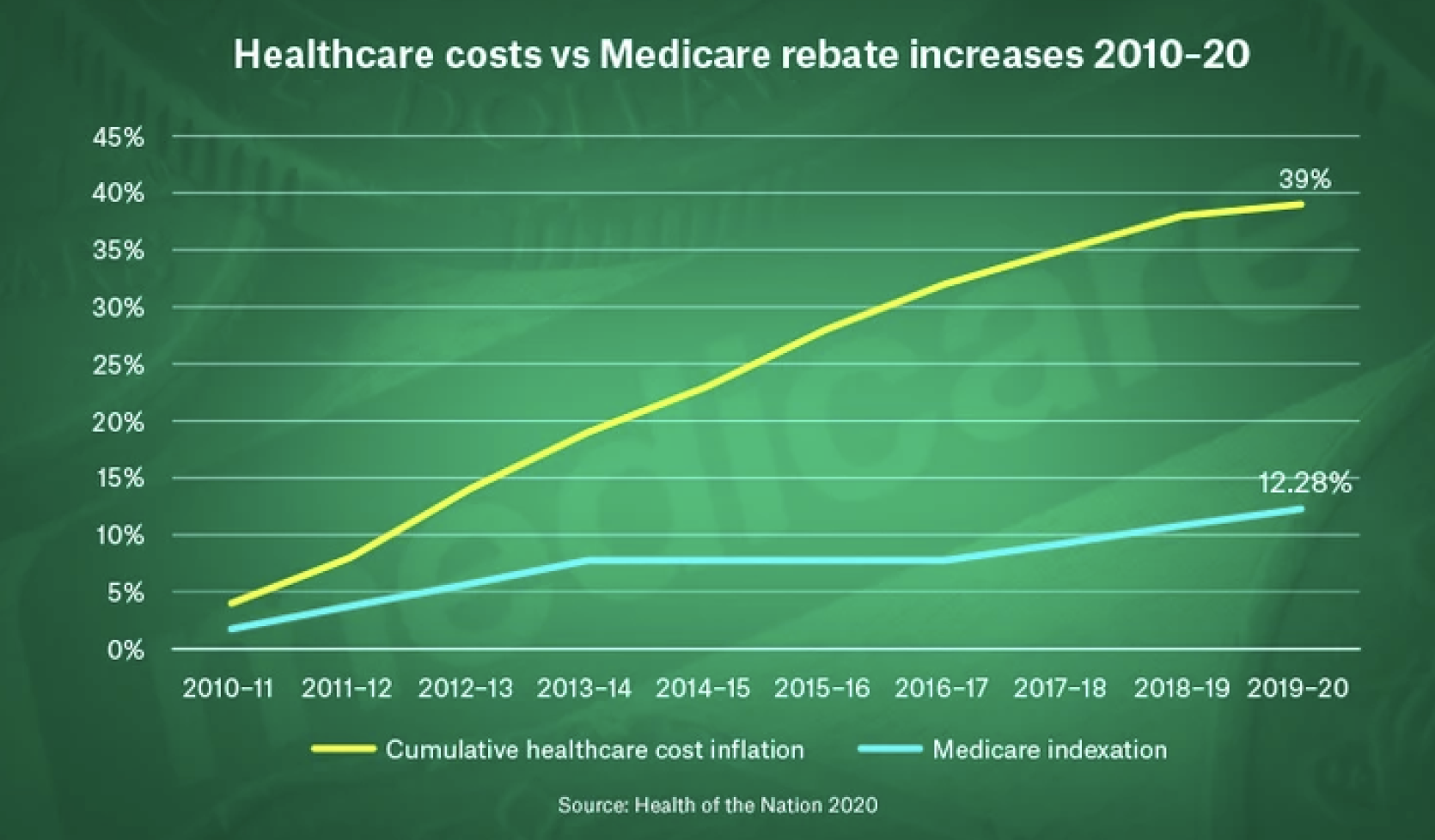
The best way I can think to explain this is if you imagine you are running a restaurant. Every year, the cost of food goes up, the electricity bill goes up, and the rent goes up. The wages for your waiters and kitchen staff need to go up. Your own household expenses go up. Petrol goes up. But imagine you are not allowed to increase the prices on your menu. You need to keep serving your food for the same prices they were ten years ago. What will happen?
This is the dilemma facing general practice. The rebate provided by the government is so far below the amount needed to cover the costs of running a practice that clinics have had two choices – start charging a gap or see more patients for shorter consultations.
Why shorter consultations?
The fees for consultations are determined by length, and the commonest item number used is a level B, which is a consultation lasting up to 20 minutes. The fee for this is currently $38.75. This amount is the same whether we spend five minutes with a patient or 19 minutes. If a clinic is fully bulk billing, the only way to make ends meet with the rebate so low is to spend no more than about 7–8 minutes with each patient (even less in some places).
To be a good doctor, I need time. I need to be able to give people space to tell me their worries, to tease out complex symptoms, to do a thorough examination. I am never going to be the sort of doctor who hurries patients along so I can collect as many consultation fees as possible per hour.
Medicare is fundamentally flawed in this respect. A GP who sees ten patients an hour for quick, simple things earns much more than a GP who sees two patients an hour for long, complex issues.
The highest rebates go to procedures and the lowest to women’s health and mental health. This is the eternal frustration of being a GP. As much as I wish it otherwise, it is not financially viable to practise good quality medicine free of charge. I love my patients and my colleagues, and therefore I am not going to quit. I will keep doing my best in a system that is not set up for the type of GP that I am.
But I hope this goes some way to explaining why we have had to start charging a gap for patients who are not on concession cards. We simply cannot care for you the way you deserve on the rebate the government is willing to provide, although we have kept our fees as low as possible.
So back to the original question: Why is it so hard to get doctors to come here?
I can see the answer to this question from both perspectives now. Having made my home in the country, I can understand and share the frustration of the local community. I love the peace and quiet, my vege garden and keeping chickens. I often wonder why city doctors can’t see what an amazing place this is to live. I then remember how I felt seven years ago when my husband was first looking at a job here. I looked at the map and immediately thought no way, that is too far. It was hard moving away from all our family and friends with two small children. It is still hard being away from them all. Being a rural GP can be incredibly lonely at times, as the challenges of small-town medicine can make it difficult to make friends. We won’t solve this problem by pretending that there are no hardships involved.
I believe, however, that the fundamental reason why we don’t have enough GPs is that we have had almost ten years of relentless defunding of primary care. This is the reason why junior doctors are walking away from general practice.
You may ask then, why did I stay? There was no single reason for this decision; it was one that built up slowly over time. I can say that it had nothing to do with money, and everything to do with the people I met here. I think deep down I have always had a longing to live in the country, and the little acreage we are living on now truly feels like home to me. My husband and children are settled here now and with time we have made good friends. I have had an incredibly generous and kind mentor at work who supported me through my training and taught me to be a better doctor. She was the main reason I wanted to stay on after I completed my specialist training. The clinic had been so good to me while I was training that I wanted to stay and give back to the community. I am still hopeful that we will get more doctors here again.
So what can you do?
If you are feeling frustrated about the doctor shortage in town and are anxious about the future, please channel this into taking some action. Write to your local federal member to let them know that our towns are struggling and urgently need government action. The more people speak up about this, the greater the chance for change. Finally, please remember that doctors are human too, and all of us ultimately are seeking a place to belong and be at home. Please be kind to all those working in healthcare in our town. If we are fortunate to be able to attract new doctors or medical students to our town, please do everything as a community to embrace and welcome them. This is a great little corner of the world. I know we will weather this storm together.
This article was reprinted with the permission of Dr Deborah Carrington: www.drdeborahcarrington.com. The original article is at: www.drdeborahcarrington.com/post/where-have-all-the-gps-gone.
 For four decades The Echo has printed the stories some people loved, some people hated, and some pretended not to read. If you want us to keep telling the truth, the real truth, not the sugar-coated version. We’ll need your support to keep the presses rolling.


