


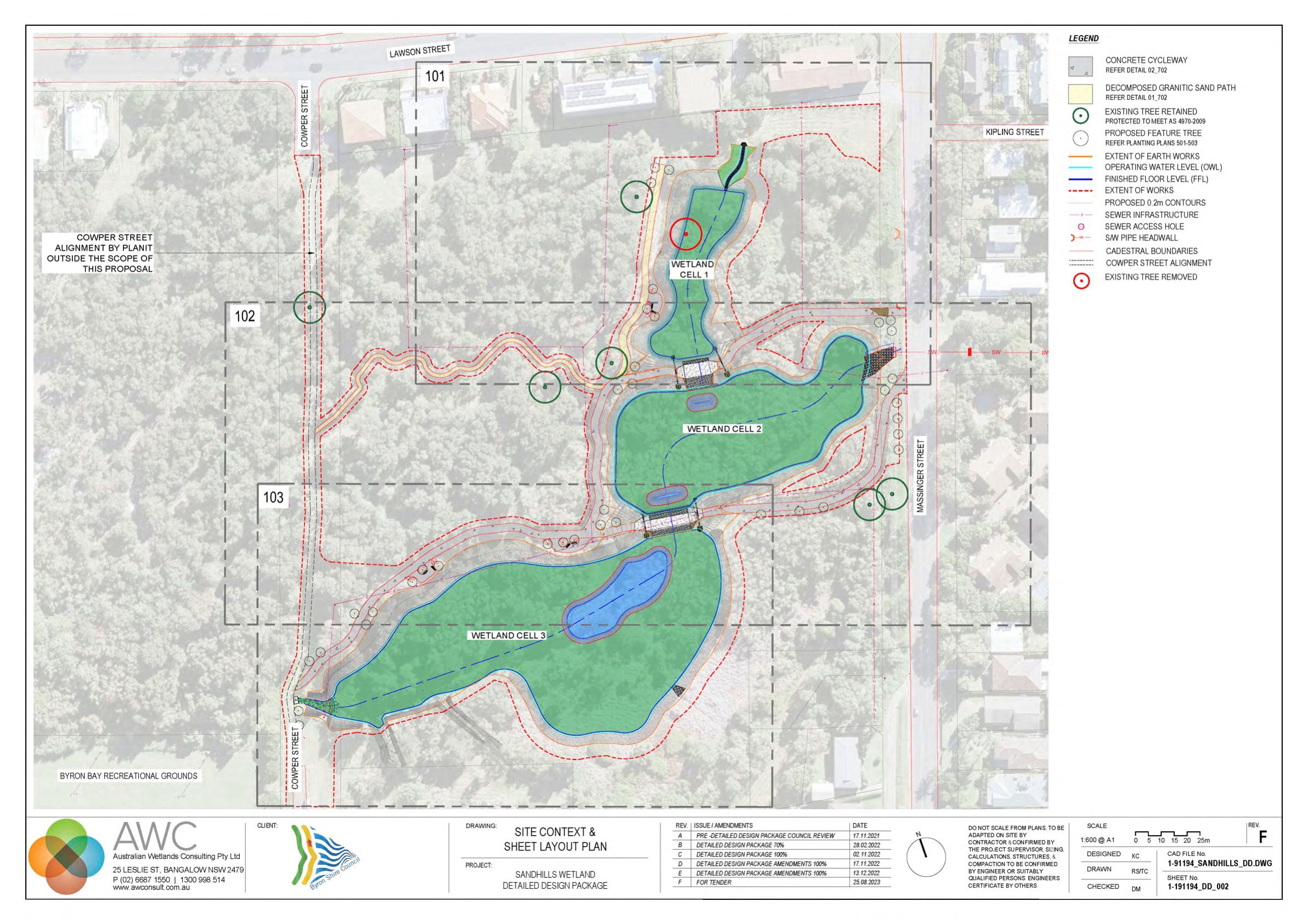
Big changes are proposed for Sandhills wetland, located opposite Clarkes Beach and the Youth Activities Centre (YAC) on the edge of Byron Bay’s CBD.
Extensive technical documents are on public exhibition until February 11, and can accessed via Byron Council’s website.
Council staff say, ‘The area was sand mined in the 1930s, destroying the natural wetland and a lot of the native vegetation. Restoring the wetland is one of the most significant environmental projects to be done in Byron Bay in recent years’.
A main feature is three large ‘cell’ areas located near Massinger Street, along with inlet ponds. They would be dug, on average, to about 1m deep, and as such, will require substantial tree and native vegetation removal.
These cells would provide ‘flow buffering and a dedicated place for the deposition and periodic removal of sediment’.
‘Preliminary’ concrete path/cycle ways are proposed throughout the 1.8 hectare site.
The objectives, as stated in the Basis of Detailed Design Report, are ‘improving the site’s environmental and cultural values, flood mitigation, storm water treatment and storage, integration with catchment water cycle management objectives, providing education and recreation opportunities and creating connections between key sites in and around town centre’.
‘The Sandhills site is currently undeveloped with the exception of a pedestrian track connecting Cowper Street to Lawson Steet, and underground services (sewer, stormwater and recycled water main)’, says Council.
Biodiversity Offsets
As some of the area is known as a littoral rainforest, Endangered Ecological Community (EEC), Council is proposing the Biodiversity Offset Scheme (BOS) to remove 45 types of vulnerable/protected species of flora and fauna, and replace them, ‘like for like’ elsewhere.
This includes 1.2ha of paperbark trees, and 2.1 ha of wetland that is home to the southern myotis vesper bat.
Fifteen brush box/tuckeroo littoral rainforest trees would be ‘retired’, as would 29 paperbark trees.
Their ‘retirement’ options include Burringbar-Conondale Ranges, Scenic Rim and Sunshine Coast-Gold Coast Lowlands.
The stinking cryptocarya, which is known to be vulnerable to extinction, was also identified.
The vulnerable wallum froglet has been identified, as well as a marsupial ‘mouse-like’ carnivore, called the common planigale.
In August 2022, a report by the NSW Audit Office found that the Department of Planning and Environment (DPE) ‘did not establish a clear strategy to develop the biodiversity credit market, or determine whether the scheme’s operation and outcomes are consistent with the purposes of the Biodiversity Conservation Act 2016’.
Among the extensive criticisms of the scheme, the NSW Audit Office said there was no ‘long-term strategy with clear goals’.
Council also developed the Butler Street bypass under the Biodiversity Offset Scheme.
According to the Environmental Impact Statement (EIS) (prepared by Planit Consulting), they say in conclusion, ‘The proposed works will significantly improve local water quality, particularly at the Clarkes Beach stormwater outlet and provide additional flood storage to assist in mitigating flooding in the nearby Byron Bay Town Centre’.
‘The objectives of the project are to deliver improved cultural, social, economic and environmental outcomes.
‘An assessment of relevant legislation and environmental planning instruments has confirmed the proposal is permitted without development consent’.
$2m cost
A bill of quantities estimate put the total cost at $1,999,129.99, yet excludes removing and treating material cut from the site and tree removal, which ‘assumes a rate of $120/tree for both medium and large trees’.
To see the documents, visit www.byron.nsw.gov.au.
 For four decades The Echo has printed the stories some people loved, some people hated, and some pretended not to read. If you want us to keep telling the truth, the real truth, not the sugar-coated version. We’ll need your support to keep the presses rolling.


