



CSIRO’s hydrology expert Dr Jai Vaze has belatedly responded to The Echo‘s questions following strong criticism of the hard engineering-based flood mitigation options presented to the public recently.
That earlier article can be read here.
Apologising for the delay, Dr Vaze said he has recently been in the local region looking at some of the landscape features, together with the Northern Rivers Resilience Initiative team.
His detailed answers to our five questions appear below, unedited.
We asked Dr Vaze, in relation to CSIRO’s recently published document ‘Potential flood mitigation measures to be explored as part of the scenario testing phase of NRRI’, are you able to explain:
1. Why only hard engineering solutions appear to have been considered, and not nature-based mitigation measures?
The 15 options presented are from the longer list of options that were provided to the NRRI team during the first round of consultations that took place during Phase 1 of the project (in the second half of 2022). This was explained to councils and community members who came for the recent consultations. 36 of the 110 options/suggestions from councils and the community were funded as part of the $150 million funding allocated in 2023, so they did not need to be tested in a hydrodynamic model.
The current 15, which were presented to the community, were not funded in that round as they need to be tested properly in a detailed hydrodynamic model to investigate the upstream and downstream impacts. There were only 3 nature-based solution projects with enough details to be included in the list of 110 options, and they were all funded in the first round. They are currently getting implemented in the region and we are yet to get the final results.
2. Is the CSIRO seriously considering creating new channels from the Richmond River to the sea? Have the environmental effects of this been modelled?
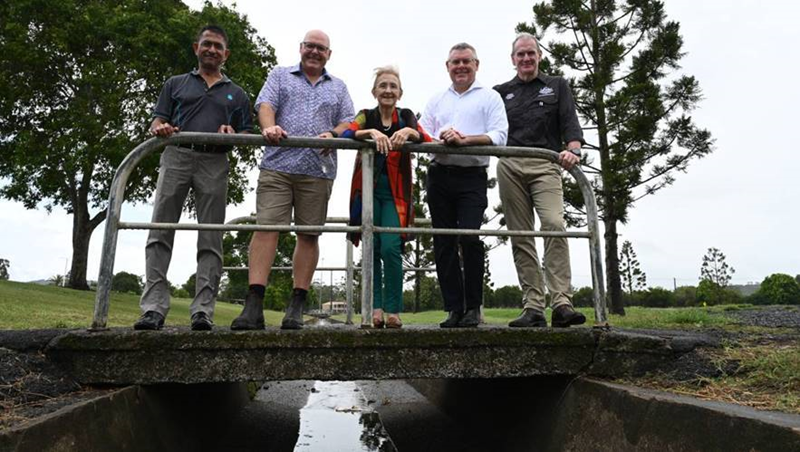
The opening up of Boundary Creek is a suggestion from the community from Phase 1 of the project and not something proposed by NEMA and CSIRO. There is published documentation and evidence that shows that Boundary Creek (as well as a few other creeks) has always been a natural outflow to the ocean from the Richmond River during floods. As such, it is not creating a new channel to the sea but will restore the catchment to its natural condition.
Detailed business cases and environmental assessments will be undertaken separately prior to options being funded by the government. Those decisions are outside the scope of CSIRO.
As the national science agency, CSIRO focuses on delivering quality science. We do not make policy or funding decisions.
3. What does the ‘Bagotville barrage upgrade’ option mean, and are you aware of the serious environmental damage the existing barrage has caused, including major fish kills in the recent cyclone event?
What has been suggested by the community in the Phase 1 consultations was to install a new control gate so that part of the flood water does not get stagnated in the lower part of the Tuckean Swamp. This will help prevent organic material from building up and decomposing, which is what leads to blackwater events and fish kills when released into the Richmond River.
The new barrage/structure will let the flood water flow freely during floods and after the swamp has drained, it will prevent the salt water from entering the swamp during low catchment flows and high tide.
As per the water quality Australia website ‘Blackwater can be a natural feature of lowland river systems and occurs during flooding when organic material is washed off the floodplain and into the river systems. This can lead to a sudden decrease in the oxygen available to fish and other organisms in our rivers.’
Blackwater can happen in flowing water when significant amounts of organic material, like leaf litter and woody debris, are washed into a river during a flood or high flow event. The decaying organic matter releases dissolved carbon, giving the water a black or tea-like colour, and this process consumes dissolved oxygen, potentially leading to hypoxic conditions harmful to aquatic life.
4. Is the CSIRO suggesting that it is possible to seriously reduce the risk of catastrophic flooding in the Northern Rivers purely through the use of additional engineering measures, if such measures could ever be funded and built?
What we have said is that we will build a detailed hydrodynamic model which will reproduce the flooding across the entire Richmond River catchment (water heights at gauges and landscapes as well as overland inundation extents and timing) for the complete range of floods (minor to the most extreme).
The model has been implemented, and the report has been released through the NEMA website on 30 June 2025. The results show that the model is capable of doing what was promised at the catchment scale.
Now we will test bundles of options (these will be multiple interventions for each part of the catchment, making sure that any interventions in the upper parts do not adversely impact the lower parts). The mitigation options have been proposed by the local community and councils.
Once the model simulations are completed, CSIRO will compare the results (water heights at gauges and landscapes as well as overland inundation extents and timing) with what has occurred historically and report the findings. This report will be released through the NEMA website on 30 June 2026.
As noted above, a detailed business case and environmental assessments will be undertaken separately prior to options being funded by the government.
5. Is the CSIRO aware of the work of the Northern Rivers Watershed Initiative (recently funded by the NSW government), and is there any plan to liaise with those experts as the region seeks mitigation of future flood risk?
We are aware of the Northern Rivers Watershed Initiative and we work closely with the Rous County Council as well as the other councils in the region. The Northern Rivers Watershed Initiative aims to help develop high-priority, shovel-ready projects to improve the water quality of the Tweed, Brunswick, Richmond and Evans river catchments.
As stated on the NSW government website “The Northern Rivers Watershed Initiative will work with landholders to revegetate and undertake weed control in catchment areas, improve soil health, address water quality in floodplain areas, increase water filtration and storage, and work to slow water flows in catchments.”
We believe the aim is to bring the basin back to its natural conditions as much as possible not to provide protection from major or large floods.
Thank you, CSIRO NRRI project leader Dr Jai Vaze.
 For four decades The Echo has printed the stories some people loved, some people hated, and some pretended not to read. If you want us to keep telling the truth, the real truth, not the sugar-coated version. We’ll need your support to keep the presses rolling.


