


Water security in rural and regional NSW is in need of urgent investment of at least $1 billion in water infrastructure, according to the latest report by the state’s Auditor-General.
Without naming the councils or water utilities, the January 28 report says of the 128 NSW councils, ‘Fifteen councils made operating losses for the water fund for the year ended 30 June 2025’.
Rous supplies region
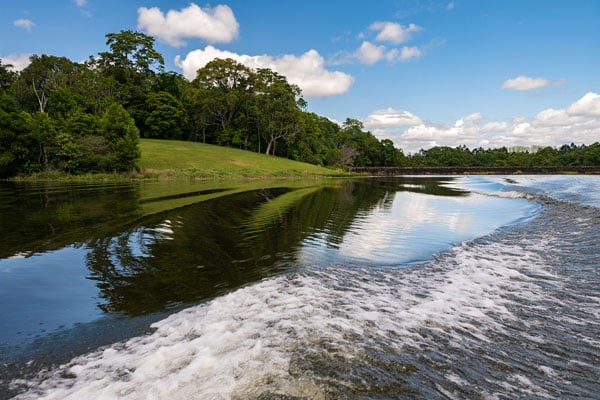
Rous County Council is the local regional water utility, supplying drinking water to approximately 110,000 residents from Lismore’s Rocky Creek Dam, Brooklet’s Emigrant Creek Dam, and the Wilsons River.
Rous is also tasked with biosecrurity and weed management. Its leadership is made up of a general manager and his team, along with councillors from the four local councils it services: Ballina Shire, Byron Shire, Lismore City, and Richmond Valley.
According to Rous’s Audited Financial Reports for the year ended 30 June 2024, Rous County Council recorded a small net operating deficit for the year ended 30 June 2024.
Its audited financial statements show a net operating result of a $148,000 deficit, compared with a $4.205 million surplus in 2022–23.
It says, ‘Bulk water revenue provides the majority of Council’s operating revenue at $23.8M, or 61 per cent of total revenue,’ says the agenda minutes. ‘This increased by 4.5 per cent compared to last year’.
High reliance on govt grants
On page 26, the NSW AG report reads, ‘Approximately 1.9 million people receive water from councils or county councils’.
‘Councils set water rates, though many rural councils with small populations have a small number of customers, so annual revenue is low’.
‘There is a high reliance on funding from grants to operate and fund asset acquisition and renewal for water supply businesses.
‘When grants revenue was removed, 30 councils (10 regional and 20 rural) had an operating loss’.
‘Water supply infrastructure requires almost $1 billion to meet agreed service levels set by councils’, it says.
‘Based on council estimates, almost $1 billion is required to ensure that water supply infrastructure continues to meet agreed service levels. This estimate has increased by 161 per cent since 2021. Many councils providing this essential service are not fully recovering operating costs. Even when they can cover operating costs it is unlikely, with a small customer base, that they will recover enough to bring infrastructure to agreed service levels. Grants are the primary source of funding for water supply infrastructure managed by councils.
‘The NSW Auditor General’s performance audit, Support for regional town water infrastructure, published in 2020, concluded that ‘the former Department of Planning, Industry and Environment has not effectively supported or overseen town water infrastructure planning in regional NSW since at least 2014. It has also lacked a strategic, evidence-based approach to target investments in town water infrastructure. The NSW government has published several Regional Water Strategies that set out a long-term road map of actions to deliver and manage water for local communities’.
Warning bell says Local Government NSW
Representing the state’s 128 councils, Local Government NSW President, Mayor Darcy Byrne, says the NSW AG’s report ‘sounds a warning bell about the financial sustainability of locally managed water utilities’.
‘Access to safe drinking water is a basic human right,’ Mayor Byrne said.
‘Anything less than that is unacceptable for any Australian community, but without urgent investment in water infrastructure in rural and regional NSW we risk these communities being left to wither away’.
‘The Auditor-General’s report shows in black and white that major investment is needed in water infrastructure in rural and regional communities, or their access to safe drinking water and wastewater processing will be threatened.’
The report also found that two regional and 13 rural councils that supply water to their communities recorded operating losses for their local water utilities, and that even where operating costs were covered, essential infrastructure upgrades were not guaranteed.
Mayor Byrne said the lack of ongoing state government investment in water management infrastructure was having real-world impacts on communities.
‘This is not some theoretical argument. Hundreds of thousands of NSW citizens are already worried about their drinking water supplies,” Mayor Byrne said.
‘Council-owned water utilities serve almost two million people in NSW, and without appropriate funding and support to deliver this basic service of safe drinking water – we are going to start seeing increasing disruption to essential water and sewer services for those communities.
‘The upcoming State Budget is the perfect opportunity for the NSW Government to renew funding for the fully allocated $1.1 billion Safe and Secure Water Program, or a replacement program to meet this critical need.’
 For four decades The Echo has printed the stories some people loved, some people hated, and some pretended not to read. If you want us to keep telling the truth, the real truth, not the sugar-coated version. We’ll need your support to keep the presses rolling.


