



At last week’s meeting, Tweed Shire councillors endorsed the Tweed Development Control Plan (DCP) 2025, which provides, ‘detailed guidelines that show the controls that apply to a particular type of development or in a particular area’.
According to Council’s website, it replaces the 2008 DCP.
Council says, ‘A DCP implements the Far North Coast Regional Strategy and supplements the Local Environmental Plan and is made according to the Environmental Planning and Assessment Act 1979’.
Those voting in favour were Cr Chris Cherry (Mayor), Cr Reece Byrnes (Deputy Mayor), Cr Meredith Dennis, Cr Nola Firth, while those against were Cr Rhiannon Brinsmead, Cr Kimberly Hone, and Cr James Owen.
Councillor Nola Firth told The Echo, ‘In the light of the clear majority of submissions being in favour of increased tree protection, councillors voted to change from the staff recommendation of 5m back to 4m for local native trees, and to retain the 40cm diameter for exotics, down from 80cm in the previous DCP’.
‘Also, again in the light of community support, we improved the landscaping for multi-storey buildings. Flood protection had already been substantially increased in the previous draft document so this remained unchanged.’
She said, ‘I have been advocating for these increased vegetation protections for a long time. Many NSW councils to the south of us such as Albury, Georges River and Hornsby all have tree protection at 3m’.
Rural dwelling entitlements
Another motion passed was around rural dwelling entitlements, which if adopted by the state government, could see a dwelling entitlement on all RU2 zoned land, except very small ‘sliver’ parcels.
Cr Firth said, ‘It passed 6 to 1, with myself against, because the state agency reports were concerned about rural land fragmentation and inconsistency with our own state and regional policies of putting new housing in areas where infrastructure is already in place.
‘If adopted, this will allow dwelling entitlements on all RU2 rural lots that don’t have a dwelling on them, which would be a big change to rural landscapes, especially if dwellings on 10 and 5ha lots also become part of the Growth Management and Housing Policy,’ she said.
During debate, Cr Firth raised the concerns of the state agencies and the SES, who didn’t support the rezoning.
‘The Department of Primary Industries and Regional Development (DPIRD) wanted prioritising all agricultural land, including RU2 farmland for food security and both the DPIRD and the Department of Climate Change, Energy, Environment and Water (DCCEEW) were concerned that agricultural and biodiversity protection take place at planning level, not at development application level where cumulative effect is obscured. The SES were also concerned about flood risks,’ she said.
These documents are publicly available on the new Disclosure of Meeting Information Requests (at the top of the meeting agenda).
Cr Firth told The Echo, ‘Mayor Chris Cherry’s initial motion on the item was to defer this item so it could be incorporated in the forthcoming Growth Management and Housing Strategy, to ensure consistency of our Council policies. However, Labor Cr Reece Byrnes moved the original motion, which was the staff recommendation, which passed. It will now be sent to the government and will come back to go back on exhibition so the community can still have their say at that point’, she said.
‘If this initiative is in fact adopted, I am hoping we can establish guardrails to keep local biodiversity strong in the face of what will be increased clearing for houses, driveways, fences etc and the impact on the bushland of domestic animals and garden weeds ‘, she said.
Compensatory tree planting policy
A compensatory street tree planting policy passed, which will put a value on trees including trees located on streets which are under Council management.
Cr Firth told The Echo she was pleased the street tree component ‘was given status as a Council asset’.
She said, ‘Other Councils down south have their street trees as documented assets. If you want to remove a street tree, there is a cost of replacement, based on professional arborist values such as the Burnley or Thyer method’.
She said the draft policy was 50 to one replacement, but was reduced to ten to one replacement during debate. ‘This equates to around $11,000 for each street tree’, she said.
‘But down south in Councils such as Manningham in Victoria, it’s more like $50–60,000 for one tree with a diameter of 70cm, and then further value on top for things like species and tree condition.
‘Given trees reduce heat, noise and pollution in addition to protecting biodiversity, this somewhat increased value for street trees is an important win’.
She explained that the compensatory policy applies only to voluntary planning agreements (VPAs) with developers, which is unlike the policies of the southern Councils.
‘Importantly the money coming from the policy will support the Cool Towns Program, which in turn aims to increase tree cover,’ she added.
Voting for were Cr Chris Cherry (Mayor), Cr Reece Byrnes (Deputy Mayor), Cr Meredith Dennis, Cr Nola Firth, while against were Cr Rhiannon Brinsmead, Cr Kimberly Hone, and Cr James Owen.
Temporary housing at holiday park for low to very low-income earners voted down
A proposal to use the North Pottsville Holiday Park as a ‘Temporary Housing Area’ for low to very low-income earners was rejected unanimously by Tweed councillors.
According to the meeting agenda minutes, councillors noted, ‘the significant environmental, planning, operational, financial and Crown Land governance constraints that limit the suitability of the site for transitional accommodation’.
Instead, councillors voted to advocate ‘that transitional accommodation needs within the Tweed Shire be addressed through State-led solutions on appropriately zoned and serviced land’.
They also noted that, ‘the site has historically operated as a caravan and camping facility prior to 2022, forming part of the Tweed Holiday Parks network and providing a long-standing and reliable revenue stream for Council’.
They will proceed ‘with reinstatement and redevelopment of the northern section of Tweed Holiday Parks Pottsville North in accordance with Council’s resolution of 18 July 2024 endorsing the Tweed Holiday Parks 2023–2034 Strategic Plan’.
Council will also request that ‘NSW Government agencies complete all necessary remediation and negotiations to facilitate hand-back of the site, enabling Council to progress with the approved and strategically endorsed redevelopment works’.
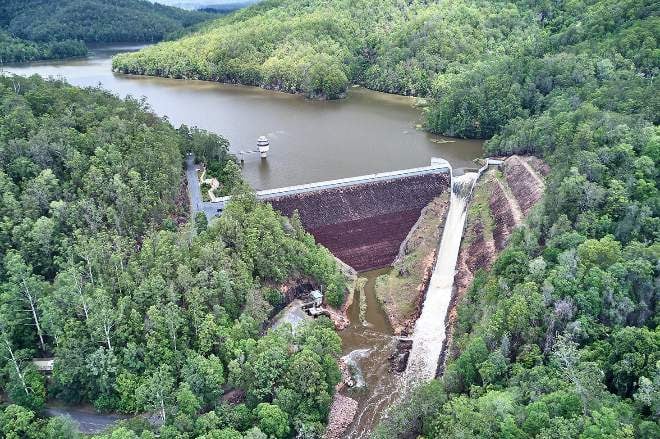
Clarrie Hall Dam running out of capacity
All councillors voted unanimously to note the progress on the Clarrie Hall Dam Raising project, which includes a staff report advising ‘the demand for water will exceed the estimated secure yield by approximately 2028, which would potentially increase the need to implement water restrictions’.
A ‘significant $304m is estimated’ for the project, and councillors requested ‘a further report by July 2026 providing additional information on:
‘A. A delivery schedule (Gannt chart) showing the project timeline including all major steps;
‘B. Funding strategy and risks;
‘C. Water supply strategy and risks beyond 2028; and
‘D. An update on further progress including outcomes of the Environmental impact Statement determination, Business Case and Delivery Plan’.
Councillor Kimberly Hone asked staff: ‘why is the dam wall project taking so long when water security for the Tweed should be our top priority?’
Council staff replied, ‘Dam projects are complex and multi-disciplinary, and they can proceed only when multiple statutory, technical, funding and delivery steps are satisfied’.
‘For these types of projects, the planning phases generally take much longer than the actual construction tasks.
The raising of Clarrie Hall Dam has been deemed State Significant Infrastructure, requiring an Environmental Impact Statement (EIS) involving multiple investigations and studies – including a number of field surveys requiring multi-year assessments.
‘As part of the assessment process, the EIS has been publicly exhibited with responses to submissions prepared and lodged. The EIS is now under formal assessment by the State and referral to the Commonwealth under the EPBC Act is required.
‘A large number of other approvals and consents are necessary for works in and near waterways such as aquatic ecology and Aboriginal cultural heritage. The offsetting of biodiversity credits is required, with negotiations across multiply agencies underway.
‘Land and tenure work has been extensive as property acquisition preferences negotiated purchase with defined steps before any compulsory action. A total of 16 properties or part thereof have required purchasing.
‘Additionally, revoking a small area of Mt Jerusalem National Park and pursuing a land-swap with National Parks is an in-depth legislative process involving government agencies and Parliamentary action.
‘Ensuring the project is delivery-ready requires dam-safety assurance consistent with contemporary Australian practice, a detailed business case and gateway assurance to seek funding and delivery model that considers market and risk requirements.
‘The project will involve quarrying of rock, mainly from the new spillway location, and adding this to the existing wall to raise its height. A new upstream concrete apron, concrete spillway and extension to the inlet tower will also occur. Construction also requires the relocation and protection of Essential Energy and Telstra assets, along with new road and bridge constructions, and road-reserve amendments. Extensive environmental and cultural heritage protection measures will also be undertaken. Construction works are expected to be completed by 2032’, staff said.
All council agendas and meeting minutes are available at https://www.tweed.nsw.gov.au/council/councillors-meetings/council-meetings
 For four decades The Echo has printed the stories some people loved, some people hated, and some pretended not to read. If you want us to keep telling the truth, the real truth, not the sugar-coated version. We’ll need your support to keep the presses rolling.


