


Brought to you by Cosmos Magazine and The Echo
Several groups release research detailing previously unknown processes at play down south.
Understanding ice loss in Antarctica has been improved by a range of research into causes of ice shelves and glacier retreat on the frozen continent.
Multiple studies have recently shown that increasing ocean and atmospheric temperatures are causing important changes in the Antarctic landscape – from positive feedback processes causing ice shelves to diminish, to updating the amount of ice that has been jettisoned into the ocean.
On top of this, parts of Antarctica previously considered less susceptible to climate impacts may instead by on the edge of melting into the ocean if the world is unable to halt continued rise in average temperatures due to global warming.
When positive feedback isn’t welcome
Ice loss can occur in many ways, but one of the key drivers amid climate change is the impact of warming ocean temperatures.
Just as an ice cube will melt faster in warmer water, so too can Antarctic ice sheets and glaciers.
And while these icy masses take far longer to melt than a humble ice cube, the principle at play is still the same.
Now, new modelling published in Science Advances by the Californian Institute of Technology, US, and NASA’s Jet Propulsion Laboratory (JPL) has increased the understanding of how ocean currents can accelerate ice melt in Antarctica.
Do you care about the oceans? Are you interested in scientific developments that affect them? Then our new email newsletter Ultramarine, launching soon, is for you. Click here to become an inaugural subscriber.
Researchers in Professor Andy Thompson’s Caltech laboratory found the narrow Antarctic Coastal Current causes a feedback process which speeds up the melting of ice sheets.
This is because freshwater released into the current from melting ice traps warm water beneath ice shelves along the vulnerable West Antarctic peninsula. This results in a cycle where more freshwater is released into coastal currents that repeatedly pushes more warm water below the ice.
Such a cycle could mean ice shelves melt at far greater rates than previously believed.
“If this mechanism that we’ve been studying is active in the real world, it may mean that ice shelf melt rates are 20 to 40 per cent higher than the predictions in global climate models, ” says Thompson.
Iceberg crumble results in the net loss of over 36,000 sq/km of area
From melting to ‘calving’ – ice loss can occur in many ways.
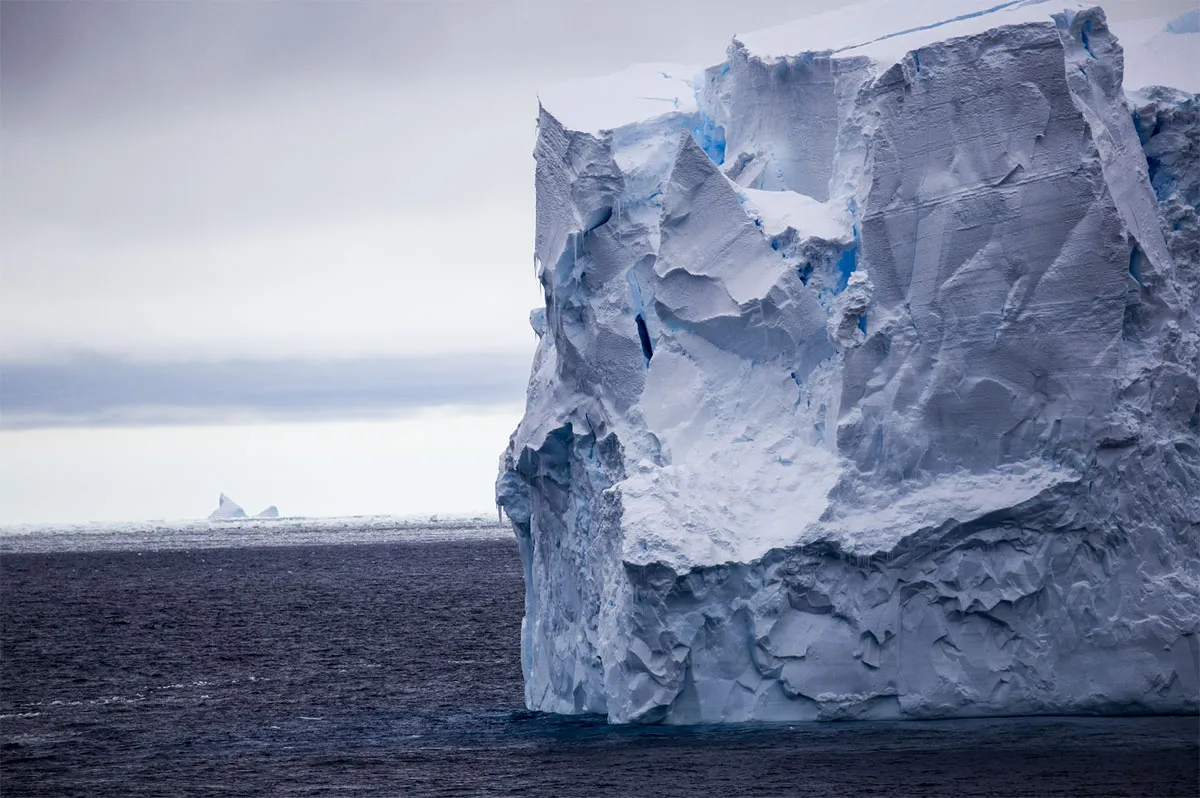
Calving – the shearing of ice from the front of glaciers – is perhaps the most spectacular way ice can be lost from polar shelves. These are made-for-television moments where huge chunks of ice split from large masses and plunge into the ocean below.
And it turns out twice as much ice has been lost through calving than has previously been estimated – with projections jumping from six to 12 trillion metric tonnes.
That’s a lot of ice.
These findings published in Nature by a team at JPL demonstrate substantial change in the Antarctic coastline over the last quarter century.
The extent of ice shelf retreat along the continent was determined by mapping elevation changes shown by data from multiple observation satellites.
It shows sizeable retreats in Ellsworth Land and Marie Byrd Land in West Antarctica and parts of Australia’s territory claim around the Totten glacier.
Lead author Dr Chad Greene says this extensive ice shedding adds further risk to increased sea level rise.
“Antarctica is crumbling at its edges,” says Greene.
“And when ice shelves dwindle and weaken, the continent’s massive glaciers tend to speed up [rate of ice loss] and increase the rate of global sea level rise.”
Limiting warming to under 2 degrees could avert decline of East Antarctic Ice Sheet
While West Antarctica is especially sensitive to climate impacts, East Antarctica – the world’s largest ice sheet which is considered the least vulnerable to melt – isn’t getting off scot free.
Researchers from Australia, the UK, US and France publishing in Nature suggest East Antarctica’s resilience might be diminished if the world shoots past a two-degree increase in average temperature.
Based on projections, keeping temperatures below two degrees might prevent melting of this ice sheet from adding to sea level rise this century. In this scenario, it would contribute less than half-a-metre of sea level rise by 2500.
If that threshold is breached, the melting of the East Antarctic Ice Sheet (EAIS) could be substantial.
“If temperatures rise above two degrees Celsius beyond 2100, sustained by high greenhouse gas emissions, then East Antarctica alone could contribute around one to three metres to rising sea levels by 2300 and around two to five metres by 2500,” says co-author Professor Nerilie Abram from the Australian National University.
“A key lesson from the past is that the EAIS is highly sensitive to even relatively modest warming scenarios. It isn’t as stable and protected as we once thought.”
“Achieving and strengthening our commitments to the Paris Agreement would not only protect the world’s largest ice sheet, but also slow the melting of other major ice sheets such as Greenland and West Antarctica, which are more vulnerable to global warming,” says Abram.
Knowledge of climate impacts on Antarctica backed in recent federal report
The Australian Government recently highlighted the danger of climate change on the world’s southernmost ecosystems in its State of the Environment report, with scientists from the Australian Antarctic Division assessing the physical and biological trends facing the region.
They found continued and unpredictable changes in the patterns of sea ice formation, as well as melting of glaciers and ice sheets due primarily to the warming of upper ocean levels and the lower atmosphere.
Dr Dirk Welsford co-authored the Antarctic assessment in the report and leads the Division’s conservation and management programs. He says Antarctica cannot afford to have the worst impacts of climate change locked in.
“The Antarctic environment is still in comparatively good condition, but the pressures on the continent and the surrounding ocean are increasing,” Dr Welsford said.
“The processes that are changing the Antarctic environment are well under way and likely to continue for at least several human lifetimes.
“While time is running out to do something, to prevent locking in the most extreme changes, I’m optimistic that when the global community comes together, like it has with the Montreal Protocol and other agreements, we can slow and even reverse these changes.”
This article was originally published on Cosmos Magazine and was written by Matthew Agius. Matthew Agius is a science writer for Cosmos Magazine.
 For four decades The Echo has printed the stories some people loved, some people hated, and some pretended not to read. If you want us to keep telling the truth, the real truth, not the sugar-coated version. We’ll need your support to keep the presses rolling.



