


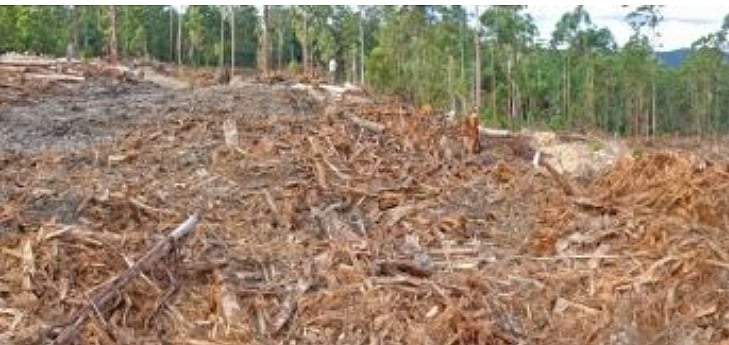
Conservations are calling for a halt to the clearfelling of swathes of native forests across the north coast under the guise of so-called ‘single tree selection’.
The North East Forest Alliance also wants NSW Environment minister Mark Speakman to enforce the state’s logging rules and direct the NSW Forestry Corporation (FCNSW) to stop clearfelling.
NEFA spokesperson Lyn Orrego said the FCNSW was clearfelling huge swathes of forests in breach of the conditions of its logging approvals.
‘FCNSW misleadingly call these large clearfelled areas – some over 100 hectares in size – “Single Tree Selection” (STS),’ Ms Orrego said.
She said a letter from the Environment Protection Authority on the minister’s behalf had acknowledged that clearfelling was not consistent with the definition and intent of STS in the Integrated Forestry Operations Approval (IFOA), and also went against FCNSW’s own silvicultural guidelines.
‘So we have an acknowledgement from the regulator that FCNSW is operating outside their approval conditions yet the minister will do nothing about it,’ she said.
‘The so-called solution put forward in the EPA letter is to wait for the new IFOA the state government is planning to put on public display at some time in the future.
‘We know the government’s intent is to authorise the clearfelling (with just a few trees to be retained) across 140,000 hectares of public forests between Grafton and Taree and to increase logging intensity elsewhere.
‘This just rewards FCNSW for their illegal logging practice and is an unacceptable “solution”’, she said.
North Coast Environment Council spokesperson Susie Russell said the lack of regulation in the forestry industry was ‘shameful’.
‘The impact of clearfelling on our forest dependent threatened species such as the koala is disastrous,’ Ms Russell said.
‘The number of koalas on the east coast of Australia declined by more than 40 per cent in the 20 years between 1990 and 2010.
‘The Greater Glider, considered common when the Approvals were issued has now been listed as threatened with extinction. Logging is the main threat it faces.
‘Other impacts of clearfelling include soil losses, water pollution and the lost opportunity to store carbon by not keeping the public forest estate in a more mature growth stage as it used to be.’
Ecologist, David Milledge of Landmark Ecological Services, said clearfelling had a substantial adverse effect on biodiversity and on native animals.
‘This is evidenced by the high proportion of such species listed as threatened under the Threatened Species Conservation (TSC) Act 1995. It is diametrically opposed to Ecological Sustainable Development,’ he said.
Meanwhile, Ms Russell said the NSW Public was footing the $79 million bill subsidising the logging industry.
‘People only have to look on Google Earth and click on the history button to see that the state forests across the north coast of NSW are being hammered as they never have been before. It’s vandalism pure and simple,’ she said.
‘This is why the North East Forest Alliance is campaigning for a transition out of logging of our public native forests. They need to be left to grow old and managed for public benefit, which includes increasing water supply and supporting the unique animals and plants that depend on them,’ she said.
‘Now that the EPA, writing on the minister’s behalf, has admitted that the clearfelling is “not consistent with” the IFOA the minister has no excuse to allow such intensive logging to continue.
‘He must order this illegal logging to stop now as it contravenes the law and the promise of Ecologically Sustainable Forest Management (ESFM) which the IFOA was written to deliver.’
 For four decades The Echo has printed the stories some people loved, some people hated, and some pretended not to read. If you want us to keep telling the truth, the real truth, not the sugar-coated version. We’ll need your support to keep the presses rolling.


