


Leah Gibbs
NSW premier Mike Baird has this week announced a plan for a six-month trial of shark nets off the beaches of northern NSW. This would extend the state’s shark net program from the 51 beaches currently netted between Wollongong and Newcastle.
The announcement was triggered by Wednesday’s shark accident, in which a surfer received minor injuries from a shark bite at Sharpes Beach, Ballina.
The decision marks a turn-around in Premier Baird’s position on sharks. For over a year he has acknowledged the importance of addressing the issue, and has adopted a measured, long-term, non-lethal approach to managing shark hazards. Specifically, the NSW government has, in the last year, allocated funding and resources to non-lethal strategies including surveillance, research and education.
Killing sharks has been highly controversial in Australia in recent years, and in NSW shark nets have been a focus of ongoing, highly polarising debate.
Three common misunderstandings about shark nets
The decision to introduce shark nets in the state’s north invites us to revisit some common misunderstandings about this strategy.
First, there is wide misunderstanding about what shark nets are and what they do. The nets used in the NSW Shark Meshing (Bather Protection) Program do not create an enclosed area within which beach goers are protected from sharks.
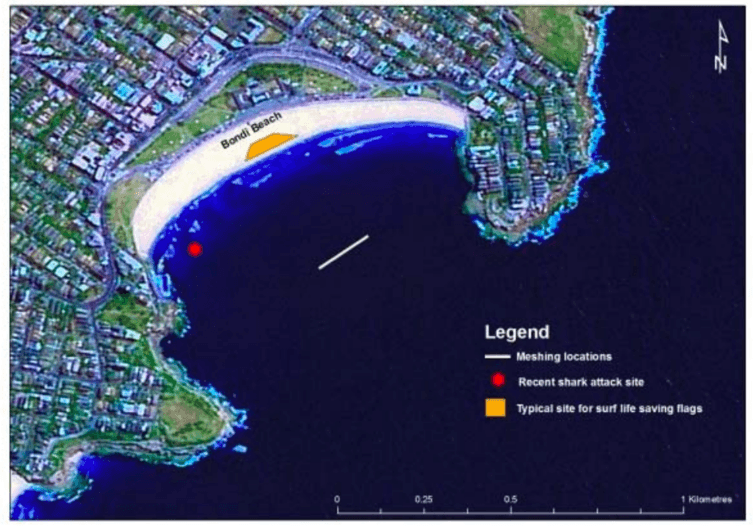
They are fishing nets, which function by catching and killing sharks in the area. Nets are 150 m long, 6 m deep, and are suspended in water 10-12 m deep, within 500 m of the shore.
Second, whether shark nets work is still up for debate. Shark nets have been used in NSW since 1937. Since then, the number of netted beaches, methods for deploying nets, and data collection and record-keeping methods have changed, and data sets are incomplete.
Our use of the beach and ocean has also changed dramatically. There are more people in the water, in new areas, and we’re using the ocean for different activities. At the same time, our observation of sharks and emergency response have improved dramatically.
The suggestion that nets prevent shark accidents is an oversimplification of a complex story, a misrepresentation of both technology and data, and it misinforms the public.
And finally, shark nets cannot be a long-term solution. They are out-dated technology based on outdated thinking, developed 80 years ago.
They go directly against our international responsibility to protect threatened species (under the International Union for the Conservation of Nature and our own Environment Protection and Biodiversity Conservation Act), and our national priorities for protecting marine environments and species, including several shark species.
We know that shark nets in NSW kill on average at least 275 animals per year (measured between 1950 and 2008), and that the majority of animals killed pose no threat to people. We can do better than this.
Learning from the (very) recent past
Right now we have an opportunity in NSW to learn from recent experiences in Western Australia. In 2012, the WA government, under Premier Colin Barnett, introduced hooked “drumlines” to kill sharks in an attempt to reduce the risk of shark bites. Like this week’s announcement by Premier Baird, that policy change was stimulated by a spike in shark accidents.
The response to the new policy was a highly-polarised debate and extraordinary public outcry, including two public protests at Perth’s Cottesloe Beach attracting 4,000 and 6,000 people, and protests in eleven other cities around the country, including 2,000 at Sydney’s Manly Beach.
The state’s Environmental Protection Authority received a record number of 12,000 submissions from scientific and other experts presenting reasons to cease the cull. The WA government heeded the EPA’s recommendation and cancelled the policy.
Our research with ocean users conducted during this period showed that perspectives are diverse (we surveyed 557 WA-based ocean-users using quantitative and qualitative research methods).
Among people who use the ocean regularly, some strongly oppose killing sharks; others are ambivalent; and a smaller number of people are in favour. People’s views and understandings are nuanced and carefully thought through.
However, within this group, the strategies for managing shark hazards that were most strongly supported were improving public education about sharks, and encouraging ocean users to understand and accept the risks associated with using the ocean. Other widely supported strategies included developing shark deterrents and increasing surveillance and patrols.
The most strongly opposed approaches were those that killed sharks including culling, proactive catch-and-destroy measures, baited drumlines, and shark nets.
In recent years we have been making good progress in Australia on public discussion and investment in more effective and ethical approaches for reducing shark bites. This week’s move to introduce an outmoded technology to the north coast promises to further divide the community.
We should continue to invest in developing new strategies that better reflect our contemporary understanding of marine ecosystems. Perhaps we also need to consider (temporarily) altering the way we use the ocean, avoiding areas of higher-than-usual shark sightings.
Leah Gibbs is a senior lecturer in Geography at the University of Wollongong.
This article was first published in TheConversation.
 For four decades The Echo has printed the stories some people loved, some people hated, and some pretended not to read. If you want us to keep telling the truth, the real truth, not the sugar-coated version. We’ll need your support to keep the presses rolling.


