


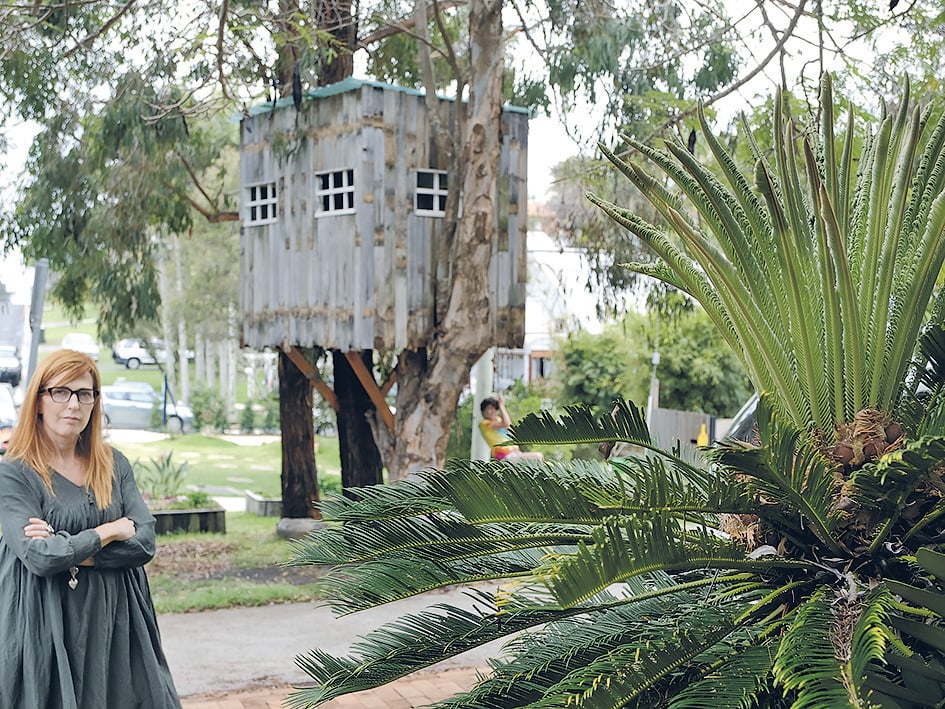
What is public art? This is the question that local resident Mellanie Coppin is planning to ask Byron Shire Council’s public art panel as she looks for a way to redefine the cubby house that was installed on the road reserve near her home in Massinger Street, Byron Bay.
After being told by the council to remove the cubby house in August 2017, Mellanie has asked if there was a way to keep it there, as she says it is loved by both children and adults as well as locals and tourists.
‘Virtually every day people stop in their tracks or in their cars to take photos of this treehouse. Neighbours have instagramed it, kids play in it and the positive feedback has been curiously overwhelming,’ said Mellanie.
Melanie has asked council if the cubby house could be ‘considered amongst the public art features of our town rather than an encroachment?’
However, the council’s tourism and projects officer Joanne McMurtry said that while she was empathetic to the idea of the cubby house being art, ‘a treehouse/cubby doesn’t fit with our definition of public art’ – and Mellanie has now been given 28 days to remove it.
According to the vision of the council’s own draft public art strategy, public art should be ‘vibrant, contemporary public art… that reflects and promotes the unique character and life-style of the region.’
The key principles of the strategy state that, ‘all public art has to be relevant to its site in response to values of identity and place,’ that ‘public art must reflect the cultural narratives of the Shire’ and add ‘value to the community quality of life.’
So why doesn’t the cubby house meet those criteria?
According to Mellanie, ‘It is appreciated daily by passers by and is frequently photographed. Neighbours, friends, tourists, walkers, riders and drivers by, all seem to love it.’
‘I was talking to my seven year old son about it last night and his response was “isn’t everything art?” And I have to agree. What makes this cubby house not art?
‘In fact as art it represents a clear intersection of art and community. It is a symbolic opportunity – so people can revisit the innocence of their childhood as well as interacting with the freedom of the alternative culture when people were experimenting with how to live with nature – the experimentation that originally drew people to Byron Bay.’
Melanie has already told the council that she is prepared to pay for the costs of insurance as well as maintain the cubby house if it were to remain.
Responding to questions from The Echo, council staff said, ‘The process for assessing public art on public land is to complete several documents: an artwork proposal form which provides information about the artwork, the materials its made from and other information about the artwork (this also requires an artists CV and other information about the artist); a risk assessment; a maintenance manual.
‘This information is then provided to the public art panel, who meet quarterly, to assess the artwork against the guidelines and make a recommendation to council.’
 For four decades The Echo has printed the stories some people loved, some people hated, and some pretended not to read. If you want us to keep telling the truth, the real truth, not the sugar-coated version. We’ll need your support to keep the presses rolling.


