


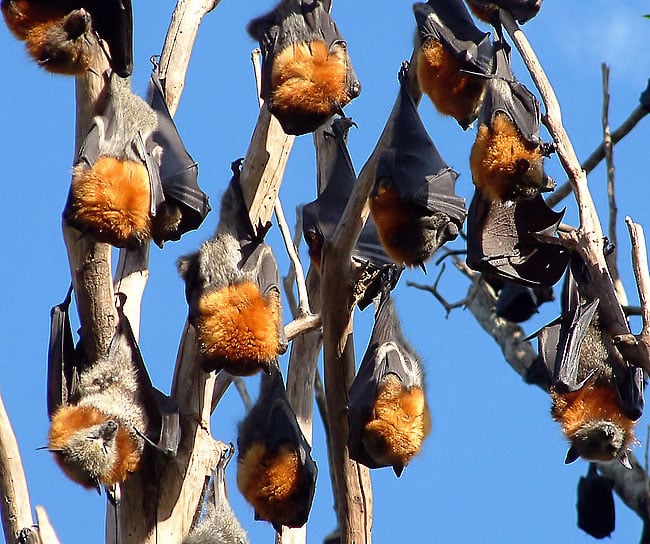
The impact of helicopters on a flying fox colony located close to the proposed site for the new Tweed Valley Hospital have been raised by the Evans Head Memorial Aerodrome Committee. They say that this issue is a serious public safety risk if the hospital was to go ahead at this site.
‘The Committee has formed the view that the proposed location for the hospital is not appropriate because of significant risk of helicopter collision with flying foxes from a nearby colony,’ Dr Richard Gates, president of the committee said today.
‘In our view this aviation/flying fox conflict has serious ramifications for the siting of the hospital because of the need for helicopter access for emergencies. If the hospital is to have a helicopter emergency facility at all then the hospital needs to be relocated to a safer area.’
Dr Gates said they were concerned at the fact there was no mention of the flying fox risk at the proposed site in the aviation review.
‘The flight path for the helicopter crosses the buffer zone for an identified flying fox colony not far from the hospital. The helicopter would be flying at low level in this area for more than a kilometre increasing risk of conflict as at airports. Flying foxes don’t tend to get out of the way. They are a known risk to aviation,’ he said.
‘There is not only the risk to the helicopter and its crew and retrieved patient to consider with the current location, but also the community at large should a helicopter be impacted en route to the hospital or on call-out. Risks to the public must be reduced as much as possible and the state government should discard any use of an “affordable risk” model in its decision-making.’

Colony destruction
The committee also raised the concern that if the position of the colony was not looked at now there would be significant risk that the colony would be ‘be destroyed “in the public interest” so that there was no longer any risk to the helicopters’ in the future.
‘This would be an incredibly dumb solution given the important role flying foxes play in the productive economy of our forests, something the state government already knows,’ said Dr Gates.
‘There are better solutions to the current problem such as a new location for the hospital. Health Infrastructure claims it reviewed 30 potential sites for the hospital. Surely one of these would be better than the current site?
‘The state government needs to make the site evaluation process public so that we can see how the current site was chosen,’ he said.
Independence of aviation consultant
The committee has also questioned the tender process that Health Infrastructure used to select the consultant to write the aviation report, noting that the consultant didn’t declare their input into the State Health Guidelines about Helicopter Landing sites as well as the number of reports previously written for the health department.
‘The consultant may well be the best in the field and that may be why their materials were used by NSW Health, but if this is so why not declare this fact to allay any concern about independence of the assessment process?’ said Dr Gates.
‘Why was the Civil Aviation Safety Authority, which is charged with aviation safety and related standards for Australia, not involved in this critical process as an independent authority?’
Make evaluation process public
The Evans Head Memorial Aerodrome Committee is now calling the state government to make the site evaluation process public.
‘Where was the due diligence for public risk and why was the flying fox matter missed when it figured prominently in other documentation available to the state government and a report referenced by the consultant? Certainly Tweed Council raised its concerns publicly with regard to the impact the proposed hospital at its current location would have on the local biology including the flying fox.’
‘Public access to this process is critical to public confidence in our institutions and the political process for this controversial hospital site,’ concluded Dr Gates.
 For four decades The Echo has printed the stories some people loved, some people hated, and some pretended not to read. If you want us to keep telling the truth, the real truth, not the sugar-coated version. We’ll need your support to keep the presses rolling.


