


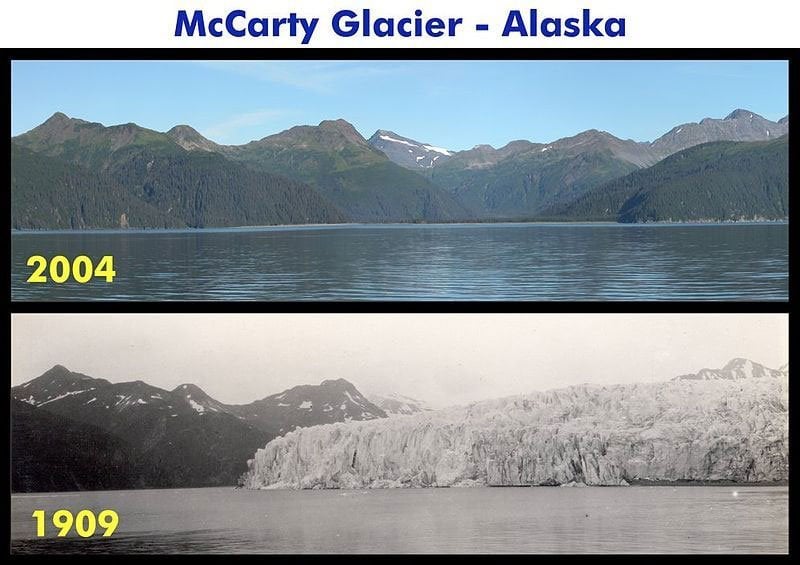
Positive feedbacks make it harder to slam on the brakes as we steam towards a hotter climate
Dr Willow Hallgren
Like a runaway steam train gaining momentum as it careens down a mountainside, scientists have warned that if we emit too many greenhouse gases, like carbon dixiode (CO2) or methane, into the atmosphere, that we will reach a ‘tipping point’ where the climate will warm uncontrollably. If we reach this tipping point it will move us inexorably towards a doomsday scenario where extreme heatwaves and searing, interminable droughts are punctuated by category 5 cyclones, which demolish seaside homes and cause extensive flooding.
Some scientists have looked into whether this uncontrolled warming would eventually cause the earth to move into a new ‘hothouse’ state, which would be decidedly unpleasant not just for humans but for all life on Earth.

Just a lot of hot air?
But is this a realistic scenario? Let’s examine some facts. The earth’s climate is an incredibly complicated system. Many factors influence climatic conditions here on the earth’s surface where we humans experience it, along with the rest of the world’s other countless land-based life forms.
We all know that human activities emit huge amounts of greenhouse gases and this is causing atmospheric warming and climate change. However, what most people may be unaware of is that this warming triggers many other physical and biological processes. These act as accelerators (and occasionally brakes) to speed up or slow down our climatic steam train.
Is a little positive feedback a bad thing?
Processes that accelerate warming are known as ‘positive feedbacks’, and unfortunately there are many of them that have already been triggered by the warming we have experienced so far. For example, higher air temperatures over the Arctic Ocean cause more of the Arctic sea ice to melt in summer. The ocean is darker than the ice, so more of the warmth from the sun is absorbed into the water, which heats the air some more.
Ice on the other hand bounces the sunlight back into space. Think of what the temperature is like inside a black car in summer compared to a white one. Other positive feedbacks involve changes to the ocean currents, the release of methane from the oceans, and more water vapour in the atmosphere.

Climate ‘time bomb’
However, one of the greatest dangers of continued global warming is the thawing of vast areas of frozen soil in places like Siberia and Canada. This would release enormous amounts of CO2 and methane from the soil.
The fact is that permafrost contains around twice the carbon as the atmosphere; if released this could lead to catastrophic climate change. Some scientists have labeled this a ‘climate time-bomb’. The bad news is that the permafrost has started to melt in many places. Could this feedback be our one-way ticket to Hothouse Earth?
As we continue to emit more of these greenhouse gases, we are fuelling these positive feedbacks to our planet’s – and civilisation’s – detriment. Unfortunately, even if we stop emitting all greenhouse gases tomorrow, those that we’ve already emitted will stay in the atmosphere for from decades to centuries. This is why we must stop emitting greenhouse gases as soon as possible to avoid dangerous climate change, and to shorten the period of climate disruption as much as we can.
Save me, mummy
But what about the negative feedbacks that one can imagine our mother Earth might have evolved to save her good work from being destroyed by certain destructive and naughty children (that’s us!) – can they help to slow down the warming and potentially save us from ourselves?
A potentially very strong negative feedback could result in an increase in clouds owing to higher evaporation as global warming progresses. Even small changes in cloud amount, location, and type could have large consequences.
More cloud cover can reflect sunlight back into space and cool the earth’s surface. But not all clouds can help us – some types of clouds trap heat, so to predict the overall role clouds will play as the earth warms up is really hard.
Scientists are still not entirely sure if clouds are going to help or hinder our fight against climate change, although more and more evidence suggests clouds might become a positive feedback.

Plant, plant, plant
A more reliable saviour is plant growth, which can act as a negative feedback up to a point.
More carbon dioxide in the atmosphere stimulates plant growth in places that have enough water and nutrients. Growing trees remove about half of human carbon dioxide emissions from the atmosphere every year and lock them up for decades, and potentially centuries.
Replanting forests will help stem biodiversity loss as well, and lead to higher rainfall and lower temperatures in many areas – a win on many levels.
However, in the sense that every problem has in it the seeds of its own solution, I would like to think that the most important negative feedback to global warming is the current exploding awareness of people all over the world that now is the time for us all to act, and do everything in our power to pull the brakes on climate change as hard as we can.

Dr Willow Hallgren is an earth-system scientist who studies the impact of climate change on ecosystems and biodiversity, the feedbacks between vegetation and the climate, and how policy can influence climate change, by changing how we use the land.
Willow has previously worked as a climate and biodiversity scientist in government, industry, and academic roles in both Australia and the USA at the Massachusetts Institute of Technology (MIT). She was also previously the Science editor of Monash University’s student newspaper Lot’s Wife.
She is a city escapee of many years now and is currently hiding out among the hill tribes of the beautiful Tweed Valley.

This article is from The Echo‘s eleventh annual sustainability supplement Sustainability 2019 – hints for living a sustainable life. Check it out for more great tips for those who would like to tread lightly on this planet.
More articles from Sustainability 2019:

Local councils taking action on the climate crisis
Local councils are on the front line of managing resources and the environment and are in a position to implement practical on-the-ground changes to protect the environment, reduce greenhouse gas emissions, and plan for the impacts of the changing climate.

Power to the people: take the climate crisis into your own...
If you had to walk a kilometre to pump your water from a well, do you think you would be careful how many drops you used?

Been thinking about going off the grid? Here’s some firsthand advice
Thinking about going off grid? ‘Do it!’, says local filmmaker David Lowe.
 For four decades The Echo has printed the stories some people loved, some people hated, and some pretended not to read. If you want us to keep telling the truth, the real truth, not the sugar-coated version. We’ll need your support to keep the presses rolling.


