



Brought to you by The Echo and Cosmos Magazine
The species has been officially declared endangered in NSW, Queensland, and the ACT.
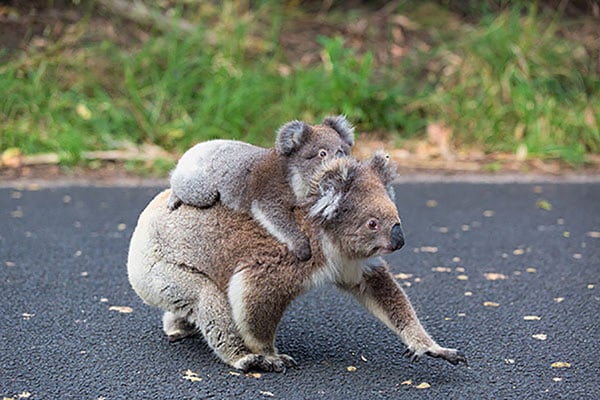
The koala – Phascolarctos cinereus – has officially been listed as endangered in Queensland, New South Wales, and the ACT. What does this mean, and what happens now?
What does the endangered listing mean?
The koala is listed under the Environment Protection and Biodiversity Conservation Act as a threatened species.
There are six categories in this listing, arranged in order of severity: conservation dependent, vulnerable, endangered, critically endangered, extinct in the wild, and extinct.
Koalas were previously considered vulnerable in the eastern states, and their status has now been shifted to endangered. Koala populations in South Australia and Victoria are not considered vulnerable.
This listing doesn’t carry any specific legal directions, but it does allow the species’ recovery to be promoted with conservation advice, recovery plans and recovery teams.
‘A decade ago, my colleagues and I provided advice at the Senate Inquiry into the status, health and sustainability of Australia’s koala population,’ says Dr Christine Adams-Hosking, an honorary fellow at the University of Queensland.
‘We were elated when, in 2012, the koala was listed as nationally “vulnerable” under the EPBC Act.’
But Adams-Hosking says that this listing hasn’t helped the plight of the koala.‘Since then, nothing has happened to facilitate the protection of koalas.’
She’s not confident that the update in listing will galvanise further action. ‘I think it is going to be similar, purely because we’ve seen this happen time and time again with other endangered listings.
‘It might at least get a recovery plan going, which would be a really good start, and which should have been written after the original listing in 2012.’
Why are numbers declining, and how can we stop it?
There are a range of things causing koala numbers to decline. Habitat clearing and climate change are two major factors, while disease, bushfires, and road accidents also all play a role.
Habitat restoration is the key way to protect koalas from further decline.
‘Habitat, that’s really the problem. If the koalas had enough habitat, we wouldn’t need the endangered listing,’ says Adams-Hosking.
‘First up, we need to save koala habitat,’ says Grant Hamilton, associate professor in ecology at Queensland University of Technology. ‘And we need to not only stop knocking down their homes, we need to probably plant more trees for them.
‘Secondly, in the areas that we’re looking for conservation, we need to understand how many are there.’
This is a big venture, requiring input from ecologists, citizen scientists, and technology. Hamilton is director of the Conservation AI Hub, which allows trained citizen scientists to send in data which is analysed by AI.
‘We’ve trained it to look for koalas, and it’s more accurate than humans are,’ says Hamilton. It could also be used for spotting other animals.
So, how many koalas are there?
Wildly different numbers for total koala populations are thrown around – anywhere from less than 80,000, according to the Koala Foundation, to over half a million.
‘Estimating numbers is unbelievably difficult,’ says Adams-Hosking. ‘They’re so hard to find, let alone count.’
Hamilton agrees, saying that when running studies on collared koalas in specific parks, even trained koala spotters can miss a large proportion of the creatures.
Read more: Koala populations hanging by a thread
Adams-Hosking was lead author on a 2016 study that, based on input from a panel of 15 experts, estimated there were 144,000–605,000 koalas in the wild nation-wide, with a 24 per cent decrease over the previous three generations of koalas. Declines were steep in Queensland and NSW (53 per cent and 26 per cent respectively), and less steep in Victoria and SA (14 per cent and 3 pre cent).
‘Where we have done quantitative work, we can see that there have been dramatic declines – up to 80 per cent in many areas – and of course, the bushfires put a big hole in that on top,’ says Adams-Hosking.
Professor Michael Archer, a palaeontologist at the University of New South Wales’ Earth and Sustainability Science Research Centre, says that this recent decline is out of sync with the evolutionary history of koalas.
‘Whatever the actual number, it’s still going to be enormously high compared with the apparent abundance of them in the past. What’s happened to koalas [is] they’ve lucked out over the last 10 million years.’
Archer says that according to the fossil record, koalas were originally specialist organisms, inhabiting only a small part of the continent – the change in climate and spread of eucalyptus trees has favoured them.
What about other animals?
The koala is, of course, not the only endangered species in Australia. Other animals are also in need of protection.
‘Platypuses, to us, have a long-term record of massive decline,’ says Archer.
‘We’ve collected fossil platypuses in South America. And they’ve had a long-term decline over the last 60 million years to bring them to a very critical situation today. It’s an infinitely more fragile situation than the one that faces koalas.’
However, he believes that protecting koala habitats is still an important move, because other species will benefit.
‘I’m not really too wound up about this, because any additional care for koalas has to include protection of koala habitat. And that will mean increased protection for [other] animals.’
On this, Adams-Hosking agrees. ‘Woodland forest are occupied by many other beautiful little native animals, from birds down to beetles and butterflies.’
Restoration efforts that focus on the whole ecosystem are an important way to allow threatened species to recover. An example of this, according to Adams-Hosking, is the Richmond birdwing butterfly, which was listed as vulnerable in Queensland at the same time as the birdwing butterfly vine, which its larvae need to feed on.
This article was originally published on Cosmos Magazine and was written by Ellen Phiddian. Ellen Phiddian is a science journalist at Cosmos. She has a BSc (Honours) in chemistry and science communication, and an MSc in science communication, both from the Australian National University.
 For four decades The Echo has printed the stories some people loved, some people hated, and some pretended not to read. If you want us to keep telling the truth, the real truth, not the sugar-coated version. We’ll need your support to keep the presses rolling.


