


Brought to you by Cosmos Magazine and The Echo
DNA shows that the tortoise is really phantasticus.
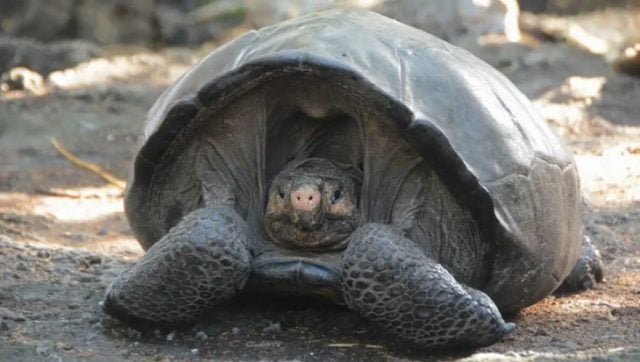
In 2019, a female giant tortoise was found on Fernandina Island, in the Galápagos archipelago. Fernanda, as she is now called, was a miracle find, with researchers suspecting she might be a fantastic giant tortoise, or Chelonoidis phantasticus, a species believed to have gone extinct in 1906.
Now, peer-reviewed DNA evidence has finally confirmed it: Fernanda is a fantastic giant tortoise, and the species is not extinct.
The DNA evidence suggesting Fernanda was distinct was announced last year, but it has now been peer-reviewed (assessed by independent experts) and published in Communications Biology.
The researchers sequenced Fernanda’s genome, as well as the DNA from the last confirmed phantasticus specimen, collected in 1906.
The researchers then compared this DNA to that from 13 other species of Galápagos giant tortoises. They found that the DNA from Fernanda and the 1906 specimen were distinct from all the others, but related to each other.
“For many years it was thought that the original specimen collected in 1906 had been transplanted to the island, as it was the only one of its kind,” says Peter Grant, a professor of zoology and ecology and evolutionary biology at Princeton University, US.
“It now seems to be one of a very few that were alive a century ago.”
More on Galápagos giant tortoise genetics: The genome of Lonesome George
Fernanda doesn’t look exactly like the male 1906 specimen, so ecologists weren’t initially sure they were the same species.
“Like many people, my initial suspicion was that this was not a native tortoise of Fernandina Island,” says paper co-author Dr Stephen Gaughran, a postdoctoral research fellow in ecology and evolutionary biology also at Princeton.
While tortoises can’t swim between islands, they do occasionally float across during storms, or get carried by sailors.
“We saw — honestly, to my surprise — that Fernanda was very similar to the one that they found on that island more than 100 years ago, and both of those were very different from all of the other islands’ tortoises,” says Gaughran.
“The finding of one alive specimen gives hope and also opens up new questions, as many mysteries still remain,” says senior author Dr Adalgisa Caccone, a researcher in ecology and evolutionary biology at Yale University, US.
“Are there more tortoises on Fernandina that can be brought back into captivity to start a breeding program? How did tortoises colonise Fernandina, and what is their evolutionary relationship to the other giant Galápagos tortoises?
“This also shows the importance of using museum collections to understand the past.”
Fernanda is small, but estimated to be over 50 years of age. Researchers have found tracks and scat of at least two other tortoises on Fernandina, meaning there’s a small chance she may not be the last of her kind.
More on the Galápagos Islands: More to learn about evolution from Galápagos finches
The genetic relations between Fernanda and other tortoises described in the paper also bring new questions to the fore.
“The genetic work provides intriguing hints of a mixing of genes with members of another population,” says Grant.
“It would be fascinating if confirmed by future detective work on the genome. Another thought-provoking finding is the nearest relatives are not on the nearest very large island (Isabela) but on another (Española) far away on the other side of Isabela. The question of how the ancestors reached Fernandina is left hanging.”
Interested in having science explained? Listen to our new podcast.
This article was originally published on Cosmos Magazine and was written by Ellen Phiddian. Ellen Phiddian is a science journalist at Cosmos. She has a BSc (Honours) in chemistry and science communication, and an MSc in science communication, both from the Australian National University.

 For four decades The Echo has printed the stories some people loved, some people hated, and some pretended not to read. If you want us to keep telling the truth, the real truth, not the sugar-coated version. We’ll need your support to keep the presses rolling.


