



The Macaranga tanarius is a tree that is commonly seen as a pioneer species in disturbed rainforest areas. In Australia it naturally occurs from the Richmond River, New South Wales to Cooktown in tropical Queensland.
So it is with serious concerns that the Lennox Head Landcare has written to Ballina Councillors regarding their decision to ‘Council stop the planting of the “Macaranga tanarius” native tree from the list of accepted tree species being planted by Council and local community groups’.
‘We are deeply concerned that Councillors chose to accept internet research conducted by amateurs, and the personal beliefs put forward by some, over the professional opinion of Council’s qualified staff,’ they stated in their letter to councillors.

Wrong tree in photos
Councillors Stephen McCarthy and Phillip Meehan put forward the motion to ban the planting of the native tree, however, they misidentified the tree and showed photos of Hibiscus tiliaceus not Macaranga tana to the April council meeting.
‘We are deeply concerned that Councillors chose to accept internet research conducted by amateurs, and the personal beliefs put forward by some, over the professional opinion of Council’s qualified staff,’ said Shaun Eastment, on behalf of Lennox Head Landcare.
‘With such a contradiction in opinions we feel it would have been responsible to seek further information from recognised professional local bodies before resolving to ban the planting of this species on public lands.’
Factually incorrect
During the council debate it was put forward that the Macaranga tanarius was introduced to Australia in the 1970s and 1980s. However, Lennox Landcare point out that Macaranga tanarius has been classified as a native since records of native species were first kept during the early settlement of NSW.
Mayor Sharon Cadwallader, Cr Jeff Johnson, Cr Eoin Johnston, Cr Stephen McCarthy, Cr Nigel Buchanan, Cr Eva Ramsey, Cr Phillip Meehan and Cr Rodney voted in favour of the ban while Greens Crs Kiri Dicker and Simon Chate voted against banning the planting of this native Australian tree.
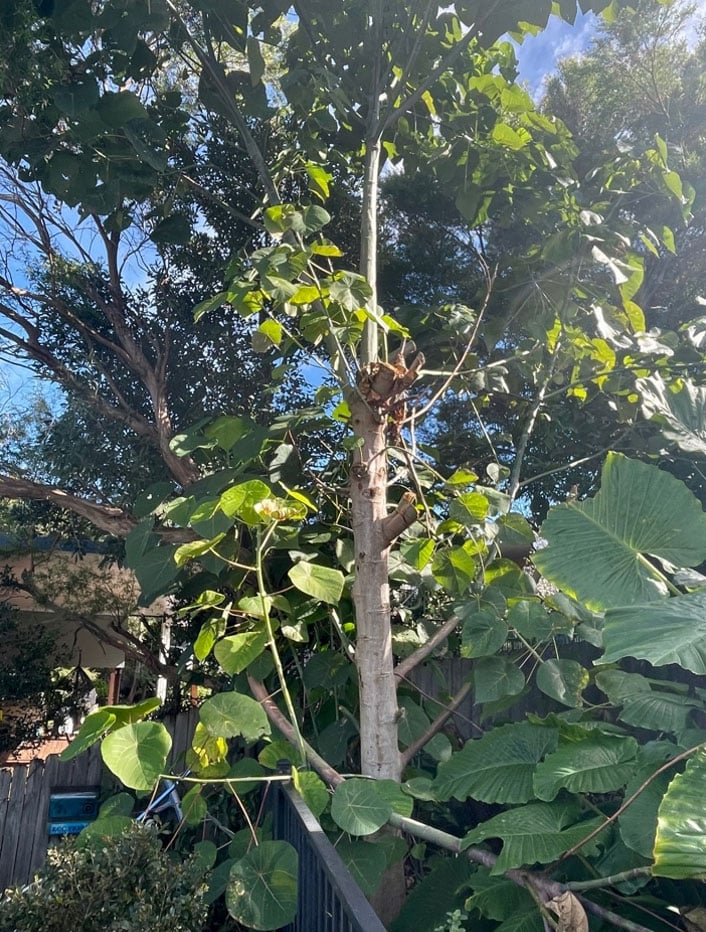
Different species
The two trees do have some similarities as both Hibiscus tiiaceus and Macaranga tanarius have large, soft, heart-shaped leaves, and both are a similar shade of green.
‘However the similarities stop there,’ explain Lennox Head Landcare.
‘The growth habit of suckering and subsequent formation of impenetrable masses which inhibit the growth of other plants beneath them is not unusual for Hibiscus tiliaceus when slashed, as happens in some places during regular maintenance of roadsides and paths by Council’s own crews. In addition, Hibiscus tileaceus often grows in wet swampy areas where other species don’t survive. It dies back with age and is naturally replaced with other native species when conditions suit.
‘Macaranga tanarius, on the other hand, invariably forms a single trunk which, if chopped, simply grows a new trunk and subsequently branches from a point above the cut.’
While Lennox Head Landcare have said they are not seeking to reverse BSCs decision they have chosen to ‘express our disappointment with the lack of fact checking prior to decision-making and thus the precedent being set in this instance’.
If you are interested in this issue or getting involved in Lennox Head Landcare you can contact them via email: [email protected].
 For four decades The Echo has printed the stories some people loved, some people hated, and some pretended not to read. If you want us to keep telling the truth, the real truth, not the sugar-coated version. We’ll need your support to keep the presses rolling.


