


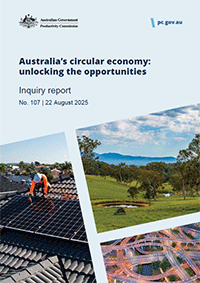
On Friday last week, the Productivity Commission’s (PC) final report on the circular economy was released, which outlines Australia’s ‘opportunities to lift materials productivity and reduce waste’.
Circular economies are those based on the reuse and regeneration of materials or products, especially as a means of continuing production in a sustainable or environmentally-friendly way.
The report will be tabled in federal parliament shortly, says the PC.
Yet the official media release was unfortunately lacking in any real content or meaningful reform.
It spoke of priorities and opportunities, and gave vague advice ‘on how best to measure progress and address key barriers’.
It’s a well-known fact that China rejected imported Australian waste in 2018, and after eight years, Australia still has limited recycling capacity.
While the authors say ‘overall progress has been slow’, on a positive note, it reads, ‘all levels of government have recently increased focus on policies that foster circular practices and reduce materials use’.
For example, actions already underway include reducing regulatory barriers to prefabricated housing, recognising the carbon benefits of biomethane in Australia’s carbon reporting system, and increasing transparency in business sustainability through mandatory climate-related financial disclosures’.
Yet localisation expert, Helena Norberg-Hodge, raised this as a red flag, saying it ‘favours large-scale industrial production and will help to destroy smaller local businesses that are using healthier materials, adapting designs to place, etc’.
Recommendations
The report identifies three areas for improving the circular economy: 1) streamlining and harmonising regulations to encourage businesses to adopt innovative technologies and practices, while protecting the environment and human health; 2) strengthening obligations for businesses that supply products with high-risk or high-value waste streams, such as small electronics or small-scale solar photovoltaic systems, through product stewardship promoting circular activities; and 3) ‘innovation through programs and services that facilitate coordination, collaboration and capacity building’.
Is this the language of an agency that has a clear idea of improving outcomes, or is it just paying lip service to the existing paradigm?
To be fair, on page 105, there is a ‘strategic reform approach’ which relates to the sectors of built environment, food, mining, electronics and textiles. This relates ‘more generally to rights to repair, packaging and plastics, and infrastructure investment evaluation’.
Yet when it comes to specifics, the PC report seems to fall short. The authors speak of undefined ‘outcomes frameworks’ and ‘economic, social and environmental goals’.
A big clue into why very little is happening in the circular economy space was highlighted on page 107: ‘The Australian, state and territory governments should implement the full suite of recommendations from the PC’s Right to Repair inquiry. The Australian government should publish a formal response to that inquiry that indicates a time line and work plan for implementing these reforms’.
The report also touches on packaging regulation, managing emerging chemicals of concern, and undertaking infrastructure investment evaluation.

Place-based initiatives needed
Helena Norberg-Hodge adds, ‘State and territory governments should facilitate place-based initiatives by providing guidance and resources, such as templates, to assist local governments developing circular economy plans. They should also fund a pilot for circular economy transition brokers’.
‘These brokers would help build the circular economy knowledge and capability of local governments and small to medium sized organisations in ways that are tailored to their context, and help them navigate government processes, such as regulatory approvals.
‘Transition brokers would work in partnership with Aboriginal and Torres Strait Islander people to embed valuable knowledge in place-based circular economy practices and support Aboriginal and Torres Strait Islander people and businesses to lead circular economy activities.
‘In regions that are expected to experience mine closures, state and territory governments should develop land transition plans that identify the mined land, infrastructure and residues that will become available as mines close and how they can best be used. They should develop these land transition plans, well prior to the point of closure, in partnership with Aboriginal and Torres Strait Islander people and local communities.
‘But on the other hand, it’s clear that this is coming from a toxic, trade-based, industrial framework which is far removed from simpler, genuinely ecological and sustainable ways of doing things which would be available to us at much lower costs if we could just start from a clear-headed approach-one that was free from assumptions about GDP, etc’, Norberg-Hodge adds.
See more at www.pc.gov.au/inquiries-and-research/circular-economy/report.
 For four decades The Echo has printed the stories some people loved, some people hated, and some pretended not to read. If you want us to keep telling the truth, the real truth, not the sugar-coated version. We’ll need your support to keep the presses rolling.


