


A “Community Conversation” session on Byron Shire Council’s Operational Plan, Budget and financial plans will be hosted tonight (online only) from 5pm–7pm.
Some of the measures being considered include a Special Rate Variation (SRV), which would see a accumulative increase of 35.03% to “improve the financial sustainability of Council by reducing the operating deficit in the General Fund”.
Council also propose to increase water access charges and usage charges by 10%, while increasing sewerage charges by 3.80%.
Council says the following documents are all on public exhibition until 31 May 2026:
- Draft 2026 to 2027 Operational Plan
- Draft 2026 to 2027 Budget
- Draft 2026 to 2027 Statement of Revenue Policy including Fees and Charges
- Draft 2026 to 2036 Long Term Financial Plan
The following is an explanation by Council regarding the documents:
What is the Operational Plan and Budget?
The Draft Operational Plan sets out the program of work Council plans to deliver in the coming financial year.
The Budget demonstrates how this will be financed.
The Operational Plan progresses the four-year Delivery Program and the 10-year Byron Shire Community Strategic Plan 2035.
What is the Long-Term Financial Plan?
The Long Term Financial Plan is a 10-year rolling plan that informs decision-making.
It forms part of the Resourcing Strategy and provides information about the resources needed to implement the strategies in the Community Strategic Plan.
The Long Plan helps to test long term community aspirations against financial realities.
The Long Term Financial Plan (LTFP) must be used to inform the decision making during the finalisation of the Community Strategic Plan and the development of the Delivery Program.
What’s in the 2026-27 Operational Plan?
There are 372 activities proposed for the financial year grouped under the five Community Strategic Plan community objectives.
Within each objective, the Operational Plan is structured according to the Delivery Plan priorities.
Each Operational Plan activity is coded, and details included about the activity, completion statement, due date, and responsible unit. Links to relevant Council Resolutions and the Disability Inclusion Action Plan are also referenced.
There is a new Delivery Program Priority included at 1.4.4 “Work Health and Safety – Enhance a Safety First culture to support and ensure physical and psychosocial safety for all workers”
This emphasises our focus on safety culture.
This amendment to the Delivery Program can be included without it being re-exhibited as it is not considered significant. It does not alter the adopted strategic direction, outcomes or resourcing of the Delivery Program. Instead, it strengthens and clarifies our existing commitment.
What’s in the 2026-27 Budget?
The Budget uses the following parameters:
Rate peg increase of 4.6% as announced by the Independent Pricing and Regulatory Tribunal (IPART).
Provision for the 3.5% Award increase from the first full pay period after 1 July 2026 under the Local Government (State) Award for Council staff. The Award is still to be finalised as it expires on 30 June 2026. Allowance for Superannuation Guarantee at 12.00%.
New external loan borrowings of $2,400,000 for replacement of Causeway 7&8 on Upper Wilsons Creek Road, $3,102,000 improvements for First Sun Holiday Park $2,035,500 and Suffolk Beachfront Holiday Park $2,835,200.
Reflective of actions contained in this Operational Plan. As an overall summary,
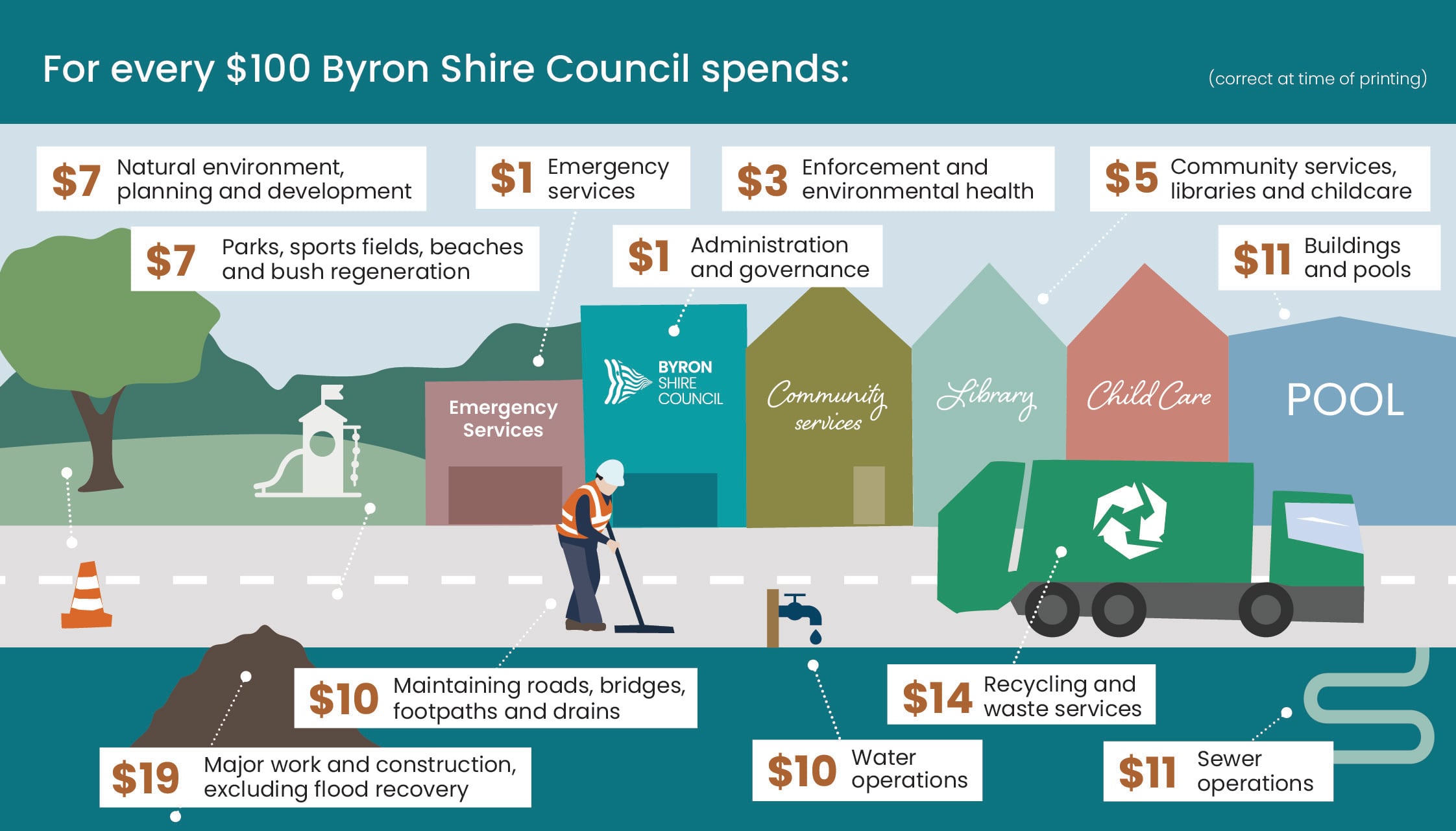
Council’s total 2026/2027 Budget is $241,229,000 made up as follows:
Operating expenditure (excluding depreciation) $109,296,300
Depreciation expense $25,811,600
Capital works $102,652,600
Debt repayment (loan principal) $3,468,500
Excluding depreciation expense, the total spend of Council for 2026/2027 is estimated at $215,417,400.
On a Consolidated All Funds basis, Council is expecting an overall budget surplus in 2026/2027 of $66,220,000 and an operating budget deficit of $2,428,300
What’s in the 2026-27 Statement of Revenue Policy (Fees and Charges)?
Draft General Land Rates and Charges: The Draft 2026/27 Revenue Policy includes the proposed general land rating structure.
The rating structure incorporates the approved rate peg of 4.60% determined by the Independent Pricing and Regulatory Tribunal (IPART) for Byron Shire Council representing the standard rate peg of 3.00% plus Emergency Services Levy factor 0.10% less an Election Cost Adjustment -0.10% and plus a population increase factor of 1.60%. It also incorporates new land values provided by the Valuer General of NSW with a 2025 base date for the purposes of determining general land rates.
Proposed increases in charges in the 2026/27 Revenue Policy include:
Waste Charges – increase of 5.7% to 5.9%
Water access charges and usage charges increasing by 10.0%
Sewerage charge – increased by 3.80%.
The stormwater charge has not increased. It is a regulated charge that has not changed over the last twenty years.
Draft Fees: Changes in cost are set out in the Draft 2026/27 Fees and Charges. Among those changes, some significant proposed changes include:
Continuation of not imposing a merchant service surcharge for payments made to Council using debit or credit cards. This is also to be consistent with determination from the Reserve Bank of Australia to abolish the imposition of these charges at point of sale from October 2026.
For Children’s Services, the annual levy fee per child is to increase from $250 to $450 to assist with operational costs including excursions, incursions and consumables.
Cemetery fees are prosed to increase in line with inflation, except for burial surcharges on a weekend or public holiday from $332 to $688 per hour with a minimum charge of four hours.
A change in the methodology for certain charges at the Resource Recovery Centre to reflect charges per 100kg of waste as opposed to the previous methodology of per tonne. The aim is to make this more understandable to customers given not many bring in tonnes of waste.
Former Section 355 Committee Managed Facility Fees now under the administration of Council have had further refinements for consistency across different facilities. This has seen some fees increase and others decrease.
There is an indicative fee disclosed for bulk headworks connection fee for Rous County Council but this fee will be amended to whatever fee Rous County Council proposes to charge given Council only acts as an agent in the collection of this fee.
Significant increases at face value for market activities on Council land with a restructure of the pricing to improve the equity in pricing on a per stall basis. Whilst there are price increases per day of up to 79.91% for a 301 + stall market, this equates to a cost of $3.84 per stall opposed to the current fee of $2.13 per stall. There are other increases depending upon the size of the market in terms of stalls ranging from 37.50% to 79.91%.
Reduction in fees of 30.58% for applications for air space and footpath usage.
Increase in fees for annual food business administration of up to 46.25%.
What’s in the 2026-2036 Long-Term Financial Plan?
The Plan presents Council’s financial projections incorporating the General, Water and Sewerage Funds, with particular emphasis on the General Fund.
The Plan includes both a base case projection and an alternative scenario based on the assumptions outlined within the document.
It also incorporates key performance indicator (KPI) trend analysis aligned to the indicators historically reported in Council’s annual financial statements.
The scenarios contained in the Long Term Financial Plan are:
Base Case – Existing Council operations and current levels of service
Scenario 1 – Base Case + additional funding via a Special Rate Variation to:
Improve the financial sustainability of Council by reducing the operating deficit in the General Fund.
Support climate change adaptation by funding the renewal, construction and maintenance of infrastructure required to respond to or mitigate the impacts of climate-related events. This may include funding loan repayments for projects, as well as restoration and betterment works for infrastructure damaged by natural disasters where Disaster Recovery Funding Arrangements (DRFA) approval is not available.
Enhance business resilience by supporting the implementation of new systems, including information technology solutions, and undertaking facility improvements that improve organisational efficiency and business operations.
Strengthen infrastructure maintenance and renewal, with a particular focus on stormwater drainage assets and transport assets, including roads, bridges, footpaths and cycleways.
The Special Rate Variation scenario is based on an application under Section 508(A) of the Local Government Act 1993 for a three-year rolling rate increase indicated to commence on 1 July 2027 as a permanent addition to Council’s rate income.
The indicative Special Rate Variation includes a proposed overall increase from 2027/28 to 2029/30 financial years of 31.60% inclusive of rate peg for an accumulative increase of 35.03%.
These documents form part of our Integrated Planning and Reporting Framework.
https://yoursay.byron.nsw.gov.au/OP
 For four decades The Echo has printed the stories some people loved, some people hated, and some pretended not to read. If you want us to keep telling the truth, the real truth, not the sugar-coated version. We’ll need your support to keep the presses rolling.


