


More than nine months after fire damaged Bangalow’s Byron Creek Bridge, Byron Shire Council has yet to choose a repair design that would allow heavier vehicles to use the crossing again.
Council said in June that repairs were planned for late 2026. But a report to tomorrow’s Transport and Infrastructure Advisory Committee meeting (October 29) says three repair options are still being assessed.
The report gives no final cost or construction start date.
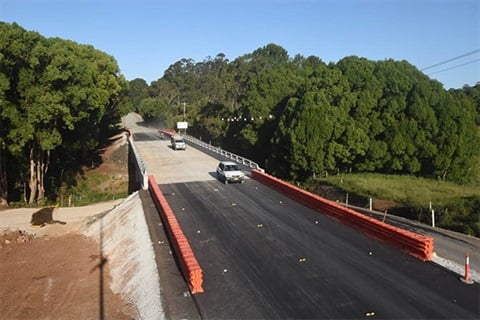
The bridge carries Bangalow Road over Byron Creek, east of the township. Built in 2020, it was damaged by a fire beneath its eastern span on January 9.
It reopened in February with a 6.5-tonne load limit. That was increased to 24 tonnes in June after structural testing, allowing larger school buses to return.

‘However, we will still need to repair the bridge so that heavier vehicles can use it again,’ council’s infrastructure director Phil Holloway said at the time.
An August assessment by engineering consultant Alderson Associates supports the existing 24-tonne limit, but says strengthening is needed before it can be increased.
‘Further load rating increases are not possible without strengthening of the bridge structure,’ the assessment states.
Testing found a 12 per cent reduction in the breaking strength of a damaged steel strand used to strengthen the concrete. The strand also broke in a brittle manner.
The consultant identified a long-term risk of deterioration where protective concrete had been lost, and recommended repairs within six to twelve months.
The three options involve strengthening the bridge with post-tensioned concrete, reinforced concrete or structural steel.
The consultant favours post-tensioned concrete for its durability, but describes the options as ‘very preliminary in nature’.
The work would involve removing damaged concrete around steel strands held under high tension, making the repair difficult to cost before further design work.
Council engineers have sought advice from three construction companies on costs and how each option could be built.
All three have provided written feedback. Council engineers and the consultant must review those responses before choosing a preferred option and moving to preliminary design.
 For four decades The Echo has printed the stories some people loved, some people hated, and some pretended not to read. If you want us to keep telling the truth, the real truth, not the sugar-coated version. We’ll need your support to keep the presses rolling.