


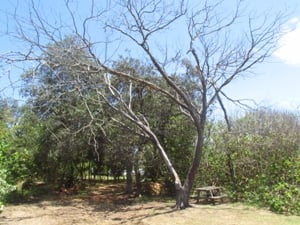
A popular rest spot overlooking the river at Brunswick Heads is undergoing a facelift to improve safety and amenity.
Some locals were recently shocked to see two old, but dead, casuarina trees next to a bench and picnic table adjacent to Torakina Park chopped down by contractors.
The dead trees were deemed dangerous and a safety risk, but were not fenced off before contractors cut them down.
Fears the picnic area, also used by the local surf club for sausage sizzles, would remain without some shade have been allayed by NSW Crown Lands which controls the land behind Brunswick Heads beach.
A spokesman for Crown Lands told Echonetdaily that replacement and more appropriate local native species of trees will soon be planted there.
The spokesman said Crown Lands agreed with Byron Shire Council that the removal of the trees was ‘essential to ensure public safety as both trees were in close proximity to the walking track with picnic tables and seats located under the trees’.
The spokesman said the removal of the trees accorded with relevant legislation.
‘Crown Lands will select and source local native species and replant in early 2015,’ the spokesman said.
Echonetdaily came under fire two weeks ago for publicising the issue, with critics saying the trees were dead and inappropriate species for the dunal area and common sense prevailed, as the dead trees had posed danger to thousands of holiday makers.
Two other dead casuarina trees remain, which also need to be cut down, with overgrown bush covering another old wooden picnic table which cannot be used as a result.
One local said the Echonetdaily ‘beat up’ had lead to a halt to the removal of two other dead trees, including ‘one of the most deadly trees remaining intact: I hope a child doesn’t get killed from a falling branch this summer’.
Brunswick Heads local Stephen Booth, an environmental consultant, said the species in question, Horesetail SheOak (Casuarina equisetifolia) were most likely planted in the mid to late 1960s ‘post sand mining or river mouth re-configuration’.
‘The land is probably reclaimed, not natural,’ Mr Booth told Echonetdaily.
‘Casuarina equisetifolia is an Australian native but not endemic to this site, its natural habitat on the northern NSW coastline being rocky cliffs,’ he said.
‘The tree is a poor landscaping/shade tree, due to it beingrelatively short lived (20-50 years). Its crown has thin leaves and its nettles are salty and acidic and very few plants will tolerate growing underneath it. The timber is very hard, and good firewood.
‘Unfortunately the hardness of the timber means that when trodden on in bare feet, in a beach setting for example, injury is certain to occur.
‘Once dead, the weight and strength of the timber makes it highly dangerous to humans when branches fall, branches being like spears.
‘This species was planted extensively across the Byron Shire coastline post sand mining some 50 years ago, and now having reached the end of their lifespan, the greater majority of those plants are dying.
‘Agencies responsible for the land they inhabit have been cutting those dead trees down for over a decade along the Byron coastline.
‘There are many tree species that could be planted in replacement, however Casuarina equisetifolia is highly unsuitable,’ Mr Booth said.

 For four decades The Echo has printed the stories some people loved, some people hated, and some pretended not to read. If you want us to keep telling the truth, the real truth, not the sugar-coated version. We’ll need your support to keep the presses rolling.


