


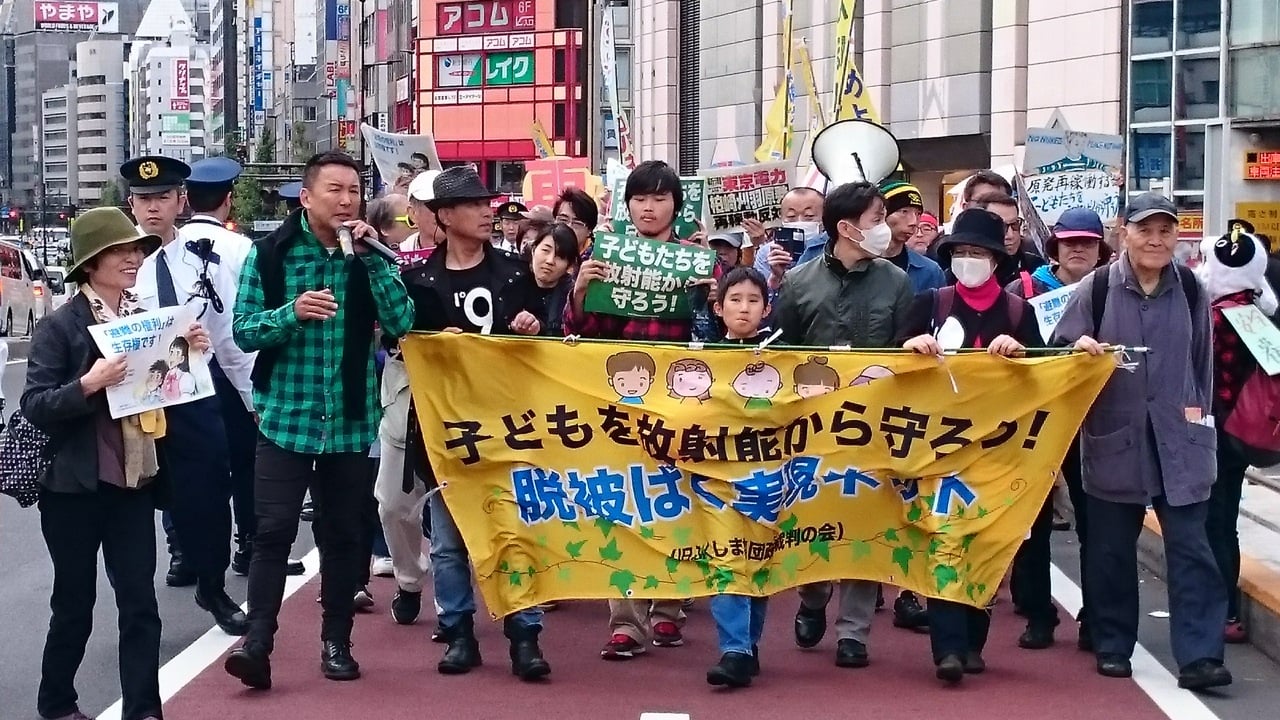
High-profile Japanese activist Toshiko Okada will be speaking at the Channon Market from 12pm Sunday March 11 to mark the seventh anniversary of the Fukushima nuclear disaster.
Okada’s speech in the Rainbow Chai Tent will be followed by a march around the market, and will include music and art.
Local Japanese activist and actress Saya Minami interviewed Okada, and they spoke about introducing a Chernobyl-type law in Japan – and the rest of the world – to protect people from the risks of radiation.
Where were you when the Japanese tsunami hit the coast?
I was at home in Saitama prefecture, about 250km away from Fukushima; I was watching TV and saw the houses and cars being washed away. I was screaming “Please run away quickly!”. My family home is near the ocean in Fukushima so I was very worried about my family. But they were okay. After that the Fukushima power plant exploded and my sister and relatives were evacuated to another prefecture, but the government said it’s safe so they went back after a few weeks.
How did you get involved in this work?
After the Fukushima nuclear accident, I heard that the organisation suing to save the children of Fukushima from the risks of radiation had lost a case, so I wanted to help them. I joined as a volunteer. Currently I am supporting their second trial, networking with radiation victims and taking action to help Fukushima children exposed to radiation.
What are the aims of the Citizens’ Network for Evacuation from Radiation?
The aim is to connect with citizens’ groups and individuals to achieve a society that is free from radiation exposure.
Tell us about the monthly demonstrations in Tokyo.
We protest in front of Shinjuku Station in Tokyo. We speak the truth about Fukushima and call attention to the fact that Kanto district – which includes Tokyo – is also contaminated with radiation, which the mainstream media won’t report. We criticise the current government’s scary policy, which prioritises the economy over people’s lives.
We also protest at the front of the office of the prime minister once a month, against the government’s policy of abandoning the people of Fukushima.
Is it easy to raise issues of nuclear safety and radiation in Japan?
It’s not difficult to bring up the issue, but the Japanese government says that it’s already safe. They say ‘let’s eat Fukushima food, let’s go to Fukushima.’ People think we are spreading a false rumour, which makes it hard for us.
The majority of Japanese people, including the people of Fukushima, are mostly silent, as they might be confused or not interested. That’s the biggest problem.
Why is it important to have a Japanese version of a Chernobyl Law?
The public radiation exposure safety limit was 1mSv before the Fukushima nuclear accident, but after the accident, the Japanese government increased the safety limit to 20mSv only for Fukushima people, and they do decontamination and say it’s safe. There are 54 nuclear power plants in Japan. We don’t know when we will have another accident like Fukushima. That’s the problem. We have to leave a safe environment for our next generation.
Tell us about politician Taro Yamamoto and his role in the anti-nuclear movement.
Most politicians never mention the risks of radiation exposure. Taro Yamamoto is one of the few politicians who raises the issue of radiation exposure and wants an inquiry in the parliament. He is the voice of the people and the best colleague.
What do you hope to achieve with this visit to Australia?
I hope to get support for our action to introduce the Japanese version of Chernobyl law and I hope to tell the truth about Fukushima to the world.
I also hope this law to protect people from radiation disaster will be adopted by the Australian government, to protect Aboriginal people or other people who live with the potential exposure to radiation near uranium mines, nuclear waste dump sites etc.
I hope this law will spread to the world and protect all the people who suffer from radiation disaster worldwide.
I believe that’s what we should do for the next generation.
I believe that this action would also add pressure on the Japanese government, which doesn’t think people’s lives are important.
And it would save the people of Fukushima as well.
 For four decades The Echo has printed the stories some people loved, some people hated, and some pretended not to read. If you want us to keep telling the truth, the real truth, not the sugar-coated version. We’ll need your support to keep the presses rolling.


