


Richard Hil
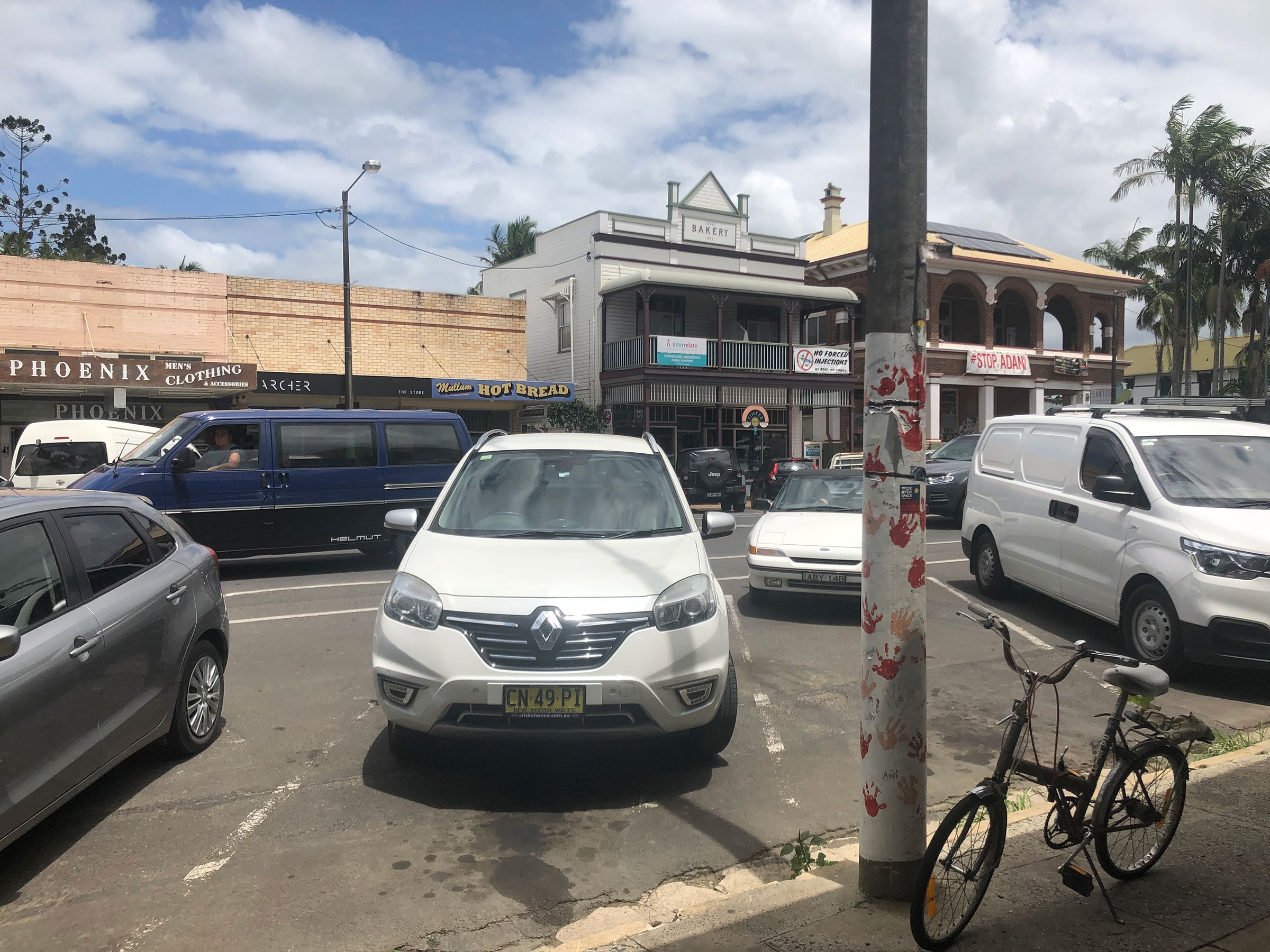
It was a fatal error – driving half a kilometre into Mullumbimby to pick up a carton of milk. My partner drove while I conducted reconnaissance for that elusive parking spot.
Jenn: ‘There! – no, no, that’s for disabled’.
Me: ‘What about there? Look!’.
Jenn: ‘No, no, that’s for loading’.
Me: ‘Christ! What about there? Quick! I think that bloke’s trying to muscle in! The f***** – he has!’.
Jenn: ‘Calm down’.
Me: ‘Don’t tell me to calm down!’.
And so it went on: round and round the potholed streets of downtown Mullum. Every parking spot was taken. A convoy of frustrated drivers snaked behind us, craning their necks, left and right. ‘Oh, sod it’, I say, ‘let’s just go to Woolies’.
We sped off in the self-flagellating knowledge that we’d added to the traffic congestion and pollution levels. We also berated ourselves – quite rightly – for not walking into town. Lazy sods! Inexcusable!
The fact is it’s impossible these days to just ‘duck into town’ any old time for a sourdough – at least not by car. It’s chockers during week days, with growing clusters of 4WDs, open top coupes and what look like military Hummers clogging the byways. Cyclists are a rarity as are folk on electric scooters and mopeds. During daylight hours, and sometimes at night, downtown Mullum is as congested as any inner-city suburb. It’s noisy and occasionally dangerous. Drivers seem increasingly ill-tempered.
Most people complain about this in private. Some old timers bemoan the days when the occasional beaten-up Toyota carrying a Jesus lookalike would trundle down the main street with every prospect of angled parking. These days you need to get up before dawn for such simple pleasures. My mate Gregory tells me that when he used to saunter through Mullum in the early 70s ‘you could fire a missile down the main street and it might hit a couple of parrots’. Nowadays you’d wipe out a fleet of vehicles and umpteen pedestrians.
But is it really that bad? Well, yes; it really is. Now that Byron has been turned into Santa Monica on steroids, made worse by a so-called ‘bypass’ which is no bypass at all, Mullum and surrounds have become the new epicentres of tourist interest, amply serviced by dozens of cafes, restaurants, and boutique clothing stores. It’s Fitzroy in the bush, the only difference being the fading presence of ‘alternative culture’. The Indigenous presence, although resonant and very much alive, has been visibly overlaid with a faux rainbow agrarianism and legions of superannuated ex-inner-city dwellers in search of nirvana. Those who managed to buy up proprieties twenty years ago are doing just dandy, while the precariat can only stand by and hope (usually in vain) for that ‘affordable’ home.

Meanwhile, the ever-expanding Tallowood estate on the outskirts of Mullum has ensured that its several hundred residents (and rising) are obliged to make their way to town by car. And once there, they’ll likely rub shoulders with countless Airbnb-ers who have driven long distances only to encounter what they experience at home: congestion.
I first became aware of this self-defeating phenomenon in the pretty but horribly overrun town of Berry, a few hours south of Sydney. This lovely enclave full of dainty weatherboards and prissy cafes festooned with hanging baskets attracts thousands of visitors each year who flock there in search of an aesthetic experience denied to them in city suburbs.
Here’s an obvious point: why can’t people make the places they live in look just like Berry, then they wouldn’t need to invade such towns? Sadly, Australia’s reputation for drab architecture and ticky-tacky subdivisions that pass for domiciliary bliss means that nice is always somewhere else. Modern housing estates might be called The Haven, Bliss Vale, Oakville, Sunnyside – whatever – but many of these suburban gulags are bereft of any hint of simple beauty. Farmers sell off the land, developers move in, and the rest is history.
Now I know what you’re thinking: what a snob! Alright for the superannuated self-involved to sound off about suburban aesthetics! And you’d be right, of course. But then again, shouldn’t all people be entitled, not simply to a roof over their heads, but to some sort of spiritual nourishment that comes with places that are pleasing to the eye? Or is that too much to ask? Cars, car parks, and drab housing tend to work against such things. They take rather than give.
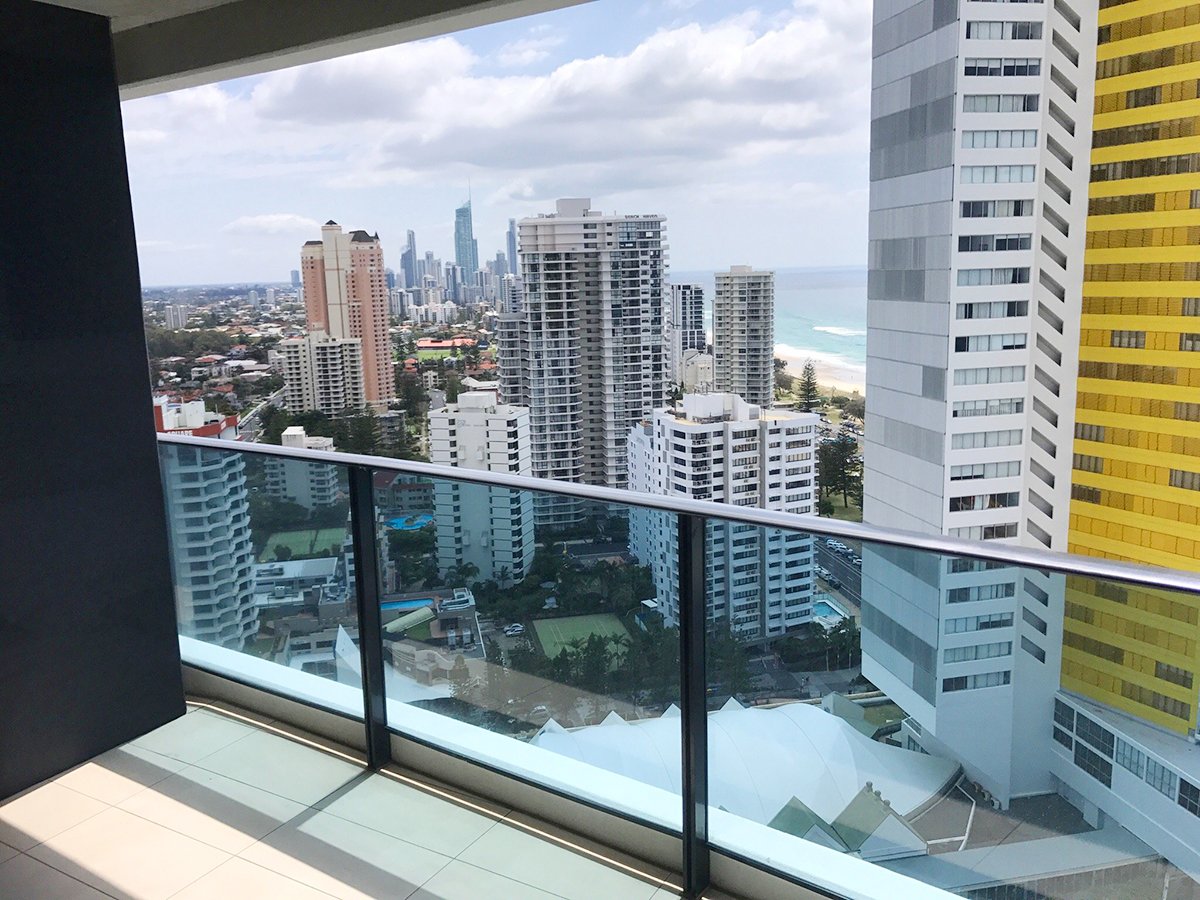
What’s worse? Well, you might take a closer look at the Gold Coast where houses have become walled fortresses with their residents invariably hunched over computers or huddled in hermetically sealed media rooms. This is part of the great migration indoors, where relationships are increasingly mediated by screens. Cars are an extension of this atomised culture that gazes at the world through a pixilated prism. Just think how these metallic carriages wreck communities, drive kids off the streets, endanger, and pollute. We let it happen at our peril. Is it happening in Mullum? I reckon.
Maybe we should be looking at Barcelona where city authorities have managed to reclaim inner urban streets by banning/discouraging cars in favour of cycle-friendly pedestrian areas. In these ‘superblocks’ community life, the social vibe, have returned – gloriously. So, Byron Shire Council, yes to ‘green corridors’ but let’s do something about those metallic, polluting carriages.
 For four decades The Echo has printed the stories some people loved, some people hated, and some pretended not to read. If you want us to keep telling the truth, the real truth, not the sugar-coated version. We’ll need your support to keep the presses rolling.


