


Wren McLean
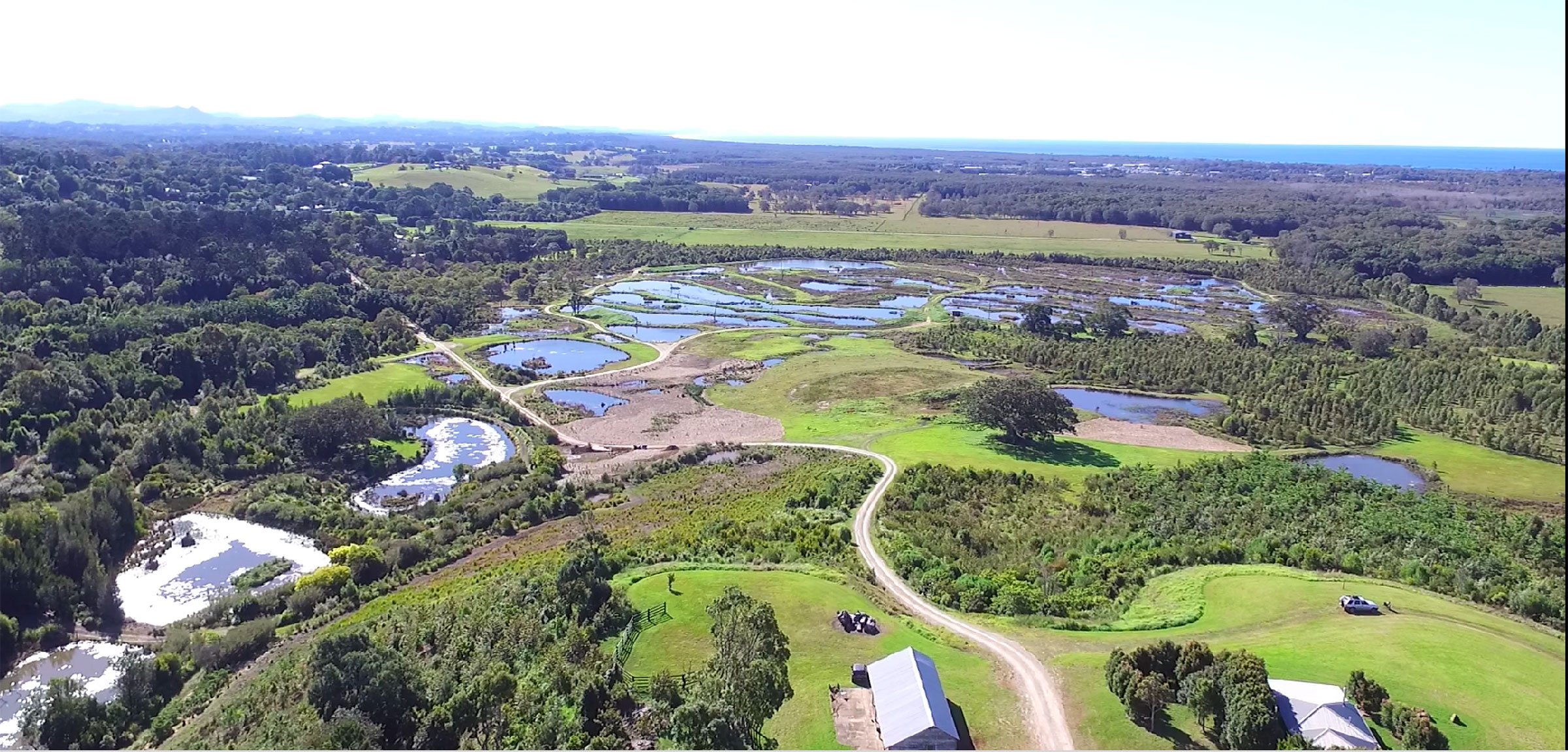
Many curious minds have pondered the purpose of the rice paddy-like waterbodies that scallop the contour lines out into the Ewingsdale coastal plain that can be viewed from St Helena Road. This privately-owned 30ha constructed wetland’s primary purpose is to provide habitat for rare and endangered birds. The majesty of these birds, and indeed the greater natural world, inspired a deep passion in the late Tony Maxwell, who whole-heartedly applied himself to do all he could to provide for them.
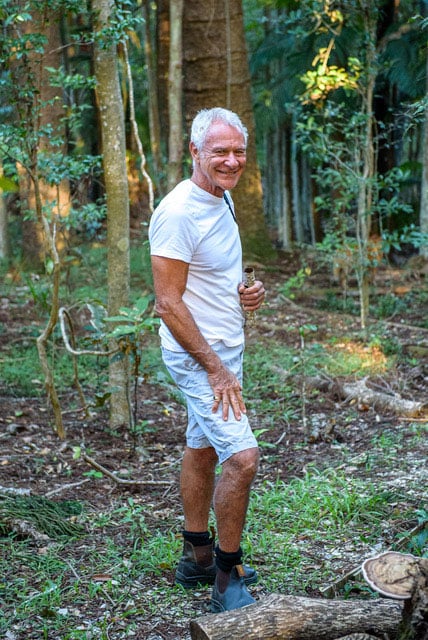
Humble, wise, and generous Tony set his mind on re-wilding what once would have been a flooded melaleuca wetland. The initial brief for the Seapeace wetland project, which back in 2016 was a low-lying cattle pasture, was to create habitat for the black-necked stork. Surface water was retained on site to drown pasture grasses and a diversity of wetland flora were reintroduced.
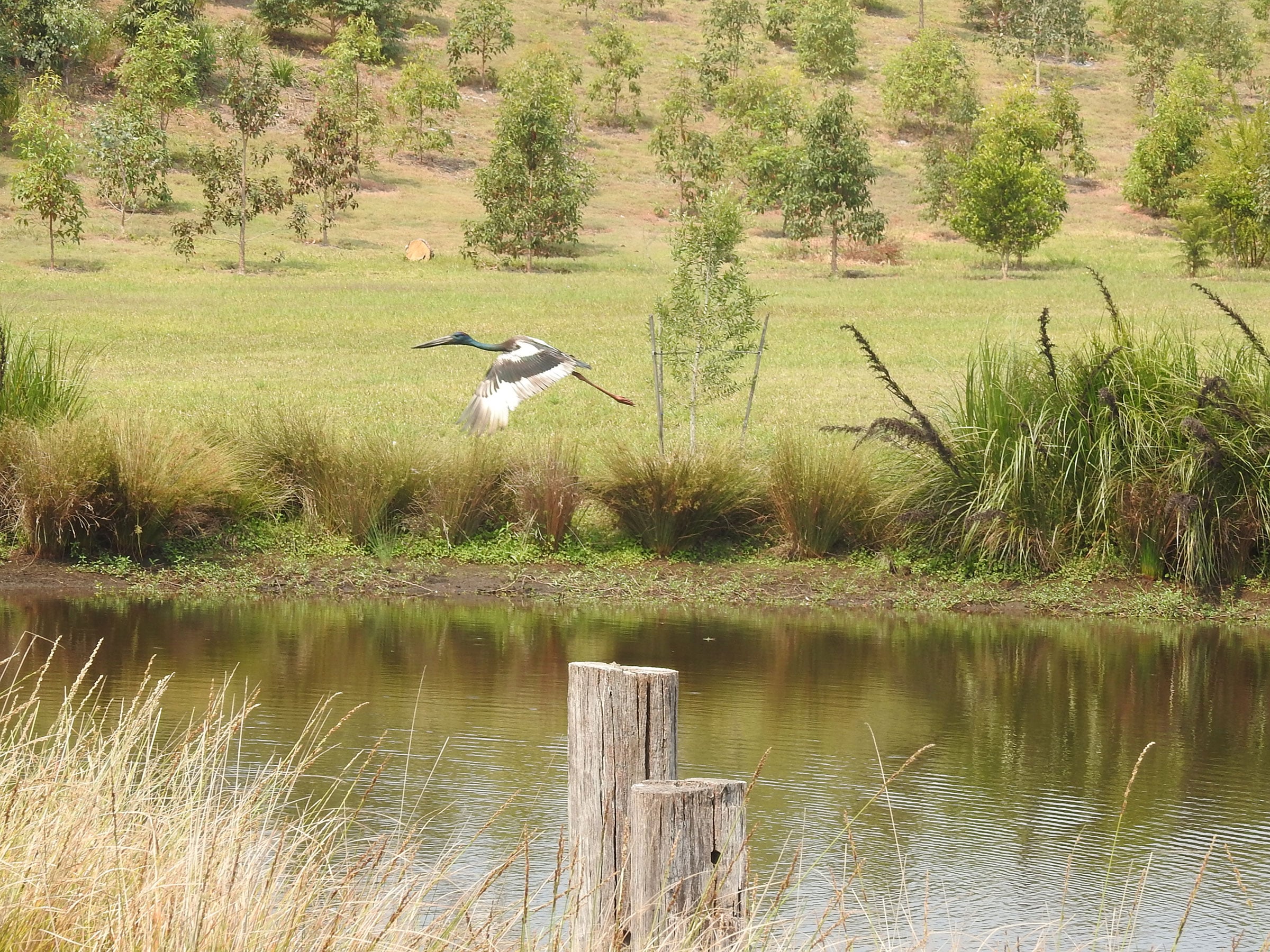
Then in June 2017, during a Byron Bird Buddies survey, we witnessed the remarkable sight of two black-necked storks gliding in and making themselves at home.
Through his vision and tenacity, Tony pulled together and funded a team of specialists to manage the many facets of this undertaking. This included the creation of ephemeral waterbodies that expose mudflats for migratory waders, the erection of stags with nesting hollows and nesting platforms, the enrichment of fish habitat with submerged ledges, snags, rock caves and floating islands, the addition of perches and snags. Specific vegetation communities were designed to support species such as the eastern grass owl, eastern ground parrot, cotton pygmy goose, painted snipe and Australasian bittern to name a few.
‘As a conservation scientist and ornithologist, I have spent days walking and monitoring the Seapeace wetlands,’ remarked Professor James Watson, of the University of Queensland.
‘Tony’s vision was remarkable. Already we are seeing the wetland come to life, and from talking with others it is inspiring a lot more people to restore their own bits of habitat’.

Passion for nature
The original Seapeace property was purchased by the Maxwell family in 2006, and they have since planted over 100,000 trees and shrubs. These include an international botanical collection of over 4,000 rare and endangered plants, from Australia and throughout the world. Inclusive of the newer wetland holding, Seapeace now covers 127.89 hectares and the site represents many local vegetation types from subtropical dry and notophyll vine forest to hoop pine forest, lowland melaleuca wetlands, dry sclerophyll forest and coastal heath. Habitat has also been provided for rare invertebrates and for mammals; with koala food tree plantings and deployment of 60 artificial hollows.
‘Tony’s fascination and passion for the natural world was ignited in his early childhood,’ his partner, Robyn Godlee explains.
‘His desire and action to support, restore, and conserve the natural world was an ongoing passion throughout his life, both via private projects and philanthropy. Tony was endlessly excited by the possibilities of what could be achieved at Seapeace in a relatively short time period.
‘We, as Tony’s family, miss his intelligence, tenacity, passion, humour, and love, but are grateful he has left us with a rich vision and philosophy. We have equal motivation and commitment to pursue environmental objectives locally and globally. Our wish is that Tony’s personal commitment will inspire and motivate others to value and respect our natural capital.’

Inspiring others
Seasonal bird surveys have been conducted at Seapeace by Byron Bird Buddies since 2016. Combined records confirm at least 182 bird species have been sighted on Seapeace. These wetlands are complementary habitat for many wetland dependent species that also utilise the Byron Sewage Treatment Plant (STP) wetlands.
‘The work that Tony has undertaken at Seapeace has created a ripple effect inspiring other landholders to consider what they can do on their own properties around wetland and habitat restoration,’ says Australian Wetlands Consultant, Damian McCann.
‘Of course, not everyone can carry out works at the same scale, but recreating wetlands and forests doesn’t need to expensive, it can be incremental.’
Seapeace is now a botanical ark and a gem of ecological diversity in close proximity to the development areas of Byron Bay.
‘This was all made possible by Tony’s vision, which from the start of his tenure was to create a wildlife and nature sanctuary. He sustained this vision with continual financial input over a very long establishment period. Its value to the biodiversity of Byron Shire is immense,’ said Seapeace’s original site manager, Harry Moult.
Many of these fauna species are highly sensitive to disturbance and the exponential success of this project will count on minimising human access and keeping the place quiet.
‘Until we have reached a point where native vegetation is dominating the system, the work here will continue. The site will be protected in perpetuity and Tony’s legacy will live on,’ says wetland project manager Tony Kenway.
 For four decades The Echo has printed the stories some people loved, some people hated, and some pretended not to read. If you want us to keep telling the truth, the real truth, not the sugar-coated version. We’ll need your support to keep the presses rolling.


