



In the hills just outside of Mullumbimby a vital, but oft forgotten piece of the town’s history, is quietly celebrating its 100th birthday.
Officially opened on March 6, 1926 the Mullumbimby hydroelectric power station now lies dormant and almost completely untouched on land off Wilsons Creek Road.
For decades, this remarkable piece of infrastructure formed the backbone of the region’s electricity supply, keeping the lights on in Mullum, Byron, Bangalow and other local towns.
Third scheme in Australia
‘At the time it was just the third municipal hydroelectric scheme in Australia,’ Susan Tsicalas from the Brunswick Valley Historical Society told The Echo last week.
‘When they put it in, it was because it was the cheaper option out of wood and coal,’ Ms Tsicalas said. ‘It was designed by William Corin, who also worked on plans for the Snowy Mountains Hydroelectric Scheme.’
The idea for the project dates back to 1909, when land along Wilsons Creek at Lavertys Gap was reserved to develop a water supply for Mullumbimby.
Local councillor W. E. Selwood, who later became Mullumbimby’s Mayor, proposed that the water scheme could also be used to generate electricity.
In 1923, the Mullumbimby Municipal Council engaged Corin to design a hydro-electric power project that would harness the flow of Wilsons Creek.
Construction began in 1924, with water from the creek diverted through a race and tunnel and then carried down a pipeline to a power station located further downhill.
From there, it drove Pelton turbines that generated electricity.
Electric lights powered by the scheme were first switched on in December 1925, and the station officially commenced operation on 6 March, 1926.
Having initially powered Mullumbimby unassisted, the plant was later supplemented with power from diesel generators during periods of low water flow.
The system was gradually expanded, and by the late 1950s the station’s combined hydro and diesel generating capacity had increased to roughly 3.15 megawatts.
The facility was also connected to the wider electricity grid in 1938, allowing it to operate as part of a broader regional power network. ‘It was an important piece of local infrastructure,’ Ms Tsicalas said.
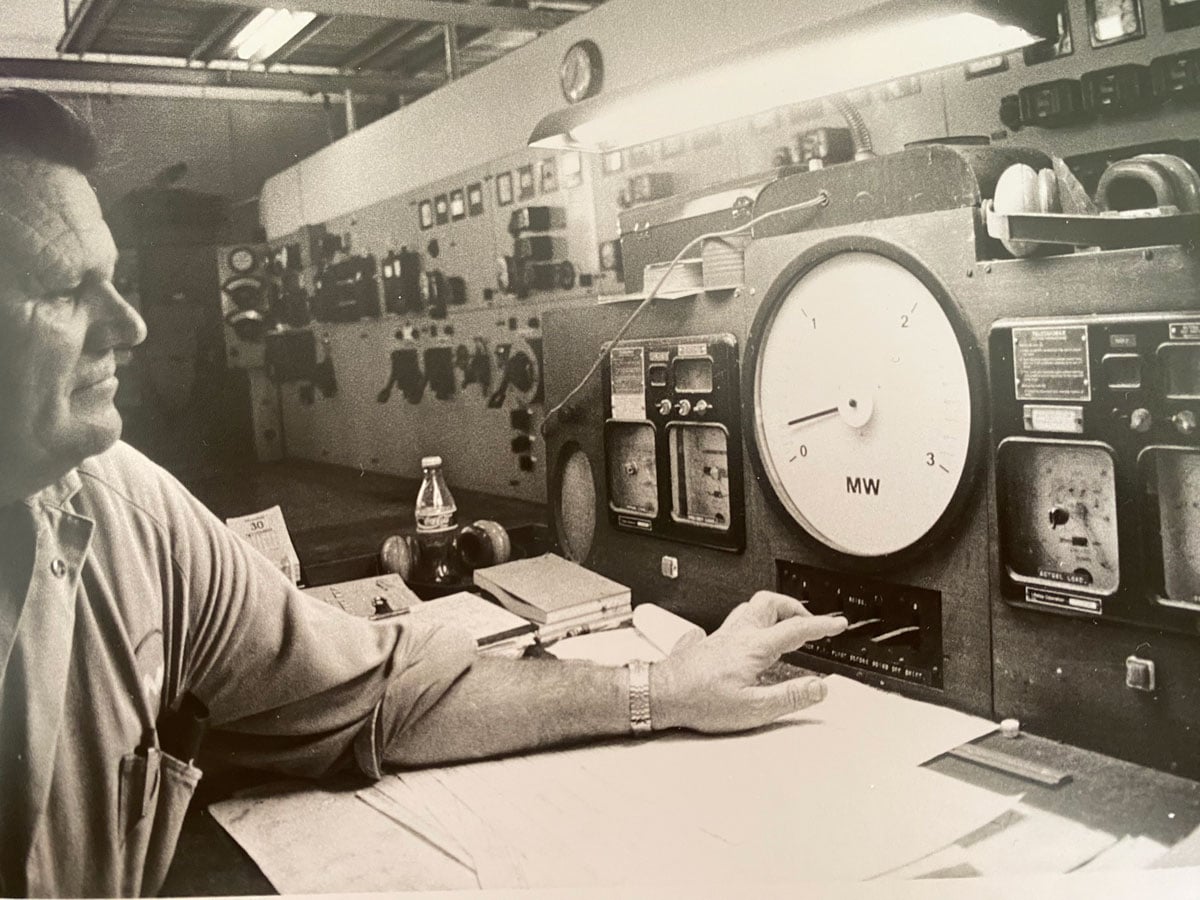
Source of income
‘The Mullumbimby Municipal Council ran it and it was the Council’s main source of income because the other council’s had to pay a fee for the right to use the power.’
But as the decades passed it became increasingly clear that the power station simply wasn’t keeping up with demand.
‘There wasn’t enough water moving through the Wilsons River to generate the power needed as the grid expanded to accommodate growth,’ Ms Tsicalas said.
Heritage listing
Hydroelectric generation largely ceased during the 1960s, and the station was eventually decommissioned in 1990. Despite ongoing discussions about returning the station to active use as a source of sustainable and renewable energy, the facility is now essentially a historical artefact.
A heritage listing put in place in 2014 means that it cannot be demolished or significantly changed. But the owners – Essential Energy and Byron Council – forbid anyone from going beyond the large metal gates and fencing which surround the facility.
‘Robyn Gray and Ray Musgrave managed to get it heritage listed, but you can’t go and bloody see it!’ Ms Tsicalas said.
‘We’re told that there are community safety issues – asbestos etc. I understand that. But what’s the point of it being state heritage listed if you can’t go and see it?
‘I’d like to see it being opened up a couple of times a year under controlled circumstances and with the proper maintenance. You could have bus trips a couple of times a year. There’s a couple of guys who worked there who are still around who could guide the tours.’
But for now, at least, the gates of the old power station remained closed, leaving this grand old relic to sit in silence the world continues to power along all around.
 For four decades The Echo has printed the stories some people loved, some people hated, and some pretended not to read. If you want us to keep telling the truth, the real truth, not the sugar-coated version. We’ll need your support to keep the presses rolling.


