


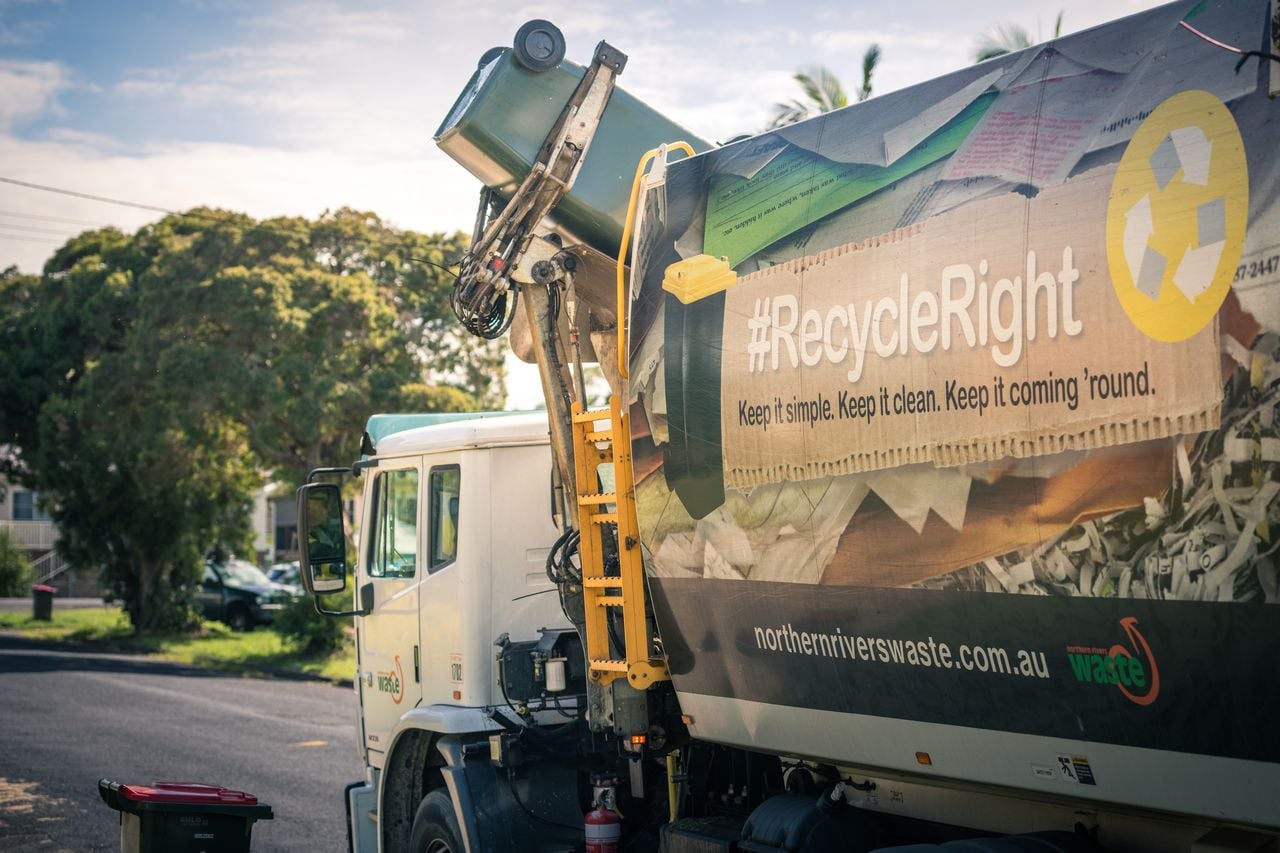
Lismore City Council says Lismore households recently threw away an estimated $670,000 by placing eligible drink containers in their kerbside bins instead of claiming their refund, while almost half the contents of red-lid general waste bins could have been recycled or composted.
Council’s 2026 Kerbside Domestic Waste Audit found residents are performing exceptionally well in separating organic waste, with a 96 per cent compliance rate in green-lid Food Organics and Garden Organics (FOGO) bins and 81 per cent compliance in yellow-lid recycling bins.
However, it also revealed that 43 per cent of material placed in general waste bins could have been diverted from landfill through existing FOGO and recycling services.
Conducted by APC Waste Consultants in May 2026, the audit involved kerbside collections of the general waste, recycling and FOGO bins of 316 randomly selected urban and rural households, with 5,577 kilograms of material being sorted and analysed at the Lismore Resource & Recovery Centre.
Two stories
Lismore City Council Director for Water, Waste and Open Spaces Matt Potter said the audit assessed overall waste trends, while identifying areas for further education and improvement.
‘This audit tells us two stories,’ Mr Potter said. ‘Lismore residents are showing they know how to recycle and compost, with outstanding FOGO results and strong recycling compliance. At the same time, we’re still sending too much to landfill.

‘Nearly half the material found in general waste bins could have been recovered, and households assessed as part of this audit have collectively thrown away around $670,000 by not claiming container refunds.’
With the NSW Waste and Sustainable Materials Strategy setting a target of an 80 per cent recovery rate for all waste streams by 2030, Lismore’s audit shows strong recycling and composting habits, with room to significantly reduce landfill by keeping recyclable and compostable materials out of general waste bins.
‘We’re still seeing a lot of food waste ending up in landfill where it breaks down without oxygen, producing methane, a greenhouse gas that’s about 26 times more powerful than carbon dioxide,’ Mr Potter said.
Contaminants
The recycling bins showed a solid level of compliance overall, but bagged and boxed recyclables and incorrectly sorted materials proved to be the main contaminants. Key contaminants included E-waste and lithium batteries in landfill, along with treated timbers in FOGO bins.
‘We are seeing dangerous and hazardous materials showing up in the wrong places, even though it’s a small proportion of the overall waste stream it can have a big impact,’ Mr Potter said.
‘In March this year, a fire broke out in the comingled recycling stockpile, believed to have been caused by a battery, highlighting the ongoing risk posed by batteries being placed in kerbside bins.’
Lismore City Council Manager Capital and Strategic Works Michael Magalhaes said treated timbers can contain harmful chemicals like copper, chromium and arsenic.
‘Small amounts of treated timber can go in general waste and larger quantities should be taken to the Lismore Facility or Nimbin Transfer Station, while e-waste, lithium batteries and vapes should be taken to designated drop-off points at major retailers or the Lismore Recovery & Recycling Centre for free recycling,”’ Mr Magalhaes said.
‘The more we use our recovery streams by putting the right materials in the right bins, the longer we can extend the life of our landfill space.’
 For four decades The Echo has printed the stories some people loved, some people hated, and some pretended not to read. If you want us to keep telling the truth, the real truth, not the sugar-coated version. We’ll need your support to keep the presses rolling.


