



Giles Parkinson, RenewEconomy
Mark down this date: Monday, July 16, 1945 – the day that the first atomic bomb was detonated in the New Mexico desert.
It is also the geological marker of the start of the ‘Great Acceleration’ – when mad-made activities began to take over from natural variability with such force that it has taken the human race just one generation to pretty much ‘stuff the planet’.
Welcome to the Anthropocene.
Such geological epochs are normally measured in the thousands of years, but scientists have been able to narrow it down the switch from the Holocene to the Anthropocene to a single day because the radioactive isotopes emitted to the atmosphere and spread worldwide by that detonation have entered the sedimentary record. That has provided a unique signal.
Since then, humanity has altered the planet to such a degree (well, nearly 0.85C in fact) that Earth’s natural systems have been pushed beyond natural variability and now risk being destabilised – all in a single lifetime.
As James Dyke, lecturer in Complex Systems Simulation at University of Southampton, writes for The Conversation: ‘We are sowing the seeds of havoc on the Earth, it suggests, and the time is fast approaching when we will reap this harvest’.
Already, the damage done by economic growth unchecked by environmental considerations over the past six and seven decades could potentially force a complete change in the state of the planet, which may render it a whole lot less hospitable for future generations.
International scientists released two papers on Friday, published in the magazine Scientist, that suggests that the planet has already been disrupted.
The first paper identifies nine planetary processes that are indicators of the health of Earth, and regulate the stability and resilience of the planet.
In four of these, the boundaries have already been crossed – the loss of biodiversity through an unprecedented rate of species extinction, and the overuse of fertilizers such as phosphorus and nitrogen already put those markets in the ‘red zone’.
Climate change and deforestation are not far behind. It means the risk of sliding into a ‘much less hospitable’ world becomes high for current and future generations.
Australian scientist Will Steffen has also led research in the creation of a ‘dashboard’ that document the ‘Great Acceleration’ in human activity since the 1950s. And it concludes that the main driver is the global economic system.
The first of these (below in blue) are environmental indicators, the second (in orange) is in social and economic indicators. The rate of change since 1950 has accelerated dramatically in nearly all of them.
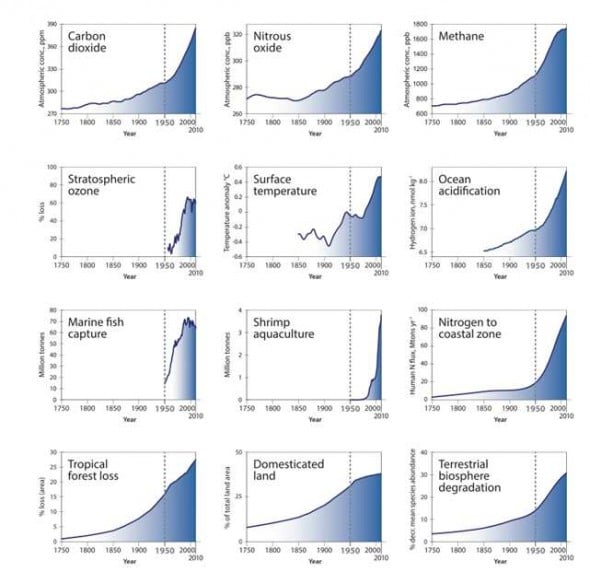
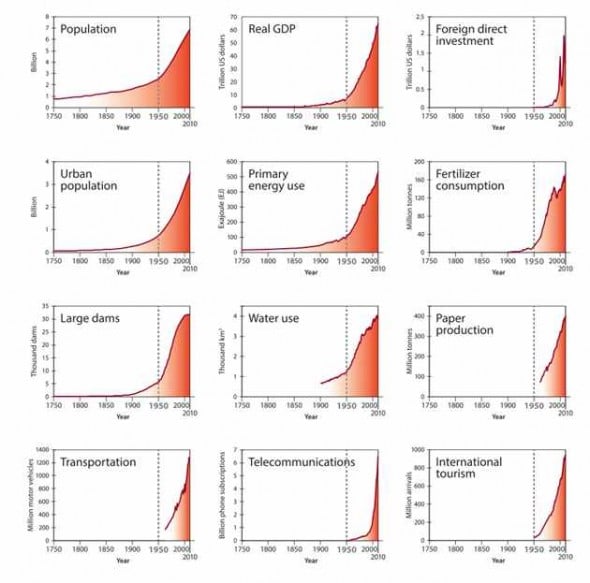 Given this, can we maintain our current standards of living and avoid calamity? Steffen says yes. ‘I am optimistic about this,’ he says.
He notes there was doom and gloom about abolition of slavery, which some said would ruin global economies even though slavery was clearly morally and ethically wrong. It didn’t.
But economies did not fall into a heap, and neither will they if the use of fossil fuels is wound down.
Steffen says there is growing confidence that things can be done differently, and rampant economic growth can be disconnected from rises in greenhouse gases – this will happen with the growing adoption of clean energy, and the electrification of transport.
And scientists know that more people can be fed with less phosphorous and nitrogen.
Steffen says the climate talks in Paris this year will be crucial to address how many of these issues are addressed, particularly in relating to climate.
And he says his graphs point to the issue of equity – the developed nations with just 18 per cent of the population account for 70 per cent of the economic growth most of the changes documented in his dashboard.
China is now the biggest emitter and other emerging countries are catching up first.
This has prompted some Australian fossil fuel companies such as Origin Energy, to suggest that responsibility should be redefined along lines of emissions per unit of GDP – a measure that favours developed countries such as Australia, and penalizes developing countries.
‘What it does say is that we cannot solve these issues without dealing with the equity issue,’ Steffen says. We cannot sweep it under the carpet.’
And Steffen says that despite talk of ‘geo-engineering’ as a way of reversing rises in average global warming, the ocean acidification means that levels of CO2 need to be addressed and cannot be ducked. Acidification increases as levels of carbon.
‘Have we stuffed the planet yet? Not entirely,’ Steffen says. ‘But there is a very high risk we will in coming decades if we don’t change direction.’
 For four decades The Echo has printed the stories some people loved, some people hated, and some pretended not to read. If you want us to keep telling the truth, the real truth, not the sugar-coated version. We’ll need your support to keep the presses rolling.


