


Harsha Prabhu
Every morning on my walk to the beach to partake of my ritual swim I have to run the gauntlet of a smouldering heap of burning rubbish.
Today’s pile included plastic waste, a plastic soccer ball, plastic bottles and all kinds of plastic packaging.
Today I could even smell the burning plastic while swimming in the sea. And I trod on plastic bags near the water’s edge.
The waste is generated by the row of beach-side restaurants and cabins that line most of Arambol – a consequence of the tourism boom.
I have spoken to the men who burn the waste, informing them that burning plastic releases all kinds of carcinogenic chemicals into the atmosphere, chemicals they can’t see but that will nonetheless poison them, leading to all kinds of health issues down the years.
But they have expressed their helplessness. Arambol – like the rest of Goa – has a rudimentary garbage collection and waste disposal system. Some items – glass bottles, aluminium cans, cardboard – are collected by freelance garbage collectors and trucked to a holding centre. Most of the rubbish ends as landfill, like the one on the road between Siolim and Mapusa, which announces its presence a kilometre before you come upon it. Plastic rubbish bags, their contents strewn open, litter the road leading up to the dump.
However, plastic on the beaches in Goa and elsewhere is just the last link in a toxic chain that starts with fossil fuel extraction. Plastic is but a derivative of the fossil fuel industry, an industry that today holds the health of the planet in hostage.
The fossil fuel cabal includes companies like Adani. This company has already fowled the Gujarat coast via runoff from its factories and power plants. It’s now set to foul the World Heritage-listed Great Barrier Reef in Australia, via the Abbot Point coal terminal, one of the largest coal projects in the southern hemisphere.
Adani’s environmental vandalism is encouraged via sweet deals from both the Indian and Australian governments.
Adani’s spectacular rise was facilitated by the BJP government of Narendra Modi, when he was chief minister of Gujarat, with public land being sold to Adani’s companies for a song.
And Adani has returned the favour by being one of the main backers of the Hindu fundamentalist government of Modi and the BJP that rules India today.
Fundamentalism and corporate capitalism make for a marriage of convenience, with the earth and her natural resources as the dowry.
Indeed, global capital has embedded itself in all governments and political parties the world over.
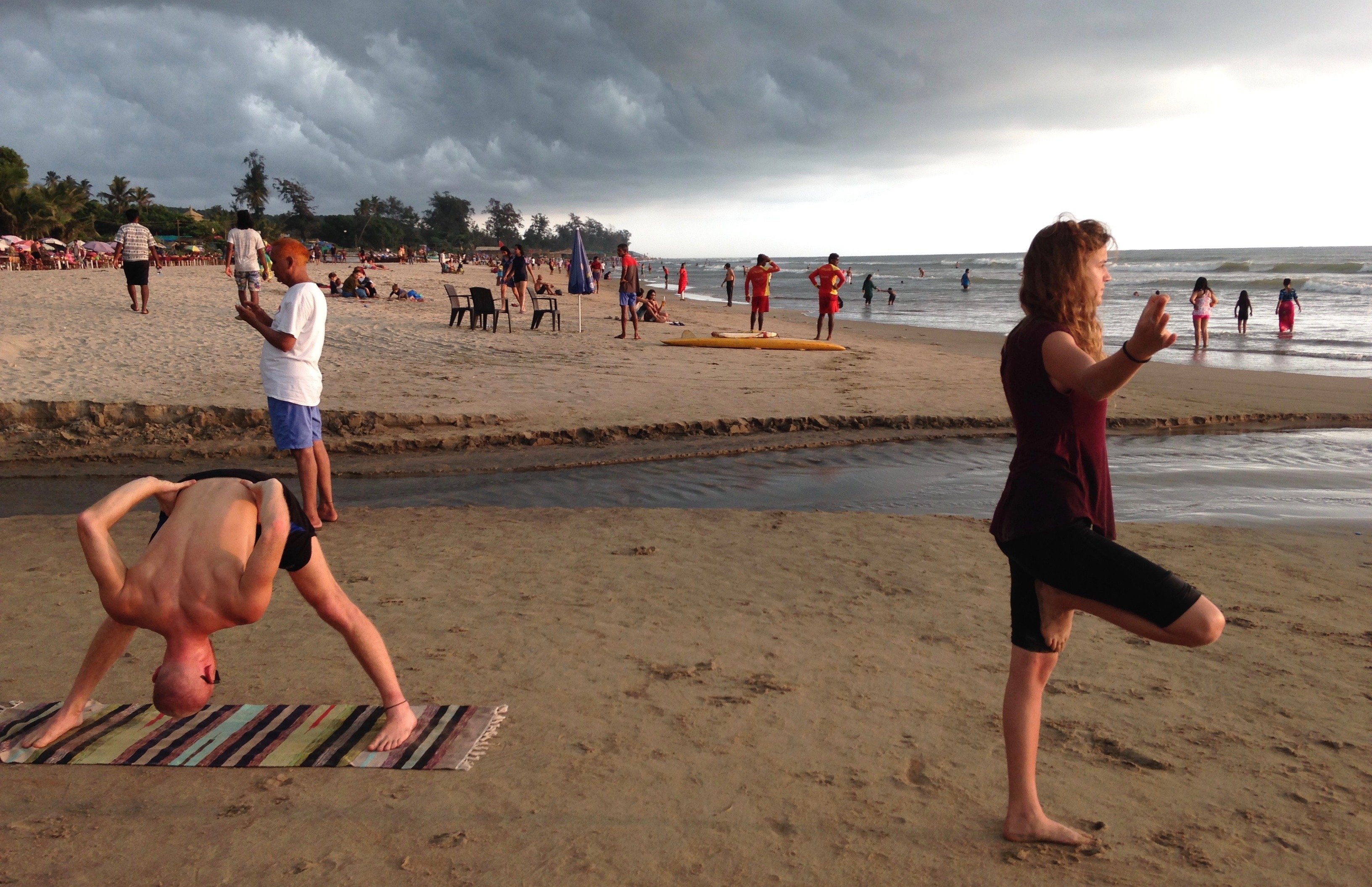
Meanwhile, the good burgers of Arambol – including the hundreds of local and foreign visitors (of whom I am one) – go about their biz of earning a living and/or searching for bliss, seemingly blissfully unmindful of the plastic burning under their noses as they go to the market to buy provisions, or skin their coconuts and cook their fish curry, or go to the office, or head for a swim, or do the downward dog.

Arambol is Yoga Central; workshops of every persuasion abound. You can get your chakras tuned, your kundalini raised, attend a cacao ceremony or at least have the eye of the goddess tattooed on your derrière. (One visitor from Oz said Arambol reminded her of Byron Bay). There’s even an Osho lookalike who walks the beach at evening in a white gown and cap.
There’s a drum circle on the beach at sunset, along with a small flea market; world music ensembles play music in the cafes; there are cutting-edge ballet troupes.
It’s hard to maintain any kind of perspective while dancing ecstatically, or sipping on a mojito on any given night, watching the lights of the Arambol coastline shining wantonly like jewels in the dark – a situation not helped by the bevy of beautiful women of every description and nationality who seem to have congregated here for the season.
And men. There’s even a nascent men’s circle to compliment the explosion of feminine energy blossoming on the beaches and love temples of Arambol.
But the ‘Arambubble’ is fragile: most visitors are birds of passage, flying where their money lasts longest. Some, like the Russians, for whom Goa has been a cheap and popular destination, have had to contend with falling exchange rates, leading to a fall in their numbers. The empty tables in the beachside cafes belie the glitter at night. Most locals complain that this season has been a bad one. So do the Banjara women from neighbouring Karnataka, their dark bodies swooping down on sunbathing touros, touting their costume jewellery and sarongs to a diminishing pool of customers. According to the local press, tourists are choosing to visit elsewhere, like Vietnam.
Low tourist numbers notwithstanding, Arambol is still a happening place. However, amidst all the season’s Dionysian mayhem and consciousness raising, it’s easy to forget that Goa is also the headquarters of the Sanathan Sanstha, a Hindu fundamentalist group accused of masterminding the assassination of intellectuals and bomb plots against popular cultural festivals in Goa.
And, while Hindu right-wing terrorists and their sponsors run free, the government goes after human rights advocates and Dalit scholars, ostensibly for being left wing.
And it’s easy to forget the fact that, at the behest of the mining lobby, both the BJP state government and many opposition MPs want to resume mining in Goa, a biz-as-usual policy barely held in check by fragile court judgements at the prompting of local environmental activists.
How to square up the search for inner fulfilment and meaning and the desire to live a simple life with the reality of religious fundamentalism and terrorism, rapacious resource extraction and its baby, burning plastic on the beaches?
Or have we abdicated from paradise, preferring to dance and sing, as Goa – along with much of the rest of the world – drowns in a whirlpool of poisonous plastic and toxic ideas, generated by corporate-driven fascism?
 For four decades The Echo has printed the stories some people loved, some people hated, and some pretended not to read. If you want us to keep telling the truth, the real truth, not the sugar-coated version. We’ll need your support to keep the presses rolling.


