



Should Council reopen blocked and diverted creeks and ocean outlets in the Shire’s north to alleviate future flooding events?
That’s the push by Jan Mangleson, from the Ocean Shores Community Association (OSCA) as well as other residents who contacted The Echo. The recent flooding impacts could have been less, they claim, if the waters could drain to the sea via ocean in/outlets that were blocked in the 1970s.
In the lead up to the second flooding event on March 27, Mrs Mangleson pleaded with Council to open the Capricornia Canal to ease flooding.
She wrote, ‘OSCA endorses the community lived experience over decades that the reintroduction of the overflow would lower flood levels at north and south Ocean Shores, South Golden Beach, New Brighton and Billinudgel’.
She says the ocean flood overflow was constructed by the developers of Ocean Shores in 1973, ‘as part of the development consent for the canal and the town’.
‘Before constructing the permanent flood overflow, the developers, Princess Properties, cut a temporary slot through the dunes where, historically, floodwaters flowed to the ocean in major flood events and this was open between 1973–76 during the major floods of 1974’.
‘Because this temporary outlet cut a sand mining road used by local fishermen, Council ordered Princess Properties to block the outlet and reconstruct the sand mining road on 22/6/1976, but the developers warned Council they would be liable if the closure raised flood levels.
‘At the 27/7/1976 meeting, Council voted to accept the liability for the increase in flood height and the developers closed the outlet’.
Mrs Mangleson says, ‘Many locals are angry that the Capricornia Canal flood overflow was not opened before the February 28, 2022, flood disaster, which has caused so much destruction to homes.
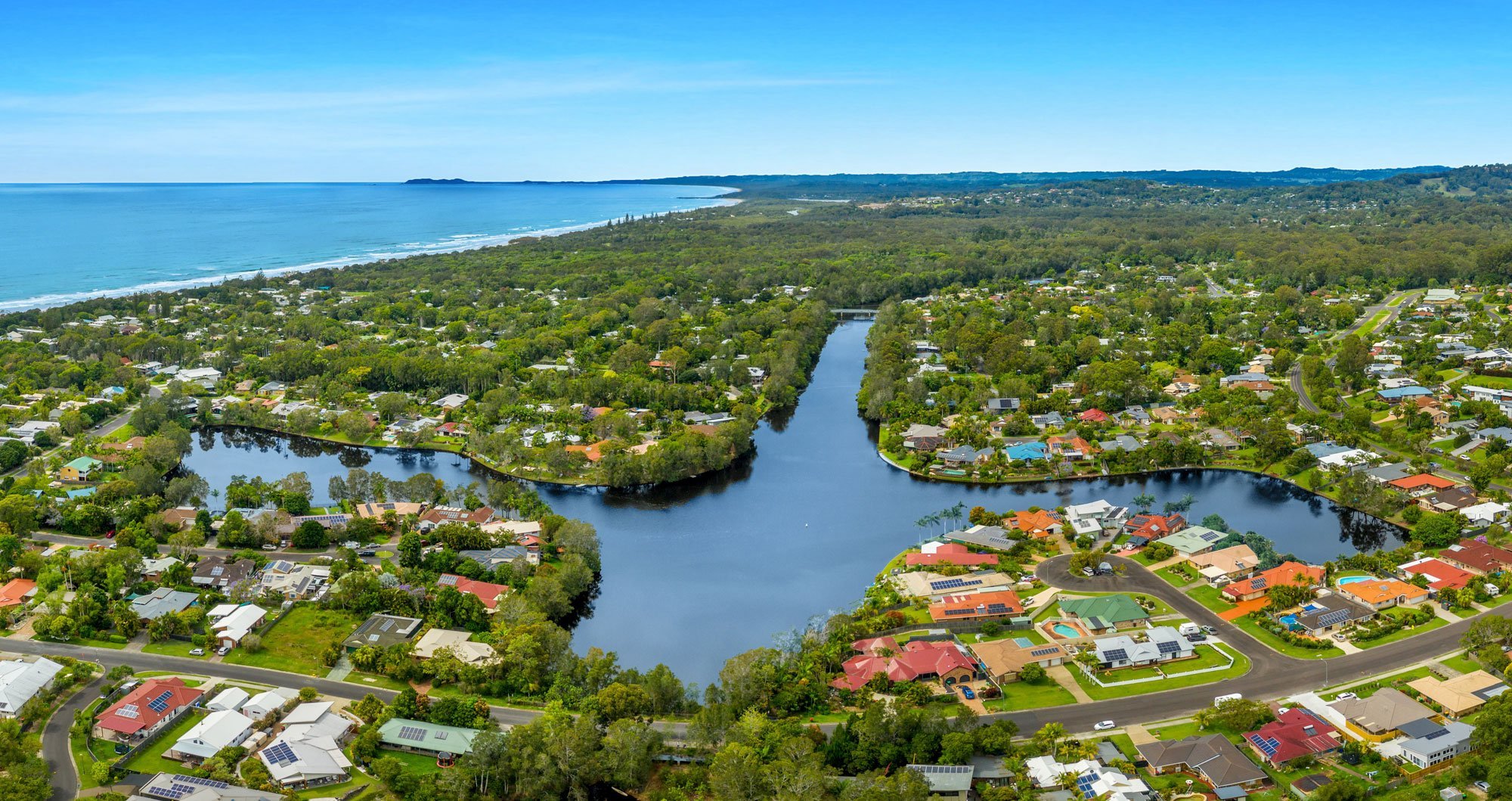
‘Newcomers to the area had no idea of the extent of flooding in the area. A huge 400 metre long rock-wall constructed in the 1960s at the entrance of Marshalls Creek to the Brunswick River has prevented the outflow of floodwaters for more than fifty years, and has caused a buildup of siltation in the river.
‘A 30m gap exists for waters to enter the Brunswick River’.
So what do the experts say about reopening coastal creeks to lessen the impacts of heavy weather events?
Coastal engineer and former General Manager of Pittwater Council, Angus Gordon, is familiar with the region’s long history when it comes to coastal management.
Mr Gordon has been involved in Byron Shire’s coastal management for decades, having written papers and advised successive governments and councils generally on coastal management.
Historical summary
He told The Echo, ‘To the best of my recollection, the statement by Jan Mangleson is substantially correct, and a reasonable historical summary’.
‘I actually do have a good recollection of what happened, because I was asked about the “slot”, or more correctly the “fuse plug” through the dunes.
‘This was at the time the area was about to be developed, and flooding was a potential major impediment.
‘There was significant political pressure to enable the flood prone land to be developed (might have had something to do with a singing/owner, [Pat Boone], and his influence).
‘Initially, Public Works advised against the entire development, as it was fairly obvious that flooding in the area would be a problem.
‘I recall an early drawing showing the canal systems (and development) stretching further south to link up to the creek but the scheme was only partially built.
‘The compromise solution was to build the canals, but then to connect them to the ocean by a “slot” through the dunes, which would be kept closed, except during floods, so as to prevent oceanic over wash inundating the development.
‘I recall my comment at the time was that it wouldn’t work, because the likely dune recovery was such that it would be an ongoing management issue to keep the slot low enough, and small enough that it could be easily broken out to release the flood (hence the term “fuse plug”).
‘However, my recollection is that Council took little interest, or possibly didn’t understand the importance of this flood relief mechanism. Nor I guess, were they in a position to fund the ongoing maintenance the developers had saddled them with.
‘Apart for anything else, one problem with opening a “slot” through the dunes to relieve floods is to be sure that ocean levels aren’t as high, because in my experience, opening up such a “slot” can often promote oceanic flooding back into the developed area.
‘I do recall raising this at the time as being a potential issue, but I don’t recall it ever being studied.
‘In summary, the area of South Golden Beach should probably have never been allowed to be developed, because it is too low, and the only practical way to manage flood waters is down the creek to Brunswick Heads.
Flooding problem ‘insoluble’

‘The problem being that ocean levels with tides, wave set-up and storm surge, are likely to back-up floodwaters anyway, and certainly pose a risk if a “slot” is cut through the dunes.
‘Further, while I don’t think the Council actually understands the history or the limitations of the design, they also probably realise (from the North Byron Floodplain Risk-Management Study and Plan) that the flooding problem is insoluble anyway, as there just isn’t the hydraulic gradient to get the flood waters out under certain conditions.
‘So, the best answer is to elevate the houses where possible… they were originally meant to be de-mountable, and so should be easy to raise… but unfortunately, memories are short, and people, and councils, do “funny” things that result in “wicked” issues.
‘A study could determine whether or not opening a “slot” to the ocean would be advantageous, or the opposite, depending on oceanic water levels during storms, and at least the community and Council would better understand the problem… particularly with climate change and rising ocean levels.
‘Frankly, I suspect an education program for all might be a good starting point… as I said, it should never have been developed in the first place, I am afraid.
‘So, while OSCA is substantially correct in their historical analysis, I am not convinced they realise what the actual situation is.
‘I recently was engaged by Central Coast Council to deal with community angst regarding flooding of dwellings and properties around Tuggerah Lake. The community was blaming Council for not maintaining the entrance, and allowing it to close.
‘It was a relatively simple matter to demonstrate that the flooding they were experiencing was largely owing to the oceanic water levels during storms, and that they were being back-flooded by the sea.
‘So, council’s inefficiency at maintaining the entrance, had the unintended outcome of reducing peak flood heights!
‘State governments have, over the years, allowed development in naturally flood prone areas – the new NSW planning minister is even encouraging this…unbelievably.
‘The only workable solution is the Dutch one; build levees and put in pumps.
‘Big pumps’.
Calls for Plan update

Meanwhile, Mrs Mangleson says, ‘It is time for Council to reassess its Flood Plan’.
She said, ‘The Ocean Shores Community Association (OSCA) calls for data to be collected from this recent event, and data modelling to take into account the huge build up of siltation in the river, creeks, drains and lakes of the area’.
‘It is time effective mitigation has to occur, and funding made available to the Ocean Shores district for flood recovery’.
In August 2020, Council adopted its North Byron Floodplain Risk-Management Study and Plan.
While the Study’s authors acknowledge that blocking beach outlets and the creation of the Sandy Road from South Golden Beach to Wooyung contributes to flooding, the authors say unblocking the creeks ‘would not be effective’, and suggest ‘house-raising and flood proofing’, which ‘could significantly reduce the impact of flooding on residential properties’.
The Echo is yet to hear from Council staff as to whether the Floodplain Study and Plan will be reassessed, as per Mrs Mangleson’s request.
The Echo asked Cr Duncan Dey, who is a hydrologist, where Council’s North Byron Floodplain Risk-Management Study and Plan were at, in terms of the actions it outlined. Mr Dey replied that of the 24 actions listed in the Plan, only two have been funded. ‘They are the deflectors on Federation Bridge and Council’s emergency website dashboard’.
‘I don’t think the Plan makes it clear enough that all measures fail for current floodplains at some time next century (or earlier) owing to sea level rise’.
He added that various draft versions of the Plan ‘are not necessarily correct’, and sit among a huge string of PDFs on Council’s website.
 For four decades The Echo has printed the stories some people loved, some people hated, and some pretended not to read. If you want us to keep telling the truth, the real truth, not the sugar-coated version. We’ll need your support to keep the presses rolling.


