


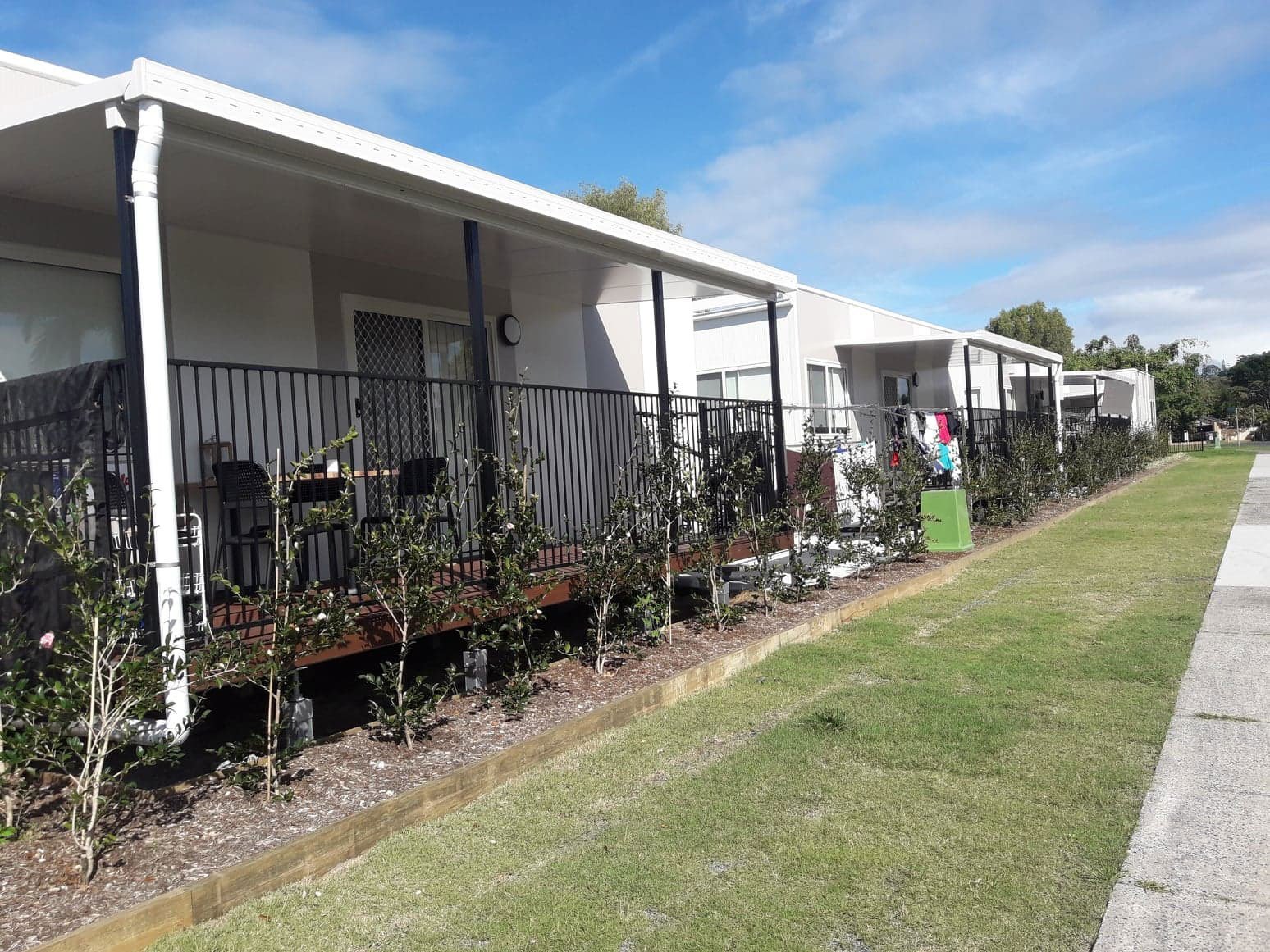
Flood-affected residents are moving into the new emergency housing in Brunswick Heads and Mullumbimby.
After a long year of homelessness and uncertainty, those people now face the challenge of living in small homes, squashed close together, in this latest social experiment in intensive community housing by the NSW government.
Many resilient locals have taken up the challenge. New tenants expressed relief and gratitude at the Brunswick Heads sites, but there’s also a pall of anxiety and trepidation hanging in the air.
The smaller Bayside site hosts 27 one, two and three-bedroom units along Torakina Road (see photo).
Fifty homes are on the sports field site, and a similar number in Mullum, alongside the railway line. Everyone has had a police clearance to reassure neighbours they pose no danger to the pre-school or community.
The units are fully self-contained with a bathroom and bedroom(s) and furnished with a new lounge suite, a dining table and chairs, a double bed and mattress, with bunks for the kids, and built-in robes.
The whitegoods provided include a front-loading washing machine that’s also a drier, an electric cooker, fridge, TV, air con/heater and microwave. The units are cosy, comfortable and welcoming, and there’s on-site parking.
The dwellings at the larger sites sit side-by-side, looking straight across at each other.
Privacy is a major issue, and the veranda screens are going up, using all types of materials with the stressed-out tenants feeling anxious and exposed.
The shops should stock up on ear plugs and headsets.
‘I think we’re gunna need ‘em’, one resident advised.
‘It has the potential to be a messy, noisy ghetto,’ one of the sportsfield tenants warned. There’s little storage room or open space around the dwellings for bikes or surf boards.
‘Don’t tell anyone you saw me here’, the woman insisted, she needs time to herself and didn’t want any visitors.
An older woman at Bayside said she slept for the first week. After living in her car and on the couch at sympathetic friends’ houses, her relief was palpable. She’d come into town to vote and was delighted to finally have a roof over her head again.
A neighbour has been busy unpacking, setting up the kitchen, rearranging the furniture and decorating with family photos and knick-knacks. Internet is an issue, with no broadband, and power has yet to be connected to Bayside, so they’re relying on a droning generator.
Support workers
The housing sites are managed by ‘Uniting’, a church-based organisation with an office on site, and support workers are provided for all tenants.
A security guard loiters around the entrance, mainly to ward off sight-seers.
Perhaps they were expecting protesters or trouble from the ‘inmates’? If you want to visit, you need to call your friend and get them to meet you at the gate.
The homes are rent free for the first 12 months, with a review underway, so residents may have to pay a contribution next year.
Only a one-year lease is guaranteed, but tenants have been promised assistance when it’s time to relocate.
The emergency housing list compiled by Resilience NSW is now co-managed, with Uniting and NSW Department of Communities and Justice, who control public housing tenancy selection.
Lack of consultation, transparency
The lack of community consultation or open, transparent, decision-making by Byron Shire Council and the NSW government led to ongoing criticism of the housing projects.
The use of land-fill, the site layout, design and construction of homes is now managed by Reconstruction NSW, and contracts worth millions have been handed out without any oversight by Council or the community.
I know several units leaked during the storm on election night, but the builders are on hand to fix any teething problems.
Non-compliance with planning, health and safety and mobile home park regulations has been permitted in this emergency, cutting red tape to save time and money. How do we evaluate the cost-effectiveness, the environmental impacts or the impact on tenants’ health and wellbeing in crowded, sub-standard caravan parks? It’s certainly not best practice.
No clear guidelines
A big hurdle for tenants has been the process and paperwork to secure emergency housing.
The lack of clear guidelines, the changing personnel, the multiple form-filling and phone calls, lost documents and missed deadlines caused ongoing stress and frustration for applicants – many gave up.
The process was described as ‘total confusion’, ‘No clarity or transparency’, ‘It’s a lottery’.
We need to end the secrecy and the backroom deals and ensure there is transparency and community consultation before any new housing projects are undertaken.
Byron Council should be leading the way, and encourage pre-fab home builders to get involved.
There are around 100 displaced residents moving into Brunswick Heads, and over 60 more in Mullumbimby. They need time to settle in, to recover from the ordeal they’ve endured, and adjust to their new reality.
The women I spoke to are reluctant to celebrate, and they requested I not identify them, though they’ve lived and worked in the community for decades.
There’s embarrassment at their plight, and fear they may not be considered a welcome addition, that others may resent the generous arrangements or argue they’re not entitled to be there.
The adverse publicity hasn’t helped.
Efforts are underway to allay concerns. A barbecue was held by the Red Cross last month in Bruns, and CWA and Vinnies are on the case.
Our supportive community is on hand to assist our comrades, and ensure they receive a warm welcome and are treated with kindness and respect.
Let’s celebrate the homecoming, and let’s get more people off the streets!
 For four decades The Echo has printed the stories some people loved, some people hated, and some pretended not to read. If you want us to keep telling the truth, the real truth, not the sugar-coated version. We’ll need your support to keep the presses rolling.


