


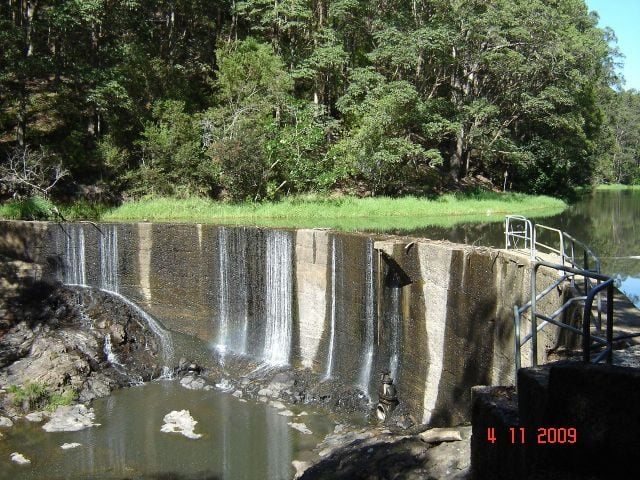
The option to source Mullumbimby’s local water supply from Lavertys Gap has risen from the dead, after Byron Council backtracked on its decision to permanently connect the town to the Rous County Council (RCC) regional supply.
In a remarkable turnaround that reflects a political changing of the guard on Council, a majority of councillors voted last Thursday to defer any decision on permanently connecting to the RCC supply for up to two years.
This time will be used to further investigate options for supplementing the existing Lavertys Gap supply, such as offstream storage, and to engage in an extensive community consultation process.
Works currently being undertaken to extend the emergency connection between the RCC supply to the whole of Mullum will not be affected by the decision.

‘This is Council’s own water supply,’ newly-elected Greens Mayor Sarah Ndiaye said of Lavertys Gap and its neighbouring water treatment plant.
‘Council has maintained it over the last almost 100 years. We have an opportunity here to keep Mullumbimby more resilient and to support sustainability…
‘Given how much new information has come to light, even in the last 24 hours, it is incumbent on us to listen to the community, to explore this further, and to rule out the possibility that we are letting go of an essential public asset that will supply the Mullum community into the future.’

The stay of execution for Lavertys Gap was passed by a majority of five votes to four, with independent Cr David Warth voting with the Greens councillor block made up of Mayor Ndiaye and Councillors Elia Hauge, Delta Kay and Michelle Lowe.
This reflects the significant shift in power which occurred during the last election, with the Greens now only requiring the support of one councillor to win any contested vote.
But last week’s victory on Mullum’s water supply was not secured without a fight.
Backed by Council staff, and an analysis conducted by external consultants, Labor councillors Asren Pugh and Janet Swain, Independent Michael Lyon, and Independent Deputy Mayor Jack Dods all voted against the deferral motion.
Crs Pugh, Swain and Lyon argued that the ageing local weir and water treatment plant could no longer be relied upon to consistently produce good quality drinking water, and that the costs of upgrading these assets while simultaneously finding or building an alternative local supply were absurdly high.
‘It is a completely and utterly irresponsible decision to not secure Mullum’s water supply so that it is safe and healthy to drink,’ Cr Pugh said.
‘I understand that some people don’t like the answers to the questions that they’ve asked. But it doesn’t mean you just keep asking until you get the answers that you want. That does not lead to good outcomes, it leads to endless delay, and to endless cost increases.

‘Will never happen’
‘This project with off-stream storage will never happen,’ Cr Pugh continued.
‘This is exactly the same thing that we went through with the rail trail – endless reports, endless questions…you delay things for ten years, you cost Council hundreds of thousands of dollars…’
Cr Pugh repeatedly questioned Mayor Ndiaye about how she expected Council to find the $300,000–$500,000 needed to further investigate supplementary water supply options.
He and Cr Lyon also grilled Council’s chief legal counsel on whether Cr Ndiaye should have been required to move a formal rescission motion rather than a motion to defer.

The Greens countered by describing the claims about the quality of Mullumbimby’s water supply as ‘misinformation’.
‘It’s really dangerous to mess with our community’s trust in the quality of our drinking water,’ Cr Hauge said.
‘Once you break that trust it can be really hard to rebuild it. We haven’t had boiling water alerts since the 2022 floods because our very talented water management staff and operators make sure that the existing emergency line is in continuous use.’
Cr Hauge also said that the economic arguments being made by Council staff, Cr Pugh and others, were based on a flawed analysis.
‘It [the analysis] doesn’t adequately consider climate change or capture the resilience value of having multiple water sources,’ Cr Hauge said.
‘It also doesn’t adequately capture the environmental cost of Rous’s future water options… or the community’s opposition to the loss of their existing water source.
‘This is a once-in-a-generation decision, and our community really deserves it to be done properly.’
 For four decades The Echo has printed the stories some people loved, some people hated, and some pretended not to read. If you want us to keep telling the truth, the real truth, not the sugar-coated version. We’ll need your support to keep the presses rolling.


