


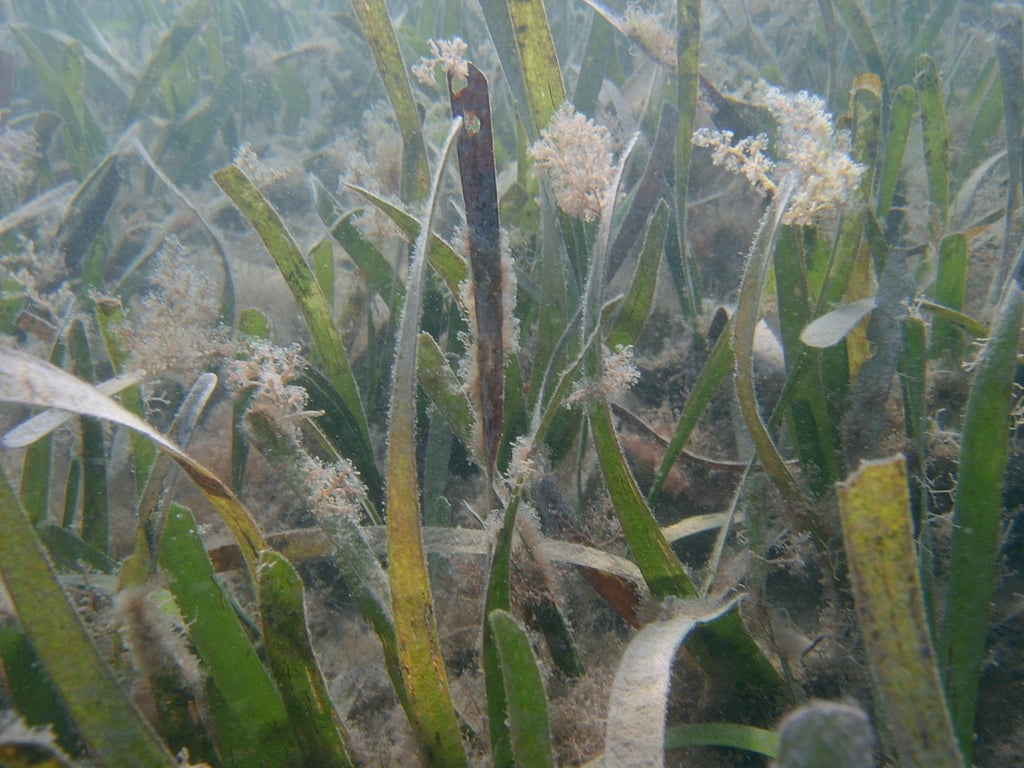
The world’s seagrass meadows are in trouble, but Australian scientists say early action can save them, even as sea levels rise.
University of Queensland Global Change Institute researcher Dr Megan Saunders collaborated with the ARC Centre of Excellence for Environmental Decisions on new research reported in the journal Global Change Biology.
‘We’re currently losing around seven per cent of global seagrass area every year due to a combination of human impacts,’ Dr Saunders said.
‘Those losses are likely to accelerate as sea levels rise.’
As waters deepen due to sea level rise and become murkier due to human activities on land, seagrass meadows in deeper waters are deprived of the light they need to stay alive.
Dr Saunders said seagrass areas were a vital factor in the battle against climate change.
‘We need to take action needs to stabilise or even expand the area of seagrass beds globally,’ she said.
‘They can lock up an awful lot of carbon and help slow climate change, as well as restore degraded fisheries.’
Dr Saunders said the keys to saving and regenerating the world’s seagrass beds were:
• Revegetating bare farmland to control erosion and runoff in river catchments
• Better managing river banks
• Better managing nutrient and soil runoff from cities
• Local authorities adopting more flexible coastal planning for development, to allow future seagrass meadows to expand into new areas as sea levels rise.
Dr Saunders said the success of the plan depended on creating light conditions at the ‘deep edge’ of seagrass meadows which allow seagrass species to continue to flourish.
‘This is the sort of information our coastal planners will need as we seek to cope with the changes imposed by sea level rise and other impacts of climate change,’ she said.
‘It also means we can think further ahead about what is needed to keep these essential ecosystems alive and thriving by allowing them to move to occupy new niches as they emerge.
Dr Saunders and her research colleagues used Australia’s Moreton Bay as a laboratory to investigate the fate of seagrass meadows generally, in the context of an expected 1.1 metre sea level rise this century.
Moreton Bay is listed as a ‘Ramsar Wetland’: these are areas of international importance that are listed under the Convention on Wetlands, also known as the Ramsar Convention.
Dr Saunders said the Moreton Bay research indicated a ‘coastal retreat’ strategy could reduce the loss of seagrass cover due to sea level rise by 2100 from 17 per cent to 5 per cent.
‘Compared to coral reefs, seagrasses are the ugly duckling of marine ecosystems,’ she said.
‘They are major nurseries for fish and prawns, and so support our food supply.
‘They trap huge amounts of carbon, and could sequester even more if we looked after them.
‘They cleanse the oceans by trapping sediment and nutrients.’
The team’s research indicates that a 1.1 metre rise in sea level would result in a 17 per cent decline in seagrass cover in Moreton Bay due to the loss of light alone.
Equivalent losses could occur globally, although exact numbers would depend on the location.
Seagrasses trap an estimated 48-112 million tonnes of carbon every year.
Their loss means this carbon will be re-released into the atmosphere, accelerating global warming.
The research was a collaboration between the Australian Research Council-funded Australia Sea Level Rise Partnership, based at UQ’s Global Change Institute, and the ARC Centre of Excellence for Environmental Decisions (CEED).
CEED’s research tackles key gaps in environmental decision making, monitoring and adaptive management.
Details on the team’s research appear in the CEED publication Decision Point, and the full paper, ‘Coastal retreat and improved water quality mitigate losses of seagrass from sea level rise’, by Saunders MI, Leon J, Phinn SR, Callaghan DP, O’Brien KR, Roelfsema, CM, Lovelock CE, Lyons MB, Mumby PJ (2013) appears in Global Change Biology.
 For four decades The Echo has printed the stories some people loved, some people hated, and some pretended not to read. If you want us to keep telling the truth, the real truth, not the sugar-coated version. We’ll need your support to keep the presses rolling.