


By Giles Parkinson, www.reneweconomy.com.au
The former head of Australia’s most notorious brown coal generator – the soon-to-be-retired Hazelwood plant – says solar PV and battery storage already represent a cheaper alternative to gas-fired generation.
In yet another clear signal that Australia’s energy markets are on the cusp of a radical reshaping, Tony Concannon, the former head of GDF Suez Australia (now Engie), says solar and battery storage already beat baseload gas on price, and its costs will continue to fall rapidly.
In a submission to the Finkel review, Colcannon – now head of Reach Solar Energy – cited a recent quote given to the company for a large solar farm (100MW) with a significant amount of battery storage.
‘Reach received estimates in late December 2016 for solar PV and energy storage (40MWh to 100MWh) which translated into a tariff between $110/MWh to $130/ MWh,’ Concannon wrote.
‘This is already competitive with gas-fired CCGT and costs are expected to reduce further.’
The opinion from one of the hardest noses in the Australian energy industry – and his real-life example – fits in with similar claims by the likes of Tesla CEO Elon Musk, Zen Energy Ross Garnaut, Carnegie’s Michael Ottaviano and numerous others.
It is also a blow to those who insist that gas generation is the only alternative as a transition fuel to a high renewasbles grid – a position given huge amplification by the Murdoch media and prominent ABC journalists such as Andrew Probyn and Chris Uhlmann.
Reach has received approval to build 300MW of large scale solar PV near Port Augusta, the home of the recently closed Northern power station. Already it has a contract from Origin Energy for two 110MW solar farms at the Bungala project, 10kms from the town.
South Australia, meanwhile, is looking to install 100MW of battery storage in a fast-tracked tender by the end of the year, and will also likely install a further 50MW of battery storage in association with a new emergency back up gas generator.
The falling cost of battery storage is taking most people by surprise, having fallen 40 per cent last year and with the head of Enel Green Energy, one of the largest renewable energy companies in the world, with a battery storage division, predicting it will follow the plunging cost curve of solar PV, as many have predicted.
Meanwhile, in his submission, Concannon noted that despite all his years (a decade) running a major coal plant, it was now clear there was no appetite for new coal-fired generators ‘of any technology type’ in Australia, despite the insistence of many in the Coalition that this is the right way to go.
‘Europe and the USA are exiting coal-fired generation and it is understood the World bank continues to not support coal projects and nor does any financial institution that has signed onto the Equator Principals which includes most global and Australian commercial banks,’ he wrote.
He added that even if the government provided an immunity against a future carbon price, banks and investors would still see this as risky because they would fear that that immunity could be diluted or repudiated, just as the carbon price was junked by the Coalition government in 2014 and the renewable energy target was also cut.
‘(These acts) have set the precedent in Australia,’ Concannon wrote. In effect, he is arguing that the Coalition killed the prospect of new coal-fired generation because of the sovereign risk of not respecting policy. (No wonder they were celebrating, see pic below).
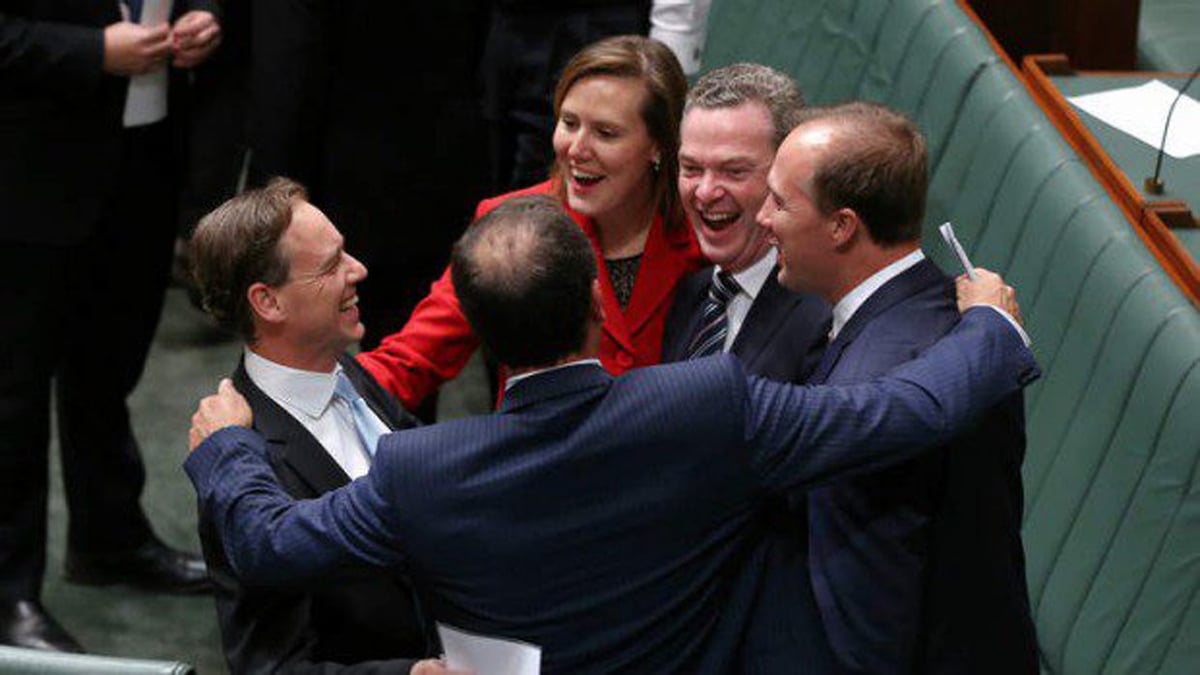
Did they know then that they had signed the death-knell for new fossil fuel generation in Australia?
Concannon said it was also clear that Australia’s fleet of ageing coal fired generators were becoming increasingly expensive to maintain, leading to more outages (such as the recent closure of two units at Liddell in the recent NSW heat wave) and rising rehabilitation costs.
And despite the insistence of many that fossil fuels are key to provide ‘grid stability’, Concannon writes that grid stability services will be increasingly provided by new technologies.
These included even faster acting asynchronous inverter technologies and/or aggregated consumer generation, controlled load shedding (financial options paid to willing consumers), installation of frequency control on interconnectors (e.g. Murraylink), and synthetic inertia from wind turbines.’
He also noted that ‘there is a lot of Press reports and misinformation’ on the topic of system security, and it was clear that solar PV could help with system inertia and moderating the rate of change of freuenxy (RoCoF) which are key measures of system security.
But he says that the Australian Energy Market Operator and the transmission network providers are only just getting to understand the potential of utility scale inverter technology (wind and solar farms).
Others have also expressed frustration that the regulators and network operators have been slow to absorb the potential of the new technologies, hence the slow pace of regulatory change and market rules.
Concannon says although they are asynchronous, and have little or no inertia, they can provide:
• most ancillary services, especially in response to over-frequency events and reactive power;
• are very fast acting (much faster than conventional plant) and this is anticipated to dampen the rate of change of frequency under severe network disturbances which in turn may reduce the amount of system inertia required to maintain the frequency;
• and a re able to remain connected at very low short circuit ratio in the order of 1.5 to 2 (typically seen with weaker networks).
‘Reach consider system inertia is important and will be provided by synchronous generation in the near-term, but will be increasingly provided by near instantaneous response from new technologies in the future,” he writes.
‘These solutions are likely to include even faster acting asynchronous inverter technologies and/or aggregated consumer generation/loads, controlled load shedding (financial options paid to willing consumers), installation of frequency control on Murraylink, and energy storage/synthetic inertia from wind turbine.”
‘Even though solar and storage costs are chepaer than gas, Concannon says the market barriers are significant, and many developers will wait for market signals that recognise the services they can offer. This will require significant rule changes that are currently being resisted by existing fossil fuel generators.
‘It will become increasing more difficult for a centralised system operator to manage a system which is becoming more opaque with behind the meter generation and/ or sophisticated aggregation of demand/ generation in the future,” he says.
 For four decades The Echo has printed the stories some people loved, some people hated, and some pretended not to read. If you want us to keep telling the truth, the real truth, not the sugar-coated version. We’ll need your support to keep the presses rolling.


