

13.2 C
Byron Shire
August 29, 2026

Five graphs you need to see before the Global Carbon Budget update

Latest News

How can we keep paying for incompetence

The only way forward is going backwards. That’s how I explain the current situation of Byron Shire Council. The...

Other News

Big Council rates rise coming – self-reflection

A chance for self-reflection? Maybe Byron Shire Council should look at having a staff reduction, instead of a rate...

Wollumbin Art Award winners to be revealed this Saturday

The winners of one of the Northern Rivers’ major regional art awards will be revealed at Tweed Regional Gallery this Saturday, as the 2026 Wollumbin Art Award exhibition opens in Murwillumbah.

50-metre Olympic-sized pool

We definitely need an updated 50m swimming facility closer to Tweed Heads. My preference is an outdoor facility. The...

Greens urged to back pathway to end native forest logging

Some of NSW’s most respected and long-standing forest campaigners and scientists have today urged the Greens not to support the Nationals' attempt to disallow the Improved Native Forest Management (INFM) method.

Katie Milne responds to Tweed’s draft housing and employment strategy

The former mayor of Tweed Shire Council, Kate Milne, has shared her submission to Tweed's Draft Growth Management Housing & Employment Strategy.

Robot armies

Nuclear war now seems a matter of not if, but when: the bulletin of atomic scientists now has us...

Photo Kentaro IEMOTO / Flickr.com

Brought to you by Cosmos Magazine and The Echo

After a carbon dip during 2020, greenhouse gases shot back up last year.

The Global Carbon Budget is about to be refreshed, giving the world a critical insight into how efforts to reduce greenhouse gas emissions are (or are not) progressing.

With the global concentration of carbon dioxide having exponentially increased in the post-industrial age, reducing human emission of this, and other carbon gases like methane, is critically important to keeping global warming to the targets set out in the Paris Climate Agreement.

Those targets aim to keep temperatures below two degrees of warming by the midpoint of the century, or ideally (though unlikely) lower than 1.5 degrees.

On Friday, the Global Carbon Project will release its latest dataset indicating the levels of carbon gain or decline across a range of variables in 2022, coinciding with the COP27 climate conference in Egypt.

See more COP27 coverage

To give you a sense of the trends, here are four graphs from the 2021 release that you need to wrap your head around.

Graph 1.

This is the big one. This chart shows the increase of carbon dioxide emissions over three decades from 1990-2021.  You can see that line has continued to increase despite occasional dips, due to geopolitical, financial or health crises. The biggest such dip occurred during COVID-19, when levels were on par with those at the start of the 2010s, before promptly darting up again with the post-COVID economic reopening.

Graph 2.

The second chart shows China and the US are the biggest contributors of carbon output by far. China’s output continued to rise through the pandemic, while western economies like those in the US and European Union dipped. The EU’s carbon output had been slowly dropping since a 1979 peak, although rose again in 2021. Importantly, India’s carbon output in 2021 was on the cusp of overtaking the EU’s 27 biggest economies.

Graph 3.

The third graph puts fossil fuels in context. Coal continues to account for the lion’s share of carbon output among fossil fuels, with 2021 projections indicating a strong rebound in its use. While coal use spiked and remains the most prominent fossil fuel in use, China’s particular reliance on it shadows the substantial use of fuels like gas and oil in the US and EU. China posted a record year of carbon emissions in 2021.

The final graphs contains glimmers of hope.
Graph 4.

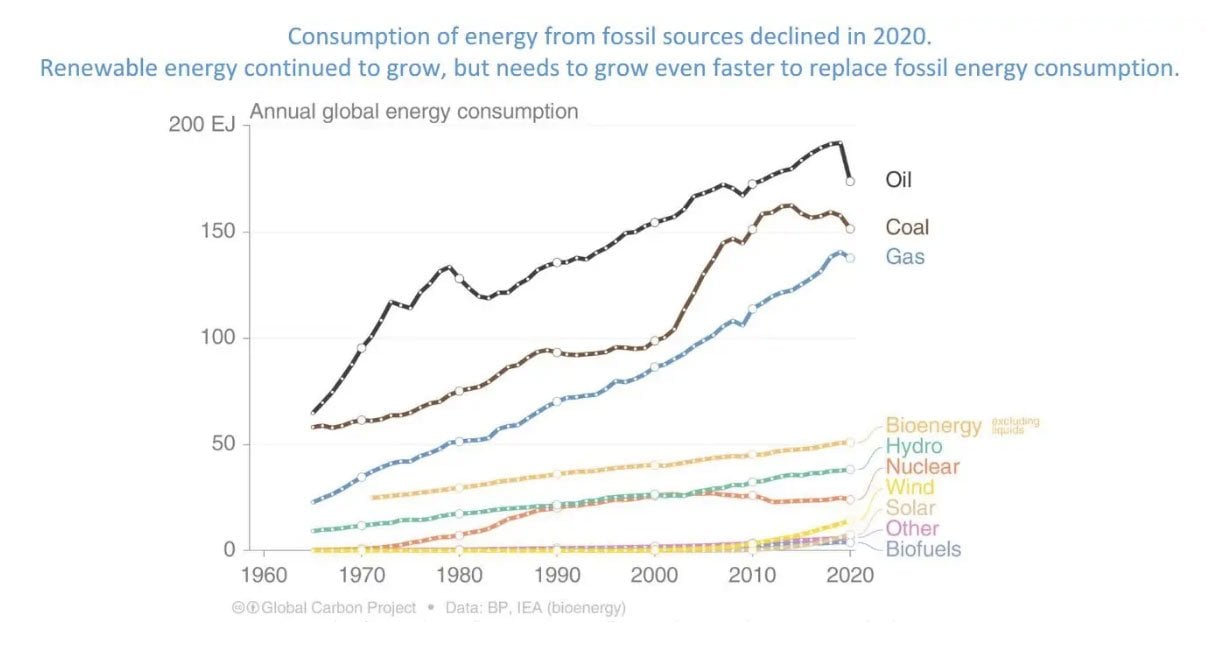
This fourth chart shows that in 2020, renewable energy sources continued to grow – despite the pandemic – and the major sources of carbon declined during. It does not, however, indicate how the global reopening influenced carbon output – we’ll find this out on Friday.

Clearly, while the world’s use of coal, gas and oil for electricity consumption appears to have reduced in recent years, the global use of renewable energy sources is still slow, despite the increase of wind and solar power since 2010.
Graph 5.

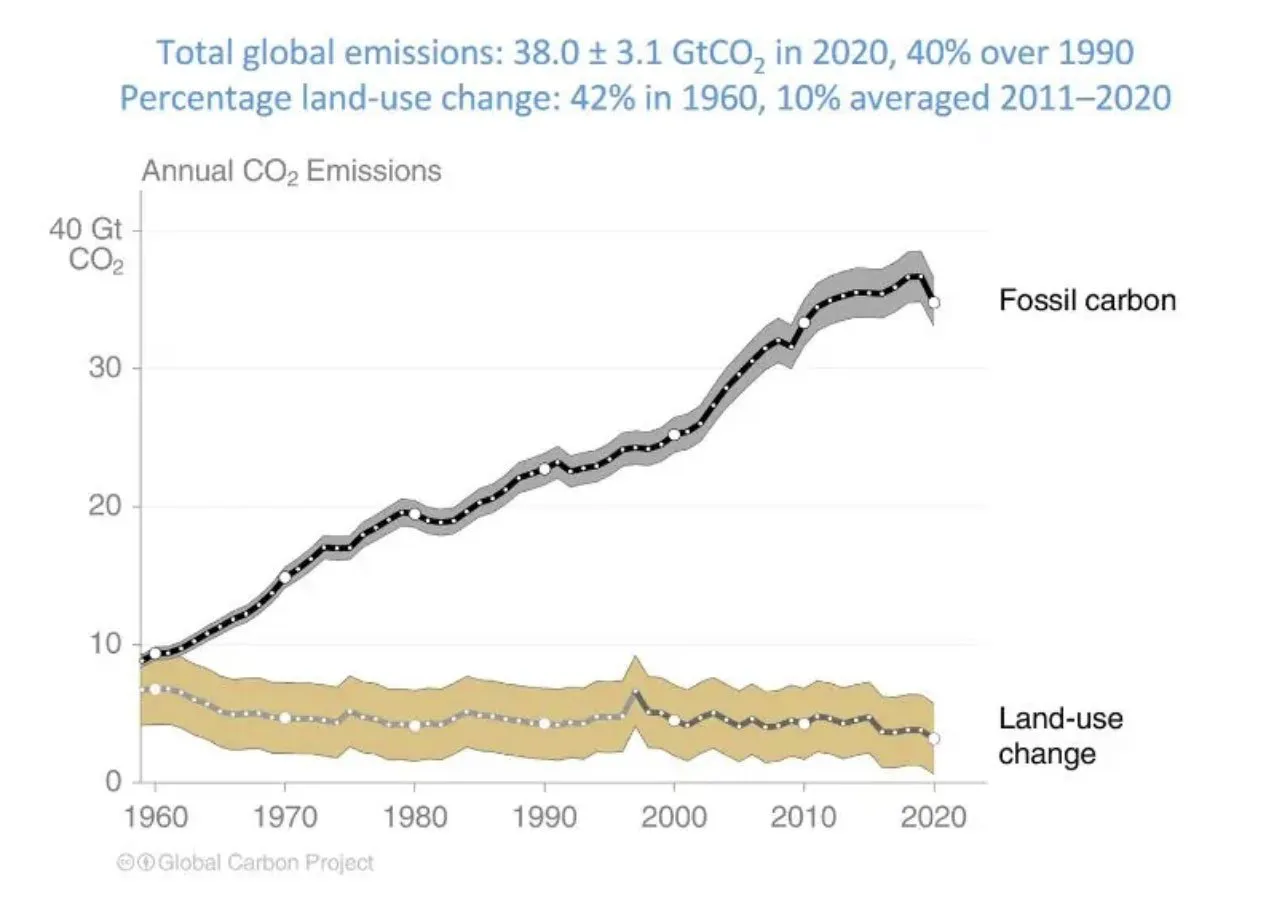
At the same time, while fossil carbon emissions dipped in 2020, there was a downward trend reported in carbon output from changes in land use. While modifying land through actions like deforestation, organic soil burn and changes to soil drainage reduces the environment’s ability to capture and store carbon, positive actions like reforestation, peatland restoration and wetland protection among others can further improve natural carbon capture.

The Global Carbon Project’s 2022 budget update will be released tomorrow.


This article was originally published on Cosmos Magazine and was written by Matthew Agius. Matthew Agius is a science writer for Cosmos Magazine.


Published by The Echo in conjunction with Cosmos Magazine.


For four decades The Echo has printed the stories some people loved, some people hated, and some pretended not to read. If you want us to keep telling the truth, the real truth, not the sugar-coated version. We’ll need your support to keep the presses rolling.

If you are a local business owner help us and in turn we help you. All The Echo asks for is advertising, not a free ride. It is every advert in The Echo and on www.echo.net.au, which creates the space for all the stories and coverage of community events, happenings and concerns.

If you are a reader you can become a sponsor of The Echo. Your support keeps the us independent.

Even a small one-off or regular donation from you will help keep the echo’s independent voice alive and strong.

Support Us

Become one of the supporters who helps keep independent, local journalism alive in the Byron Shire by contributing anything from as little as the cost of a coffee each month.

You're Wonderful, Thank you for supporting independent journalism in the Byron Shire

You’re supporting The Echo, thank you

Your contribution is keeping independent, local journalism alive in the Northern Rivers.

Because of supporters like you, we can keep every story free for everyone — no paywall, no exceptions. Your money goes directly to funding our newsroom of 40-odd local workers covering the stories that matter to this community.

Tell us what you think, give us your opinion

The Echo loves your letters and comments and is proud to provide a community forum on the issues that matter most to our readers and the people of the NSW north coast. So don’t be a passive reader, email us your epistles at editor@echo.net.au.

The letters deadline for The Echo is noon Friday. Letters longer than 200 words may be cut. The publication of letters is at the discretion of the letters editor. Please remember to include your full name, address and telephone number.

Online comments are no longer available.

Greens urged to back pathway to end native forest logging

Some of NSW’s most respected and long-standing forest campaigners and scientists have today urged the Greens not to support the Nationals' attempt to disallow the Improved Native Forest Management (INFM) method.

Ballina Council makes decision on Ross Lane

With the absence of all four of its progressive councillors for various reasons, Ballina Council pushed ahead with its agenda at yesterday's monthly meeting, including a decision which is likely to close Ross Lane for months while the road is upgraded.

Mullumbimby puts new governance models first, and now wants to build it

Imagine Northern Rivers says Mullumbimby is the only community across the region to rank new models of governance and decision-making as the number one element of its preferred future, and last week locals gathered to work out how to make it real.

Appeal to locate man missing from Broadwater

Police are appealing for public assistance to help locate a local missing man.

