



Sitting at number five of the world’s top ten countries with the highest deforestation rate, Australia is only beaten by Brazil, India, Indonesia and Tanzania. Spot number six is taken out by Myanmar who, on average, cleared over 100,000 hectares less than Australia between 2015–2020.
New Year’s day saw native forest logging cease in Western Australia and eastern Victoria, however, yesterday (10 January) Federal Court judge Justice Perry dismissed the historic legal challenge to the agreement that allows logging in north-eastern NSW native forests.
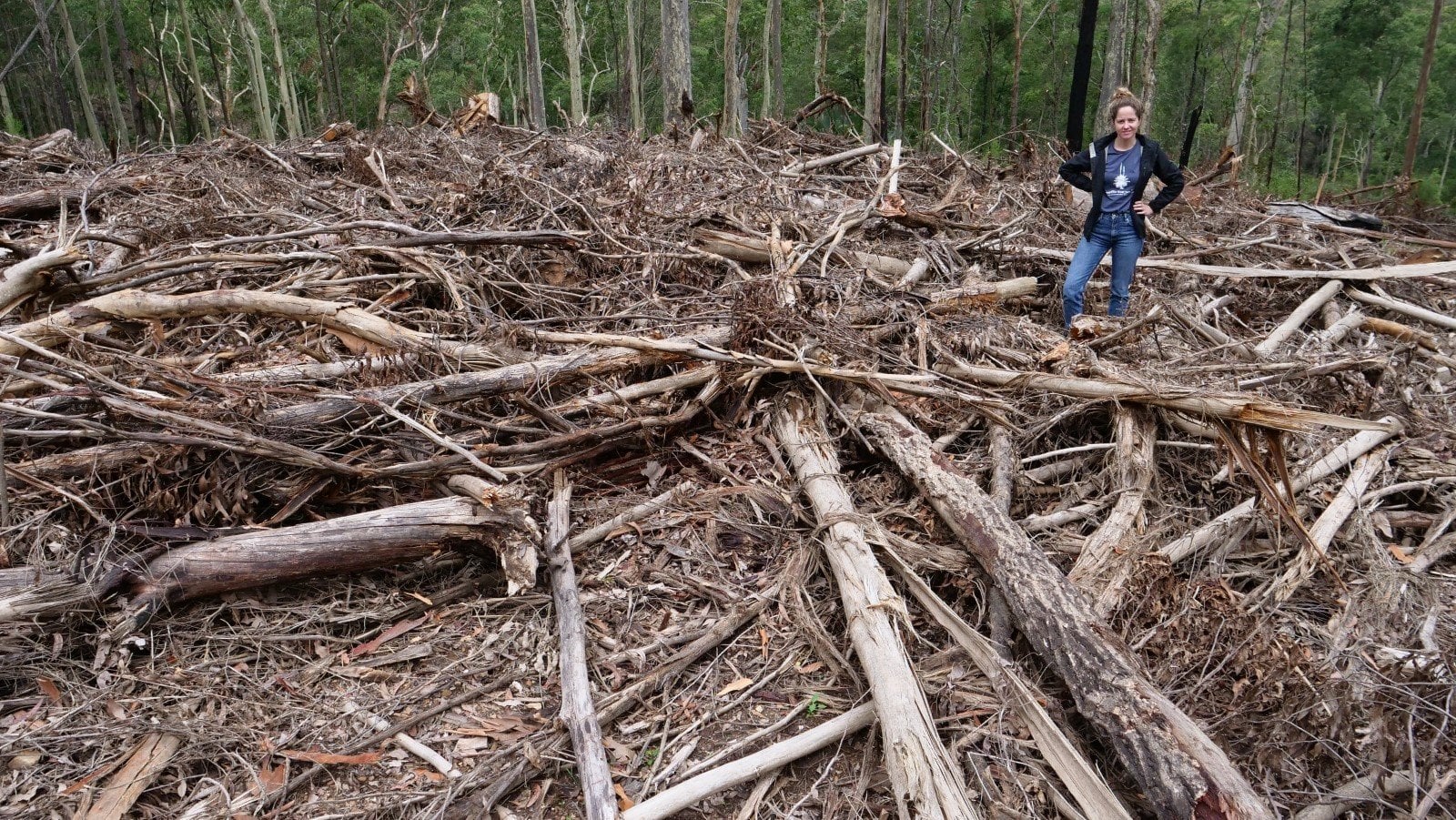
The North East NSW Regional Forest Agreement (North East RFA) covers the vast coastal area between Sydney and the Queensland border, and exempts logging from federal environmental assessment under the Environmental Protection and Biodiversity Conservation Act 1999 (EPBC Act).

North East Forest Alliance (NEFA) had challenged the extension of the Regional Forest Agreement (RFA) in 2018 based on 1997 data, without requiring a new assessment arguing that when the RFA was renewed in 2018 for another 20 years, the Commonwealth did not assess climate change, endangered species or old-growth forests as it was required to. The extension was allowed by NSW Liberal Premier Gladys Berejiklian and Liberal Prime Minister Scott Morrison who decided that they would not do a new assessment and, without any consideration of climate change, extended the existing RFA indefinitely as a variation.
This decision was strongly objected to in 2018 by then opposition environment spokesperson and now NSW Minister for the Environment, Penny Sharpe, who said the science underpinning the RFAs is out of date and incomplete, committing that ALP Labor will not sign off on a rollover of the RFAs until there is a proper, independent, scientific assessment of their outcomes, and the assumptions of the original RFAs are revisited.

Political decision
‘The decision by the court, that native forest logging is technically lawful, is a devastating blow for our forests but should not be mistaken for an endorsement of native forest logging and should rather be seen as a warning shot to the NSW and Commonwealth governments that native forest logging must be reviewed urgently and ended as soon as possible. The court confirmed that in no uncertain terms, this matter is wholly political,’ said Greens MP and spokesperson for the environment Sue Higginson.
Union welcomes decision
However, the Australian Workers’ Union (AWU) has welcomed the Federal Court’s rejection of a legal challenge against forestry in NSW.
‘Thousands of workers’ jobs were at risk if the EDO was successful as it could have led to the suspension of forestry in NSW, Victoria, Tasmania and WA,’ stated the AWU in a press release.
‘Justice Melissa Perry found intergovernmental forestry agreements should be matters for elected governments rather than courts to decide.’

EPBCA needs review
‘The finding confirms what experts and reviews are consistently saying, that our federal environmental laws are outdated and ineffective and represent political failure,’ explained Ms Higginson.
‘It is extremely disappointing that after a five year legal battle this process of not requiring a contemporaneous assessment has been legally validated,’ NEFA President Dailan Pugh said.
‘The decision to not require a new assessment put at risk the survival of a multitude of species that have rapidly declined since 1997, including many nationally threatened species that are not adequately protected under NSW’s logging rules and are being significantly impacted.’

NEFA have identified that within north-east NSW’s state forests that are currently being logged, or proposed for imminent logging, there are nationally significant populations of over 11 nationally threatened animal species and 13 plant species. Of particular concern are the endangered koala, southern greater glider, spotted-tailed quoll, Hastings River mouse, rufous scrub bird, and giant barred frog.
‘We’re disappointed by today’s decision. Without law reform, it means that native forest logging in the region will continue to be exempt from Commonwealth environmental assessment for at least another 20 years,’ said Environmental Defenders Office (EDO) Managing Lawyer Andrew Kwan.
‘This could have devastating consequences for wildlife and forests. It is vital that our remaining native forests are properly protected by a reformed federal legal framework that includes strong national oversight.’
NEFA vice-president Susie Russell pointed out that, ‘We are in the midst of extinction and climate crises, aggravated by the 2019/20 wildfires, rising temperatures and logging, so it is reprehensible that these species are still not receiving the immediate increase in protection Professor Samuel’s [independent] review of the RFAs identified as needed back in 2020’ as part of his review of the Environment Protection and Biodiversity Conservation Act 1999 (EPBC Act).
‘The evidence of serious, and in some areas irreversible, impacts on the environment by native forest logging is beyond dispute,’ Ms Higginson said.
‘The fact that the law would allow this to continue is an indictment on all governments that have allowed the logging to continue without review. Everyday that native forest logging is allowed to continue is another day that threatened species, healthy ecosystems and climate impacts are disregarded in favour of vested interests in the logging industry. Workers and communities should be resourced appropriately to accept that native forest logging must come to an end
‘The responsibility for changing the law and ending the pointless destruction of native forests now sits firmly with the state and federal environment ministers. The NSW Minister for the Environment, Penny Sharpe, made it clear in 2018 that the RFA should not be extended without a thorough review of the system and health of the environment and our forests. This is her opportunity to conduct that review and place a moratorium on all native forest logging while the review is undertaken.’

Senator Janet Rice, Australian Greens Forests Spokesperson said ‘The logging industry should be subject to the same environmental standards as all other industries. Today’s decision has shown once again that our federal environment laws including the regional forest agreements are broken.’
Ms Russell agreed saying, ‘It is time for Tanya Plibersek to provide the immediate protection for threatened species identified as required by Professor Samuel in 2020 and for Penny Sharpe to step up and end this sham RFA.’
 For four decades The Echo has printed the stories some people loved, some people hated, and some pretended not to read. If you want us to keep telling the truth, the real truth, not the sugar-coated version. We’ll need your support to keep the presses rolling.


