

20.3 C
Byron Shire
October 20, 2026

New larval seedbox technology to drive coral restoration on the Great Barrier Reef

Latest News

Cinema: NAZA

A must-see, award-winning documentary investigating AI warfare in Gaza. Fresh from winning the Special Jury Prize at the 2026 Venice International Film Festival, NAZA, the latest documentary from Academy Award-winning filmmakers Yuval Abraham and Rachel Szor (No Other Land), examines artificial intelligence and surveillance in Israel’s military operations in Gaza.

Other News

Mullumbimby Road to be temporarily closed

Byron Shire Council says Mullumbimby Road will be closed to outbound traffic for three days, except for buses and emergency vehicles, for three days from 16 to 18 November.

Something for everyone at the Picture House

From Australian superstar musos, to brand new documentaries, to comedians at the top of their game, there really is something for everyone at the Brunswick Picture House.

The price of ignorance

What often gets described as ‘racism’ in Australia is often based on plain old ignorance. People lacking the interest...

Byron Bay wins Wallace Shield

For the past 63 years Byron Bay and Ballina lady golfers have had a fierce but friendly rivalry for the Wallace Shield. Even COVID couldn't spoil the party, although the competition was played with certain restrictions.

Old Ways New Ways exhibition open in Lismore

A group exhibition, Old Ways <> New Ways, is now open at Elevator ARI, 3 Rural Street, Lismore as part of The Returning’s Indigenous Artist Residency.

Found – Missing Robert Craig, last seen at South Golden Beach

Police are searching for 72yo, Robert Craig, last seen on a bush track at Helen Street, South Golden Beach, about 7.30am this morning.

Lizard Island coral spawning event. CSIRO

Millions of coral larvae on the Great Barrier Reef have an increased chance of replenishing degraded reefs thanks to the ‘larval seedbox’ – a coral restoration technology developed by CSIRO, Australia’s national science agency, with Southern Cross University.

Results from the first trial of larval seedboxes have found coral settlement to be up to 56 times higher across thousands of square metres of reef.

The trial was conducted at Lizard Island in 2024 and shows strong promise for use of seedboxes in scaling up coral restoration.

As the annual mass coral spawning event takes place across the Great Barrier Reef in November, a second trial is underway in the Whitsundays, a valuable setting to test how well the technique works in a range of conditions.

Larval seedboxes act to delay the dispersal of concentrated larvae in degraded areas of reef targeted for restoration.

Installing new larval seedbox technology. CSIRO

Innovative delivery system

Dr Christopher Doropoulos, Senior Research Scientist at CSIRO, said the larval seedbox is a simple, efficient and cost-effective tool to help increase coral larval survival, delay their dispersal, and find optimal habitat for settlement.

‘The seedboxes work as a delivery system, allowing coral larvae more time to disperse and settle on the Great Barrier Reef, where they can establish themselves and grow into juvenile corals,’ said Dr Doropoulos.

‘We culture coral larvae following coral spawning, an annual mass reproductive event where many different types of corals release bundles of eggs and sperm into the water to fertilize externally. This enables us to collect 10s of millions of coral larvae from mass cultures to fill the larval seedboxes.

‘The larval seedboxes are deployed onto the reef, from which the larvae exit when ready and drift with the currents to cover areas of more than two hectares of reef. This approach delivers a high density of larvae over much larger areas than previously demonstrated, boosting coral restoration potential at scale.’

Valuable opportunity

Professor Peter Harrison from Southern Cross University said this research will provide a valuable opportunity to test the effectiveness of the technique in a variety of reef conditions.

‘We’re deploying the seedboxes in the Whitsundays to target areas of reef that have been previously impacted by extreme weather events and coral bleaching from warming seas,’ said Professor Harrison.
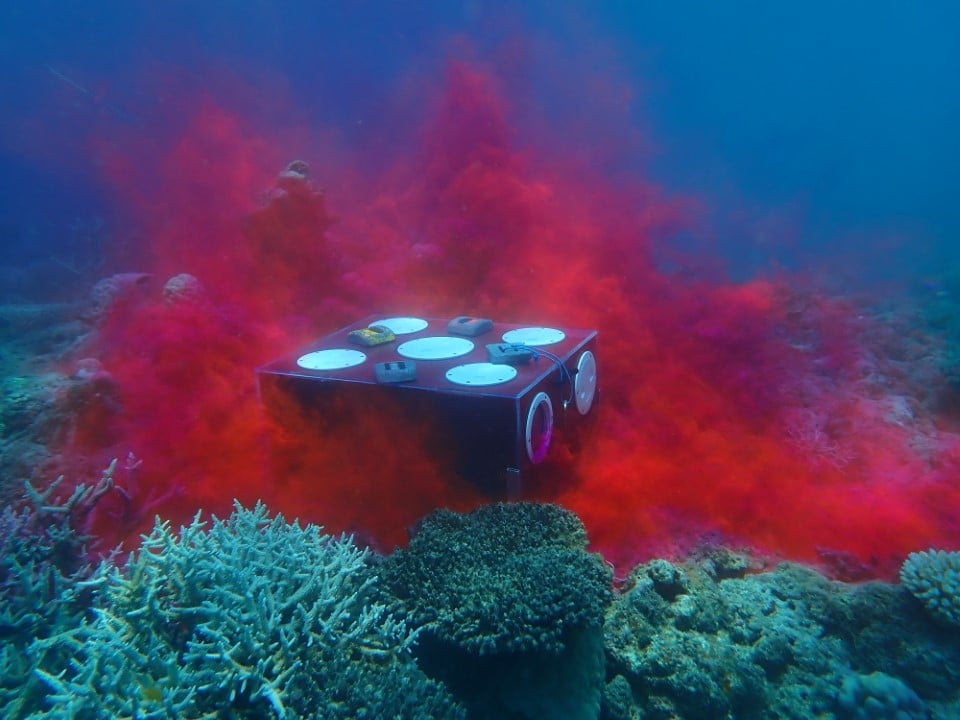
Testing new larval seedbox technology. CSIRO

‘We’re anticipating the release of up to 20 million larvae at multiple locations and the team will continue to monitor the longer-term effectiveness of the larval seedbox delivery over nine to 12 months.

‘This will help us understand how far some of the coral larvae disperse after release, and how effective the approach is in different reef environments.’

Following the assessment period, researchers will be able to determine the feasibility of the larval seedbox as a tool for coral restoration at larger scales across different environmental conditions.

Anna Marsden, Managing Director at the Great Barrier Reef Foundation, said seedboxes have the potential to become the part of the next generation of solutions for reef restoration.

‘This work is building new ways to help coral ecosystems adapt in a changing climate. This trial is possible thanks to support from Qantas, which is helping turn ideas into impact.’

This research is a collaboration between CSIRO and Southern Cross University, supported by the Great Barrier Reef Foundation, in partnership with the Australian Institute of Marine Science and local stakeholders.



For four decades The Echo has printed the stories some people loved, some people hated, and some pretended not to read. If you want us to keep telling the truth, the real truth, not the sugar-coated version. We’ll need your support to keep the presses rolling.


If you are a local business owner help us and in turn we help you. All The Echo asks for is advertising, not a free ride. It is every advert in The Echo and on www.echo.net.au, which creates the space for all the stories and coverage of community events, happenings and concerns.

If you are a reader you can become a sponsor of The Echo. Your support keeps the us independent.

Even a small one-off or regular donation from you will help keep the echo’s independent voice alive and strong.

Support Us

Become one of the supporters who helps keep independent, local journalism alive in the Byron Shire by contributing anything from as little as the cost of a coffee each month.

You're Wonderful, Thank you for supporting independent journalism in the Byron Shire

You’re supporting The Echo, thank you

Your contribution is keeping independent, local journalism alive in the Northern Rivers.

Because of supporters like you, we can keep every story free for everyone — no paywall, no exceptions. Your money goes directly to funding our newsroom of 40-odd local workers covering the stories that matter to this community.

Tell us what you think, give us your opinion

The Echo loves your letters and comments and is proud to provide a community forum on the issues that matter most to our readers and the people of the NSW north coast. So don’t be a passive reader, email us your epistles at editor@echo.net.au.

The letters deadline for The Echo is noon Friday. Letters longer than 200 words may be cut. The publication of letters is at the discretion of the letters editor. Please remember to include your full name, address and telephone number.

Online comments are no longer available.

Interview with Genevieve Clay-Smith, director of Boss Cat showing at the Byron Bay Film Festival

When Sonja (Olivia Hargroder) loses her mother without warning, the only steady presence left in her life is her grandmother, Doris. But Doris’s idea of stability means dismantling everything Sonja has built. For Sonja, who lives with Trisomy 21 (Down syndrome) and has spent her life fighting to be underestimated by no one, Doris’ plan feels less like protection and more like erasure. Directed by Genevieve Clay-Smith, Boss Cat is a vibrant, big-hearted Australian dramedy about independence, family and self-determination, anchored by a fearless lead performance.

Something for everyone at the Picture House

From Australian superstar musos, to brand new documentaries, to comedians at the top of their game, there really is something for everyone at the Brunswick Picture House.

Thirty-six unmissable films

The 2026 Russell Hobbs British Film Festival features an unmissable line up 36 films, including five retrospectives which will screen from 28 October to 29 November at Palace Byron Bay and Ballina Cinemas.

A timeless story of self-discovery

A husband with a promotion, two adorable children and a lovely new house. Nora thought she had it all. But did she? What was the discontent that was whispering to her in the shadows?