



Lennox Head Landcare and partners recently won the Environmental Award from Ballina Shire Council, particularly for their efforts to protect Lake Ainsworth from the highly invasive plant water hyacinth, which is capable of doubling in size every five days.
Water hyacinth was first detected in the lake in 2015, with local Landcare volunteers contributing untold hours since then to help protect the lake.
The Australia Day award citation said, ‘Their dedication has ensured that this special place remains protected and accessible for generations to come, while their leadership has brought other partners and agencies into the effort, building a community-driven response that continues to strengthen over time.’

This latest recognition follows a 2025 Waterways and Protection prize for the group from the NSW Tidy Towns Sustainability Awards, also for aquatic weed management on Lake Ainsworth.
Kelly Saunderson is the vice-president of Lennox Head Landcare, and has been involved with the group for 13 years.
She told the Echo her Landcare group was surprised to win this year, with so many other amazing nominees, including mycologist Stephen Axford, Amanda Philp for her turtle work, Friends of the Koala, and Ballina Environment Society.
Why did you get involved with Lennox Head Landcare, originally?
‘It’s a good thing to give something back,’ she said.’ I feel like if everyone did a little bit for the local community, the world would be a better place. I just wanted to make a small contribution, and I enjoy it too. We love nature, and the people are beautiful. It’s a really lovely group.’
She said there are a large number of people who are involved in different ways, with about 15 currently part og the regular working group which is tackling the water hyacinth, and more volunteers always welcome to become involved with this and other projects around the region.
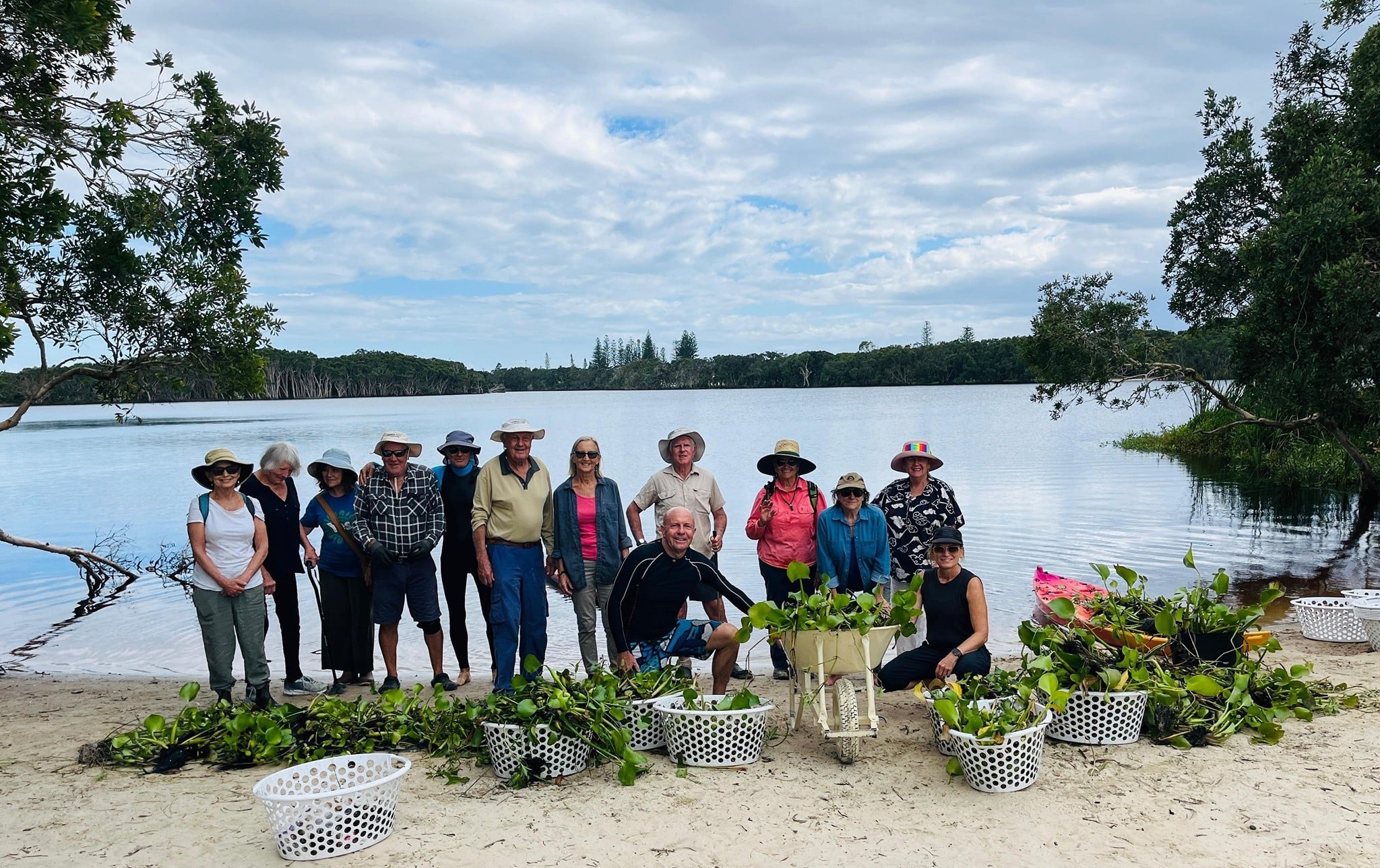
Can you tell us more about the water hyacinth project?
‘We’ve been looking after it for a long time, but maybe a year and a half ago it got really out of control and we needed to call in reinforcements.
‘That was the most heartwarming thing about the project, because we just got so many people helping. We started a little WhatsApp group. There was 30 or 40 people on that who would come along to events.
‘When the weather was good new people were coming all the time. We had holiday makers helping us. The dragon boaters got involved. Before they do their training session, they do a couple of loads of hyacinth and fill their boats.
‘There’s a local kayaking crew that got involved, young kids who were learning. Sports and Rec staff, they just volunteered. It was amazing to have so many people stick their hands up.’
Ms Saunderson says the water hyacinth requires regular, persistent attention to avoid it getting completely out of control. She pays credit to one ‘amazing volunteer’ who did an extraordinary amount of work controlling the hyacinth over several years, and left a big hole when he had to step away to do other things, with multiple volunteers now being needed to control the weed.
What’s so bad about the water hyacinth?
‘It’s quite ferocious, the way it can double in size every five days. It makes little sister plants. So it literally doubles itself. Because it’s not from here, there’s no natural predation on it. Eventually, because it floats on the water, as you may have seen a couple of years ago, it can make these big masses, and then it can suffocate the water body.

‘That also means that access to the water for people to swim would be limited’.
Kelly Saunderson says the plant is native to South America, and is thought to have started on a corner of the lake where people put kayaks and boats in, suggesting it probably came in on seeds trapped in mud.
‘Each plant can make thousands of seeds and they’re so tiny you don’t even notice them. The seeds, they’ll just stick in the mud, and then they hang around for 20 years. It’s here to stay for a little while!’
Working mainly on Ballina Council managed land, Lennox Head Landcare has working bees every Wednesday in Lennox, with another group meeting on Thursdays, and an additional sub-group at Skennars Head.
‘The Lennox Head Coastcare group sit under us as well, and we look after the bora ground. So there are lots of options for people who want to get involved.’
Perfect scenario
Kelly Saunderson is hoping newcomers to Lennox Head will become interested in what makes the beautiful local natural environment so special, and help protect it. ‘Yes, we would like them to know about it and enjoy it and help look after it into the future. I think that would be a perfect scenario.’

As well as weeding, Lennox Head Landcare is also involved in planting native plants, both around the lake and in the dunes. Their volunteers have also contributed to the annual tree planting which happens on Lennox Headland.
Ms Saunderson said another way people can help Lennox Head Landcare is to support their local plant stalls. ‘That’s something we’re really interested in providing to the community, to get more local plants in people’s gardens to grow habitat for wildlife.
‘We have stalls every now and then in town,’ she said. ‘Often we just set a gazebo up down at the lake. People can keep an eye on our Facebook page for those kind of events.
‘We have local garden plants which attract native wildlife, like the butterflies and the bees and the birds. That’s important to us. We’re interested in the long term.’
She says that with the accelerating conversion of local paddocks to housing, there are opportunities to give back to nature by adding more native plants to the mix, for everyone to enjoy.

Harvesting
The northern part of Lake Ainsworth (adjoining the Sport and Rec. Centre) will be occupied by a floating mechanical harvester from Ballina Shire Council this month, aiding the work of volunteers. The removed water hyacinth will be turned into compost.
Kelly Saunderson says she’s happy with the ‘very supportive’ stance from Ballina Shire Council, and is hoping for more assistance from local and state government going forward, but says volunteers are still very much needed to get on top of the water hyacinth, particularly in hot weather.
‘It’s more active in the warmer months, definitely, and that’s when it germinates as well. So if we we get it before the end of May, we’ve normally got a break during the year before it’s germination time.
‘It always works better, doesn’t it, when people collaborate? It’s an easy sort of project to do. If you can pick up a washing basket, you’re physically capable of doing the hyacinth. When you take it out, it’s heavy because all the little roots absorb lots of water, but then it sits in the basket and all the water drains off. It’s nice and light then.

‘Geoff Bensley came up with the holey basket idea.’
Does the hyacinth have an effect on the algae issue as well?
‘The algaes feed off nutrients, and so does the hyacinth. As we harvest the hyacinth from the lake, we’re also harvesting some of the nutrients that have been suspended in the water.
‘So we think that over time, theoretically, it might end up steadily reducing the nutrient load.’
If you want to join the wonderful volunteers at Lennox Head Landcare, you can find them on Facebook, ring them on 0448 221 210 or get in touch via their website, lennoxheadlandcare.org.
 For four decades The Echo has printed the stories some people loved, some people hated, and some pretended not to read. If you want us to keep telling the truth, the real truth, not the sugar-coated version. We’ll need your support to keep the presses rolling.


