

17 C
Byron Shire
November 7, 2026

It’s time to plan the urban forest: Let’s grow trees

Latest News

Third person dies after Suffolk Park crash

A 70-year-old woman has died in hospital after a three-vehicle crash at Suffolk Park last weekend, bringing the death toll to three.

Other News

A new season on the plate at The Imperial Hotel

As summer approaches, the Imperial Hotel in Murwillumbah has once again let the seasons shape what’s on the plate.

Questions remain over October Belongil Creek fish kill

The artificial opening of the Belongil Creek, an Intermittently Closed and Open Lake and Lagoon (ICOLL), on Monday, 12 October led to yet another significant fish kill with locals and vistors advised to avoid the area and not swim nearby.

I’m not a robot

In the microseconds it takes AI agents to tick the ‘I’m not a robot’ checkbox, do they have a...

National gun buyback scheme begins in NSW

The biggest gun buyback in 30 years began in NSW yesterday, with the first firearms set to be surrendered as part of the government’s commitment to reduce the number of guns in the community and help make NSW safer.

‘Go-ahead’ not positive

So the NRPP unanimously approved the controversial 57 Station St development after more than 2,500 signatories were against it. Those...

Inter-hospital transfer for Westpac chopper

Around 8.30am yesterday (Monday 2 November) the Westpac Rescue Helicopter was tasked by NSW Ambulance on an urgent inter-hospital transfer from Byron Bay Hospital to Gold Coast University Hospital.

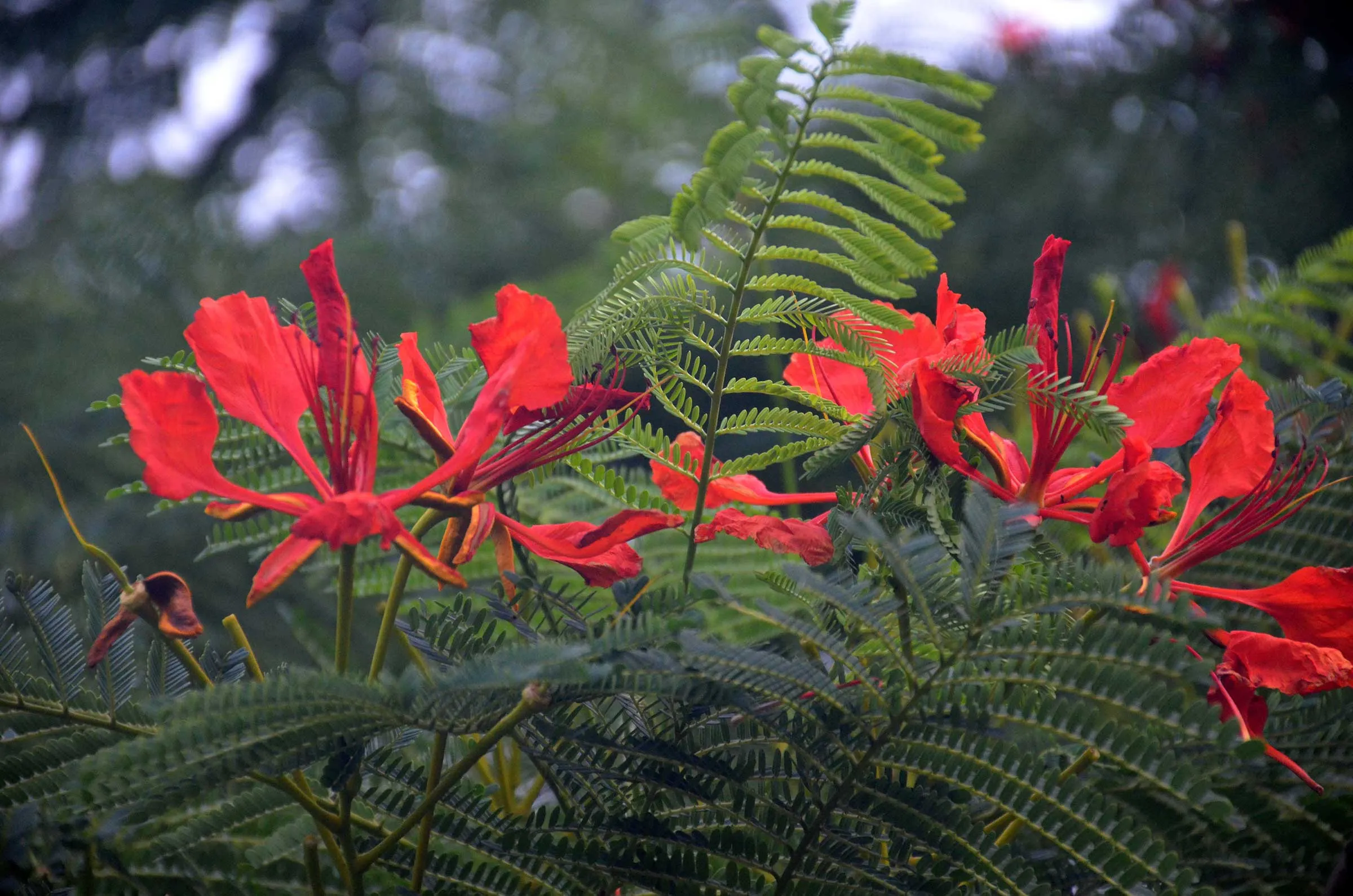
Royal Poinciana Delonix regia blooms. Photo Mary Gardner.

In our town, from December to January, each Royal Poinciana Delonix regia blooms. The magnificent red flowers cascade over the soft green leaves.

In the shade under these lush tropical canopies, I pause and marvel. How are such gorgeous trees parts of our urban forest? What makes a number of trees a forest? What is its function and has it any future?

Global interest saved the species

Poinciana are now main features of treescapes throughout the urban tropics and subtropics.

From the 19th century, the trees were planted along important streets in places such as Hawaii and India. Such global interest saved the species, which is now almost extinct in its country of origin, the impoverished Madagascar.

In Bangalore, Poinciana were the answer to urban forest planning. The goal was to line the streets and fill the parks with trees that all blossomed throughout the different seasons. The Poinciana dominate the cityscape in summer from April through June. Then as they grow their long dark seed pods, other trees blossom in their turn.

The urban forest

When it comes to urban forests, exotic trees are important. Throughout Australia and New Zealand, the plan has been to line the entrance road and the beachfront with Norfolk pines.

What’s left

In many places they are still there: large trees offering shade for people and habitat for wildlife. They also have the unexpected ability to absorb air pollution from all the vehicles burning fossil fuels.

Apart from the exotic Poinciana, Norfolk pines and other imports, what Australian trees make up most of the town forests of Byron Bay? Often seen are paperbarks (Meleuluca species). Bottlebrush (Banksia species). Moreton Bay fig/Australian banyan (Ficus macrophylla). Bangalow palms (Archontophoenix cunninghamiana) Sheoaks (Causarina species).  Eucalyptus of many sorts.

Maybe some of these trees were deliberately planted but many of them seem part of that curious subgroup known as ‘what’s left’. They remain, all that’s left after an initial development phase. They are there after the departure of previous owners who might have planted them or at least not cut them down.

In some public spaces, the trees are regrowth of forgotten origins. Those trees, part of big tracts, such as nature reserves and Arakwal Park, may yet function as part of some ecological landscapes as well as aesthetic or recreational ones.

Caught between past and future

But today’s urban trees are caught between a history of deforestation and a future of mega-development.

Our Shire Council’s ‘significant tree register’ is a list of only ‘koala food trees’: four species of Eucalyptus trees but only those ‘equal or greater than three metres in height’.

How are the next generation of food tree to grow up to such a size? Where will they grow? In fact where will any young urban tree grow to maturity?

Forest masterplan

People not only in cities but small towns the world over are thinking about tree-nature. They are pondering their streets, development applications and even climate change. They are seeing urban trees as valuable members of the community.

Individual trees need security. The urban forest as a whole needs scope to evolve.

What about urban forest evolution that includes food trees for other species, including people? What about the trees on the banks of different waterways in and about town? What about the urban beachfront or town entrance points? What about those trees, either by species or age, that are altogether missing from town? What about Urban Forest Masterplans?

The Royal Poinciana is here because some people had a few thoughts about trees. Let’s think a bit more before everywhere public becomes a parking lot. Let’s grow trees.



For four decades The Echo has printed the stories some people loved, some people hated, and some pretended not to read. If you want us to keep telling the truth, the real truth, not the sugar-coated version. We’ll need your support to keep the presses rolling.


If you are a local business owner help us and in turn we help you. All The Echo asks for is advertising, not a free ride. It is every advert in The Echo and on www.echo.net.au, which creates the space for all the stories and coverage of community events, happenings and concerns.

If you are a reader you can become a sponsor of The Echo. Your support keeps the us independent.

Even a small one-off or regular donation from you will help keep the echo’s independent voice alive and strong.

Support Us

Become one of the supporters who helps keep independent, local journalism alive in the Byron Shire by contributing anything from as little as the cost of a coffee each month.

You're Wonderful, Thank you for supporting independent journalism in the Byron Shire

You’re supporting The Echo, thank you

Your contribution is keeping independent, local journalism alive in the Northern Rivers.

Because of supporters like you, we can keep every story free for everyone — no paywall, no exceptions. Your money goes directly to funding our newsroom of 40-odd local workers covering the stories that matter to this community.

Tell us what you think, give us your opinion

The Echo loves your letters and comments and is proud to provide a community forum on the issues that matter most to our readers and the people of the NSW north coast. So don’t be a passive reader, email us your epistles at editor@echo.net.au.

The letters deadline for The Echo is noon Friday. Letters longer than 200 words may be cut. The publication of letters is at the discretion of the letters editor. Please remember to include your full name, address and telephone number.

Online comments are no longer available.

NSW commits $3 million for Saddle Road sewer link

The NSW Government will spend $3 million on a sewer link for the Saddle Road housing precinct near Brunswick Heads, a connection it says could service up to 600 residential lots.

Blacks Drain crossing fully reopens after $2.56 million rebuild

The Blacks Drain crossing on Tweed Valley Way at South Murwillumbah has fully reopened after a $2.56 million rebuild designed to reduce the risk of another washout.

From Spinifex Country to Lismore for a $23,000 art prize

In Michelle Anderson’s Kanpala, circles of red, orange and yellow bring a place in Western Australia’s Spinifex Country into view. It’s a place she returns to often in paint: Kanpa, the Country where her grandmother was born.

Work starts on eight-lane athletics track in Lismore

Construction has begun on an eight-lane athletics track at Southern Cross University’s Lismore campus, giving Northern Rivers schools and clubs a competition-standard venue closer to home when it opens in mid-2027.