


Aslan Shand
Questions are being raised around how the process for the remediation and future outcomes of the South Byron sewerage treatment plant (STP) are being delivered, with a key concern being the opportunity for community input.
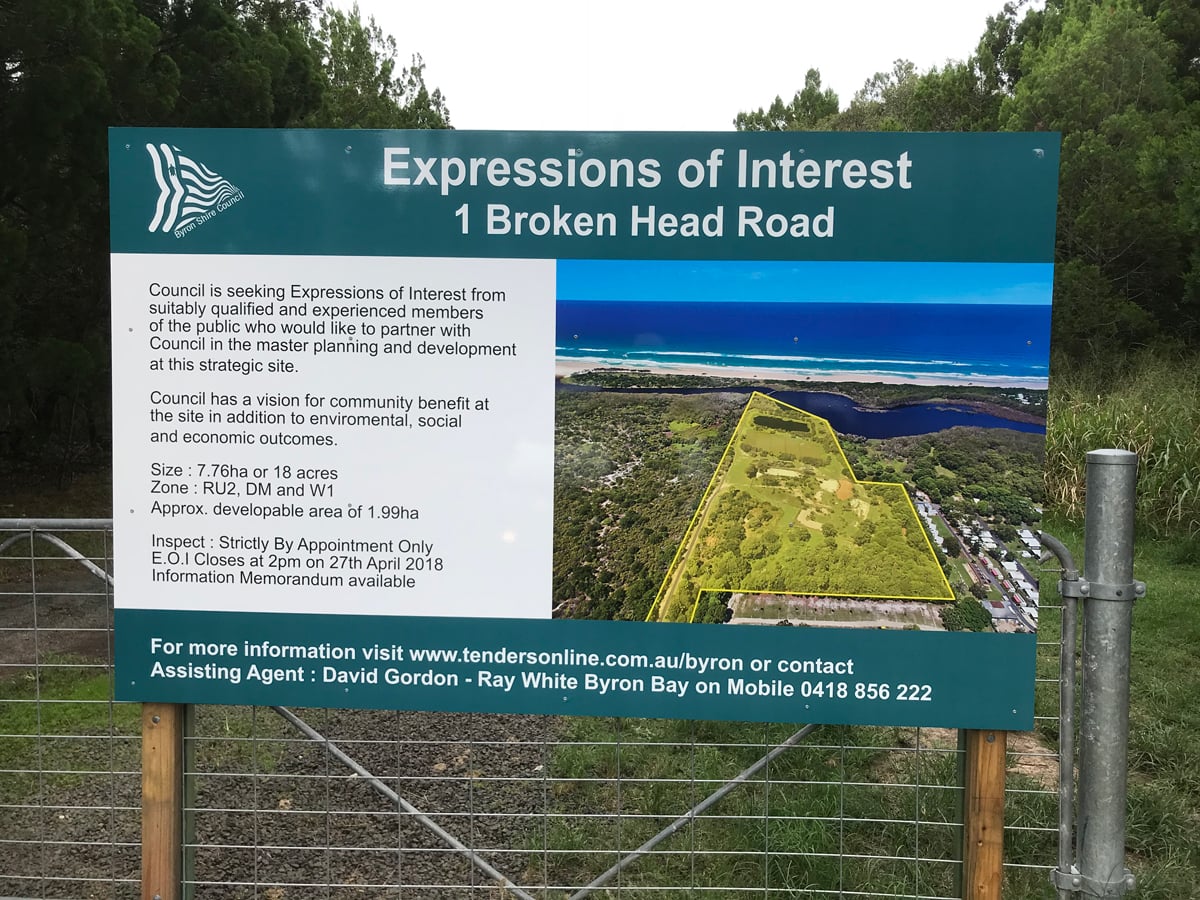
The site, at 1 Broken Head Road, was decommissioned in November 2005 and has since had around half the remediation work required done, according to councillor Paul Spooner.
However, since its closure it has been adopted by wildlife and birds as well as becoming a ‘clam’ and ‘magic’ place for locals and visitors alike said local biologist Dr Mary Gardner.
This Thursday, Council will most likely go into a confidential session to discuss the nine expressions of interest (EOI) that have been put in to council that will most likely determine the future of the site.
The reason the site has been able to go straight to EOI without community consultation is because it is classified as ‘operational land’ not ‘community land’, therefore it doesn’t require a plan of management (PoM), according to Phil Holloway, director infrastructure services.
‘Council understands there is a community desire for the property to be redeveloped into parklands and community open space but we do not have the money to do this and then maintain into the future,’ Mr Holloway said.
While he states that Council would like to maintain the land for ‘ the provision of public open space for community and environmental benefit’ he also highlights that council could ‘put it on the open market and sell it to the highest bidder’.
Community wants input
Local conservationist Dailan Pugh says that, ‘Council needs to go back to the start of this process and first ask the community what they want for the site. The first step needs to be for Council to identify and publicly exhibit options.’
‘Rather than giving developers carte blanche to decide what they want to do on the site, the community should first be able to identify the developable area and the constraints that apply.’
A 2010 draft master plan was developed for the site that looked at potential development of residential and educational facilities along with open space and environmental protection areas being put forward, but it was never exhibited.
‘This is only one option,’ pointed out Dailan. ‘It is also essential to consider other realistic options, such as Council managing it as a wetland reserve and public open space, or selling it to the National Parks and Wildlife Service.’
‘It needs to be remembered that this site is part of the water and sewer funds and any money raised from it has to go back to that fund. I also understand it is not financially strapped and could afford to continue to maintain the site as public open space.’
However, Council is looking to recover the costs of remediation, as Mayor Simon Richardson made clear responding to Sue McLeod when he stated that ‘the site needs to have a sound financial feasibility component to ensure the million dollar plus costs are met. Any proposal needs to have identified funding sources that can be relied upon to produce the investment required.’
Mr Holloway told Echonetdaily that Council’s vision is ‘to retain the ownership of the land to provide long-term, beneficial economic outcomes for Council and our ratepayers and residents and the provision of public open space for community and environmental benefit.’
The ‘level of communication will be revisited after the selective tender phase, which will determine whether there is a feasible partner and a suitable development option that meets Council’s community, environmental, social and financial objectives for South Byron STP site,’ said Mr Holloway.
Pond infill
Proposals to fill in one of the ponds at the STP site with asbestos contaminated soil have been suggested. The original remediation proposal costed for the removal of all contaminated material from the site but Council has looked at infilling and capping one of the ponds as an alternative means of reducing the remediation costs. This suggestion has also been criticised by Dailan, who said that ‘This is not appropriate for floodprone land.’
 For four decades The Echo has printed the stories some people loved, some people hated, and some pretended not to read. If you want us to keep telling the truth, the real truth, not the sugar-coated version. We’ll need your support to keep the presses rolling.


