


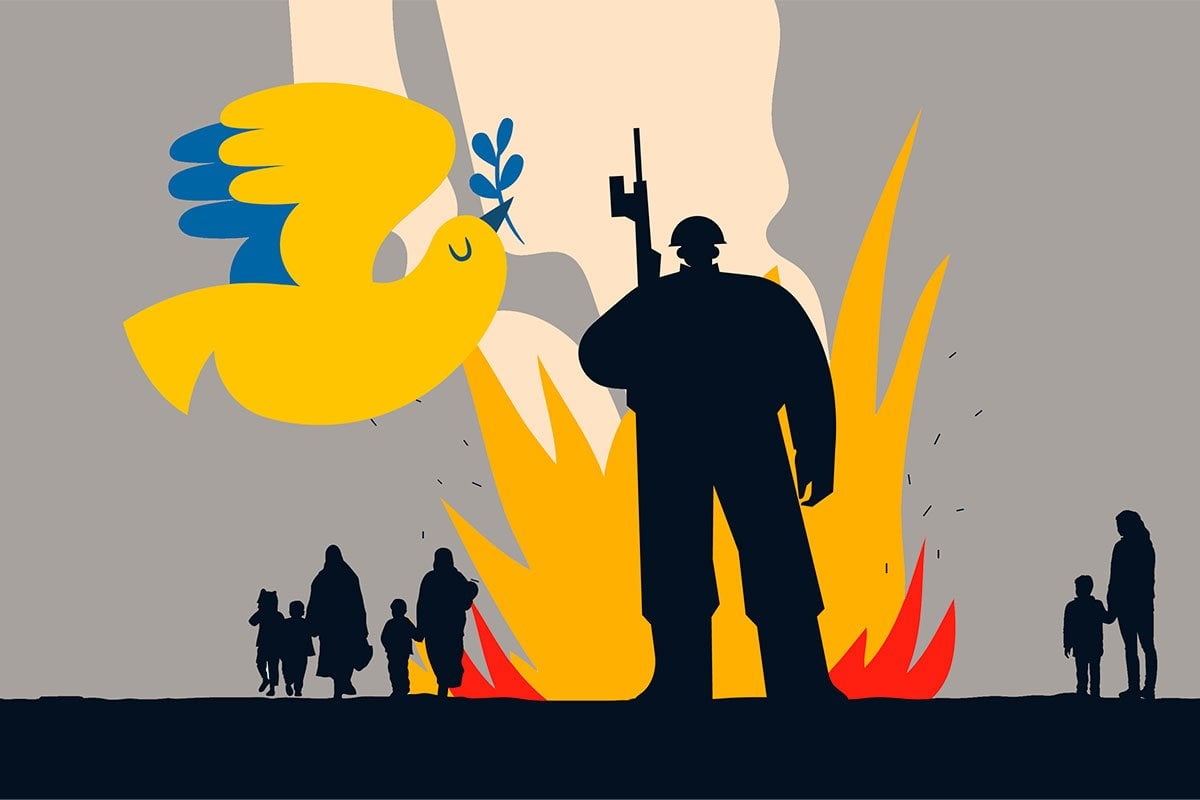
Why is peace so hard?
As the assault on Gaza resumes I am reminded of the quote by Albert Einstein: ‘Peace cannot be kept by force, it can only be achieved by understanding’.
Where is our understanding?
Understanding should be the work of government. It is the work of allies. More importantly it is the work of enemies. It is the work of neighbourhoods and communities. It is the work of artists and thinkers. It’s the work of us.
Building understanding is more powerful than building bombs. If you drop understanding 50 metres from a hospital you deliver supplies not more bodies. Right now it’s absent. We have a massive understanding deficit and because of it, people are suffering. The absence of understanding underwrites this conflict that is reaching across the world and tearing our communities asunder. Like it’s a football match and you have to pick which side to barrack for. I barrack for peace. I barrack for the pathway that delivers hope. I do not believe it’s impossible, only that narratives persist to make it so.
On the weekend Danny Almagor and Berry Liberman, the founders of Small Giants hosted Prayers for Peace in Melbourne. I received an email about the concert and this quote stayed with me. ‘We love my Israeli family and friends. We love my Palestinian friends. And I don’t understand why there aren’t more of us coming together to talk, to share, to build bridges, to vision a better future. To talk about peace. To talk about understanding. To sit together in grief. To sit together in hope. To learn how to replace fear and hate with love and respect.’
Yes.
Sometimes in all of this, we have to stop and find our humanity. Something wiser, deeper and more evolved. You see peace is hard. It takes compromise. It takes forgiveness. It takes acknowledging what has happened. It takes change and transformation. It takes vision. It takes leadership. It takes stopping killing.
Peace has always sounded like something hippies do on the weekend. It’s been ridiculed and minimised as unrealistic. As something naive and untested. As something not aligned with human evolution. But it’s not. Peace is enormously complex and co-operative. Peace is a delicate architecture built on the bones of our loss. It is charged with the stories of who we were and what we have overcome. It acknowledges our suffering. It rises above resentment. It is vast and enlightened and powerful. It is bigger than war. It is more impressive than any structure we could build. Peace is the ultimate human technology. It is beautiful and raw and mysterious. Peace rises from its trauma shadow. Peace is better than hope. It’s real. It’s possible. It is the place where we birth our children. It’s the future.
Peace and nonviolence is the conversation we need to be having. It’s a philosophy we need to embed. Peace is a way of living together so that all members of society can achieve their human rights.
And it must be achieved with nonviolence.
Nonviolence is not the easy way out. Gandhi considered violence crude and in the long run ineffective. How many bodies are enough? When does it end? Gandhi understood nonviolence from its Sanskrit root ‘Ahimsa’. It implies total nonviolence, no physical violence and no passive violence. Ahimsa translates as love. It’s beautiful and obvious. It’s the place of return for all religious texts.
For a moment, when the killing stopped, there was hope. No matter the circumstances, I don’t believe violence is ever the answer. When the dead bodies of thousands of children pile like confetti, surely we have to ask, is there another way?
There has to be.
Ceasefire.
And a new pathway to peace.
– Mandy Nolan
 For four decades The Echo has printed the stories some people loved, some people hated, and some pretended not to read. If you want us to keep telling the truth, the real truth, not the sugar-coated version. We’ll need your support to keep the presses rolling.


