


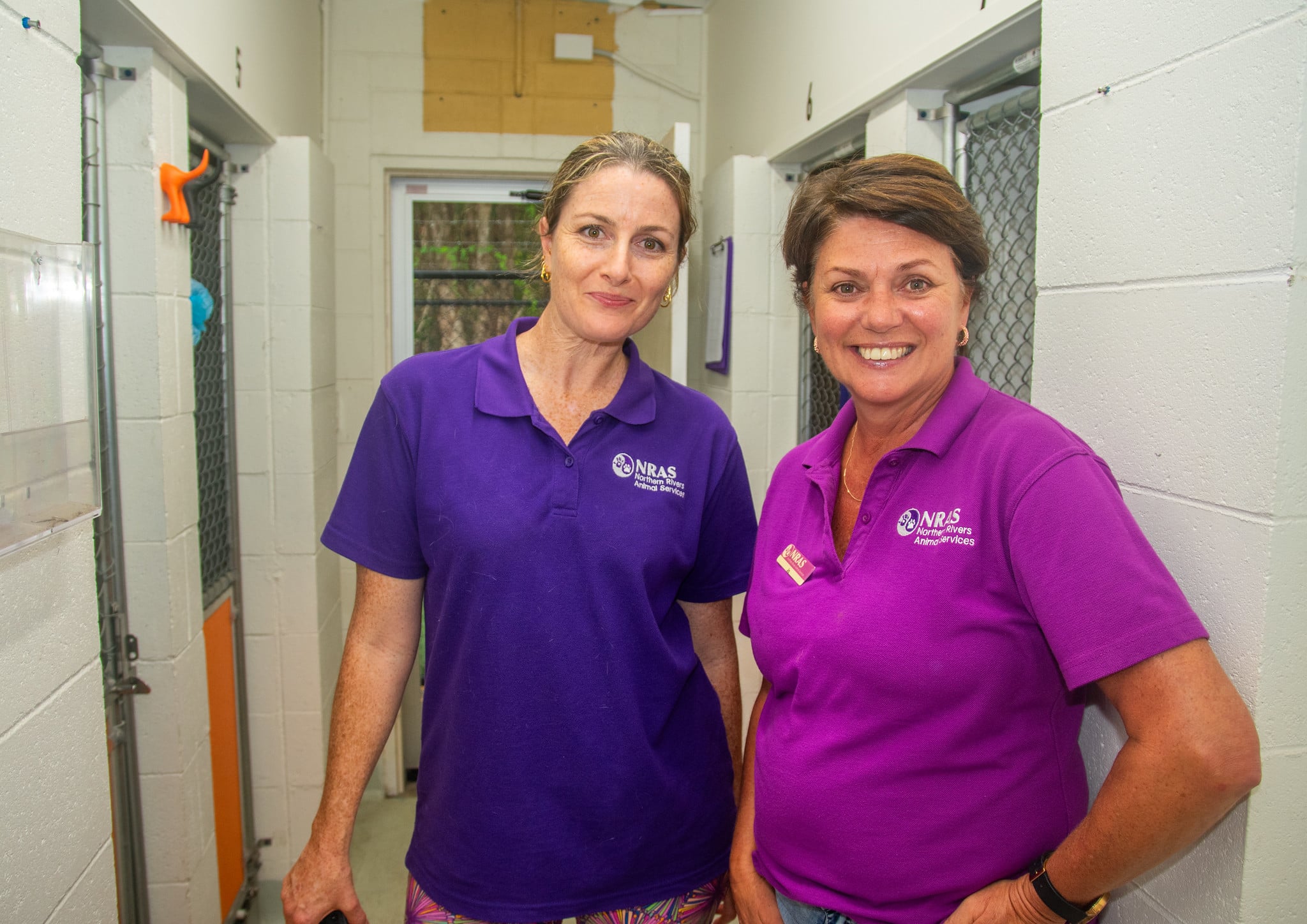
Northern Rivers Animal Services is a self-funded, not for profit charity which re-homes and rehabilitates unwanted, abused and neglected dogs and cats across the region. January is no holiday for the volunteers – in fact, this is their busiest period of the year.
The Echo spoke to NRAS Shelter Operations Manager Amy Gasnier. ‘It’s a chaotic time!’ she said. ‘The day after Christmas, I think we had about 15 calls for surrenders of animals, and leading up to Christmas was chaotic as well.’
There are a few causes for this, including people who are unwilling or unable to put their animals into boarding when they go away.

Ms Gasnier thinks the crux of it is that Christmas isn’t a positive thing for everyone.
‘Christmas brings financial strain. It brings family tension, it brings travel, it brings stress, there’s a spike in domestic violence. So there’s a lot of factors in the community,’ she said.
‘When the breaking point comes, the easiest solution is to get rid of the one that’s costing extra money, or that’s a little noisy, or which you have nowhere to put at the moment. And that’s where we get involved.’
NRAS has been operating as an independent charity for 22 years, with no regular government or council funding. ‘We have an op shop who do an amazing job, we apply for grants, and we get private donations,’ explained Ms Gasnier.
With the closest RSPCA facility in Coffs Harbour, NRAS doesn’t have the legal authority to step in where there are cases of abuse and neglect, and doesn’t ‘time animals out’, which means dogs and cats which come into care are boarded or fostered until they find new permanent homes.

Carers needed
‘We have our shelter, obviously, where we house a limited amount of animals. We also rely on a foster care network,’ said Amy Gasnier. ‘At the moment, we are in dire need of foster carers.
‘It’s a hard time of year with people traveling and whatnot. But the rental situation in this region is killing us.
‘Not only is it making adoptions hard, people don’t have the capacity to foster care either, because landlords say no pets. So that’s a massive issue. Housing is a leading cause of animals being surrendered.’
A bad situation became even worse after the catastrophic 2022 floods, with a wide range of impacts even across Ballina, depending on geography.
‘Yes, economically we still haven’t recovered. There’s a lot of people who don’t appreciate the impact that the floods have had, and how long it’s taking people to recover, and the trauma that goes with it.

‘Of course that flows through families into pets as well.’
The shelter itself wasn’t inundated with water in 2022, which meant the facility was able to temporarily house animals from the Cabbage Tree Island community. Some of those animals have been unable to return home since, with people living in pods not being allowed to leave animals at home when they go to work, for example.
In terms of foster carers, NRAS prefers to work with people who live within driving distance? ‘Yes, because we run our adoption days monthly. We need to bring animals into the premises for that. We also have vets that we work with. When your animals need to get vaccinated, or those sorts of things, we need to be able to transport them easily.
‘Our epicentre is Ballina, but we’re servicing the Northern Rivers community, so if you’re going to do foster care or be involved in some other capacity, within a 100 kilometer radius, if you’re happy to do the driving and the traveling, absolutely, I’ll take you!’

Cool for cats
Amy Gasnier explained the cat facilities at the NRAS shelter include a cat cottage, with three air conditioned rooms.
‘So depending on the cat’s personality, we might have a mother and a litter of kittens in one room, and then we might have a single cat in one room, and then we might have a bonded pair in another room.
‘If we’re feeling really ambitious, we’ll have three litters of kittens at once!’
The cats have access to safe outside enclosures as well.
If the dogs get on with humans, and each other, like the current two occupants, they’re able to mix with the volunteers in the other section of the shelter.
The names and details of animals needing homes and foster care appear on a whiteboard in the NRAS office, which is updated daily. Right now the chronic shortage of foster carers is the biggest challenge.
‘Yesterday, we sat down and we rang probably 20 or so people to say, “Can you you take anything? Can you help?” A lot of people say they’re sorry, or don’t pick up,’ said Ms Gasnier. ‘That’s really hard, because we’ve got probably 30 animals to house, and more coming in all the time.’

Animals end up in care for a variety of reasons
After a spike of people getting animals when they were home during COVID, there’s now a corresponding spike of animals being given up for adoption, including pure breeds.
‘You might have a deceased estate, or a relationship breakdown, or housing, like I mentioned. Sometimes, unfortunately, people are just irresponsible. But we also work with the local pounds; Ballina, Lismore, Casino, Kyogle…’
‘If an animal, temperament-wise, is safe. We’re going to take it,’ she says.
Amy Gasnier has been involved with NRAS for 21 years, originally as a foster carer. ‘Before that, I was that kid who always was looking after animals,’ she remembers.
‘I wasn’t allowed to have a dog for many, many years. So I was out to find one anyway I could! I was the kid who was rescuing them.’
When she and her husband rented a house that allowed pets, she became a foster carer, which is something she still does. ‘Generally we’ve got a few extras at home!’

Help needed now
Ms Gasnier told The Echo, ‘We’ve got an awesome network of volunteers and carers, and a lot of long-serving volunteers. But I absolutely need more. I particularly need more people who are confident with dogs.’
She says special experience isn’t needed, ‘but you need to have common sense. And you need to have a willingness to learn and listen and take the time to watch. There’s a lot about working with animals where you just need to stop, and look. We can learn a lot by watching.
‘I think if they’re smart enough to learn words and movements from us, we can be smart enough to do the same for them too.’
Cat enthusiasts are also needed, but she says the cat roster is more established, because they’re more suitable for the retired people who have more time to volunteer.

‘Dogs are enthusiastic, they’re happy to see you and they jump on you. Obviously, I don’t want to put anyone at risk. So I need able-bodied, confident people, who don’t mind walking the dogs and getting out and about with them socialising.
‘We also need cat cottage volunteers, and administrative volunteers, people in the office,’ she said.
‘I’m here every day. And we always have two people in the office. They’re answering phones, doing paperwork, and helping the animals.’
Volunteers who have lost their dogs for whatever reason are able to get a ‘dog fix’ at the NRAS shelter, Ms Gasnier told The Echo.
‘Yes, in the current climate where there’s so many people struggling with housing issues, and they have that need to care for something and love them, if you can’t do that in your everyday life, come in here and I can give you something to do!’

How else can people get involved?
Amy Gasnier said, ‘Currently, we’re blessed to have some really generous businesses in our area donate to us. So food supply for dogs is looking pretty good at the moment. We do need some help with cat food.
‘My wish would be for parasite prevention products; flea, tick, heartworm. Because absolutely everything that walks through these doors is going to be treated.
‘Everything that leaves us is desexed. vaccinated, microchipped, vet checked and fully parasite prevention treated. So it’s a great gift, because those products are pricey.
‘If people bring them in and donate, I’ll give them a big hug!’
Ms Gasnier says kitty litter is always needed too. ‘Yes,we’re literally throwing money away. They poop in it and we throw it away. But it’s a necessary thing and it costs us money.

‘Our op shop is also fantastic. If you’ve got bits and bobs, clothes, you know, anything from around the house of interest, send it our way.’
The NRS Op Shop is at 2/268 River Street, Ballina, opposite Dominos Pizza.
How to get in touch with the great people at the NRAS Shelter
Amy Gasnier says anyone can email the Ballina shelter directly via [email protected] or call the office weekdays from 10am-4pm on (02) 6681 1860.
The NRAS website at https://www.nras.org.au/ is currently being updated, and will soon have links to all the animals that are available. You can also keep up with what’s happening at NRAS and see the current rescues on Facebook.
Ms Gasnier says NRAS also keeps an active database to help team up people with their perfect pet partners. ‘You might come in today and say I want to adopt a white fluffy dog, and I don’t have that today. But I’m going to grab your details and write down what you are looking for.

‘I’ll keep that on our database. And when that white fluffy dog comes through the door, I’ll remember and call you, and say get in here!’
NRAS can cross-check with animals who have come into local pounds as well.
Amy Gasnier also recommends that people use the PetRescue and SavourLife sites to help with human-animal matchmaking, wherever they are in Australia.
Once people and animals are connected, NRAS goes through a careful process to ensure that the rehoming will work for everyone concerned.
While the shelter once accepted everything from pet ferrets to roosters and rabbits, they are now only able to help with cats and dogs. ‘That’s our wheelhouse and that keeps us busy,’ Ms Gasnier said.

How NRAS can help you help animals
‘If you’re even curious about foster caring, call and have a chat, I’m happy to talk you through it,’ she said.
‘We are not going to saddle you with an animal. Say you’ve got an existing pet, and it’s not working out, or the animal is too much. We’re not going to turn around and say you’re stuck with it. That’s not what we do.
‘The adoption process is a matchmaking service. The foster care process is a matchmaking thing as well. I’m not going to send out a boisterous 60 kilo dog to a house full of young children. That’s not smart, that’s not safe.
‘So you’re going to let us know what your household’s like, what works for you. And then I’m going to look for an animal that’s going to slot in with that.
‘We’ll provide everything; we’ll provide the food, we will pay for all the vet work, we will give you beds, we will give you kennels, we will give you toys, we will give you support. If you’ve got a problem, ring us and we will talk you through it.’

The best thing
‘I just think fostering is the best thing on Earth because you get all of the perks of pet ownership with none of the financial strain, no long-term commitment. What could be better?
‘We’ve had a number of animals from deceased estates, which is really heartbreaking, ‘said Ms Gasnier.
‘I think a lot of people have this misconception that rescue animals are all these reject dodgy animals – they’re not, there’s a lot of love invested in beautiful pets who have had work put into them.
‘So you’re not necessarily taking on an animal with trauma, or some complex history that you’re going to have to make accommodations for. We’ve got a lot of unwanted litters, we get a lot of large breed dogs.
‘So if you’ve got a spot for a big doggie or beautiful cat, we want to hear from you!’
 For four decades The Echo has printed the stories some people loved, some people hated, and some pretended not to read. If you want us to keep telling the truth, the real truth, not the sugar-coated version. We’ll need your support to keep the presses rolling.


