


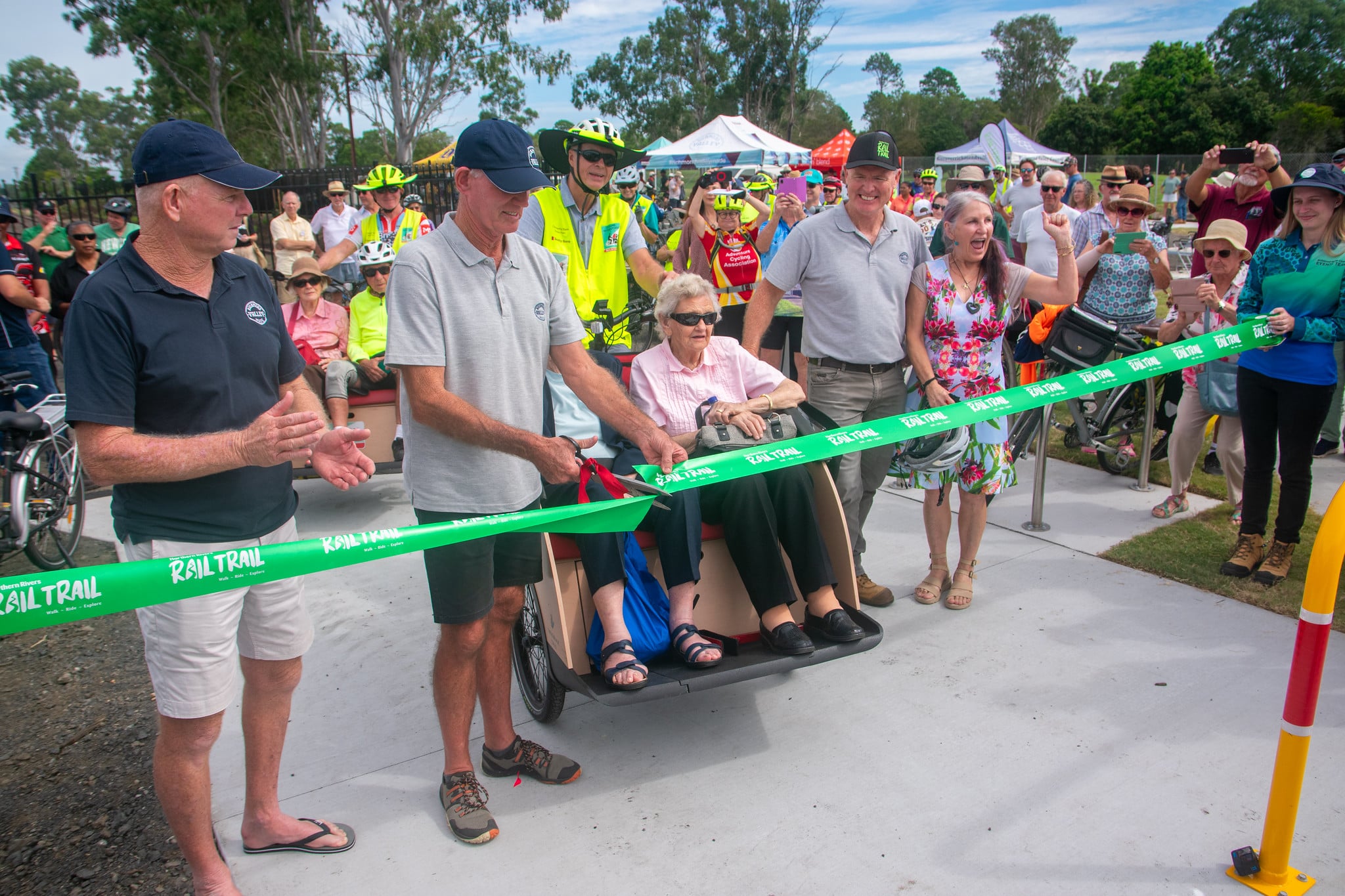
The latest leg of the Northern Rivers Rail Trail opened in style on Saturday, with hundreds of two-wheeled travel enthusiasts spinning along the newly opened 13.4 kilometre section from Casino to Bentley.
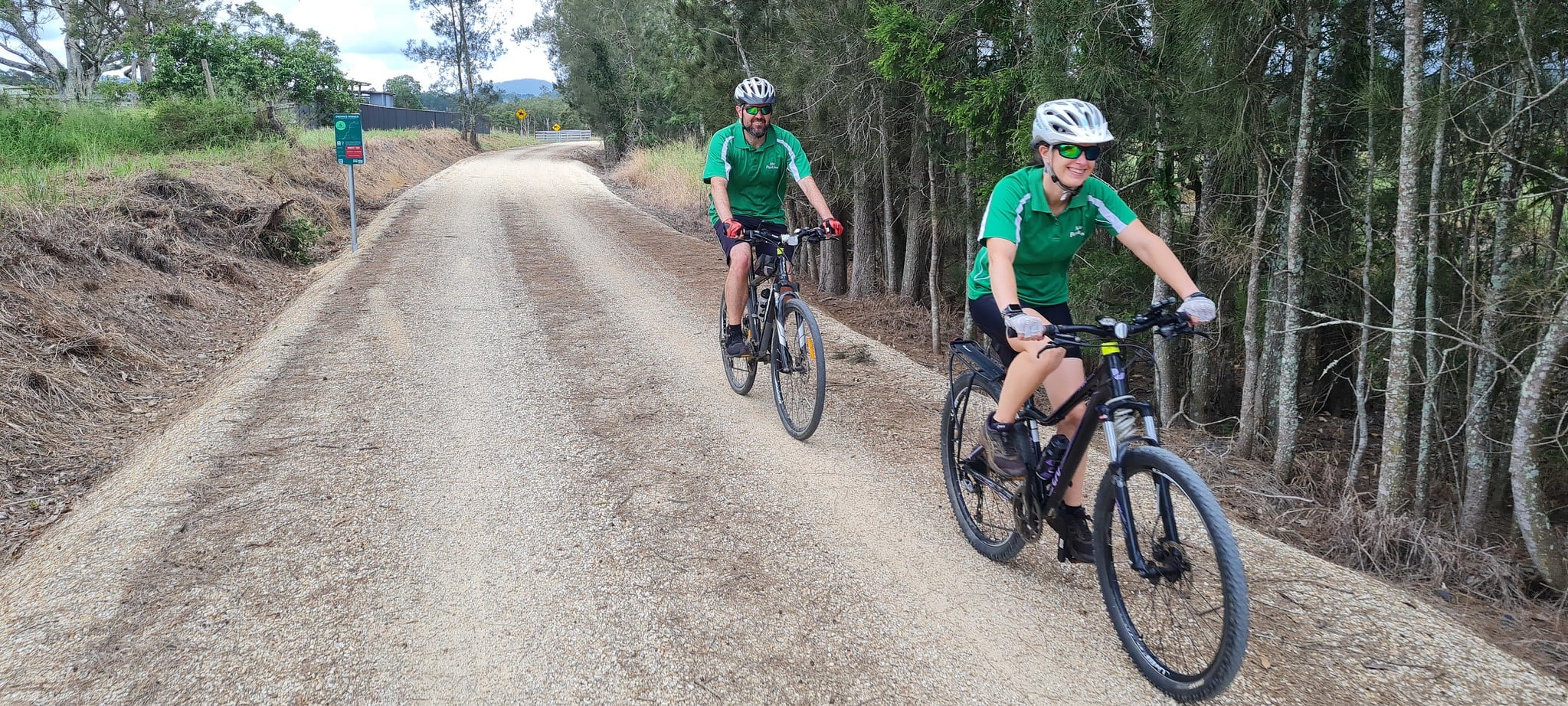
For those Richmond Valley cyclists accustomed to sharing the road with trucks doing 100 km/hour, it was a striking contrast to turn off and glide along the newly completed trail, with only the sounds of wheels on gravel and birdsong. The new trail is wider than the Tweed section of the rail trail, with a separate track for horses in several sections and safety fences where there are steep drop-offs.

Surprises along the way include beautiful mature grass trees and a big hill over the Naughtons Gap tunnel, with spectacular views in both directions from the top.
The tunnel contains threatened bats, who have been left in peace.
For the opening speeches, Casino and Lismore locals were joined by people from Grafton, Sydney, Brisbane, Tweed, Dubbo and the Gold Coast, including Cycling Without Age representatives, who led the opening contingent along the trail.
Elder Sam Walker gave a welcome to country before Richmond Valley Mayor Robert Mustow spoke about the ten year odyssey to get the rail trail built, and the history of the old Casino Railway Station site, where the trail begins (near the Richmond Dairies).
He spoke about the great success of the Tweed Valley section, which has exceeded all expectations, and Casino’s hopes to replicate that, especially once the neighbouring sections are completed to create a 143 kilometre rail trail.
Mayor Mustow credited the lobbying of all the people in different levels of government with different political affiliations at different stages who helped make the new trail a reality, particularly the Member for Page, Kevin Hogan.

40,000 visitors expected
Mr Hogan spoke about his initial disappointment about the railway being closed, and his growing enthusiasm for rail trails since that time, as he came to realise (via conversations with Pat Grier) the significant regional and international tourism implications. He said he expected the new trail to generate at least 40,000 visitors to the region per year, with funding in part from the National Tourism Icons program, assisted by Austrade.
Member for Lismore Janelle Saffin acknowledged Mr Hogan’s role in securing the finance, and agreed the new rail trail would bring a major tourism boost, following the inspiring path laid down by Tweed Shire (represented at the Casino opening by Mayor Chris Cherry).

Lismore Mayor Steve Krieg was also present, and asked when the next section would be finished, from Bentley to Lismore. ‘By Christmas!’ he said.
Sam Palmer from Austrade was present on behalf of Don Farrell, NSW Minister for Trade and Tourism, who said the government believed the rail trail was perfectly positioned to take advantage of the latest tourism growth trends, in Australia and internationally.
‘The interest in participation in nature-based travel has expanded dramatically over the past 10 years,’ she said. ‘There’s been about a doubling of the number of people who are getting involved in bushwalking, riding bicycles, horses, visiting national parks, looking at nature reserves and bird watching.
‘This is everything you offer with this rail trail, so we’re very assured of your success.’

Thanks to the workers
Richmond Valley GM Vaughan Macdonald paid tribute to the many people who worked hard to make the trail a reality.
In practical terms, he said 48,000 tonnes of quarry products were needed to construct the bike and bridle trails. Council also built 207 car spaces across three new car parks, 14 kilometres of fencing, created extensive plantings, signs, picnic shelters and a new toilet block at the Bentley end – a major undertaking by any measure, and ‘a great team effort’.
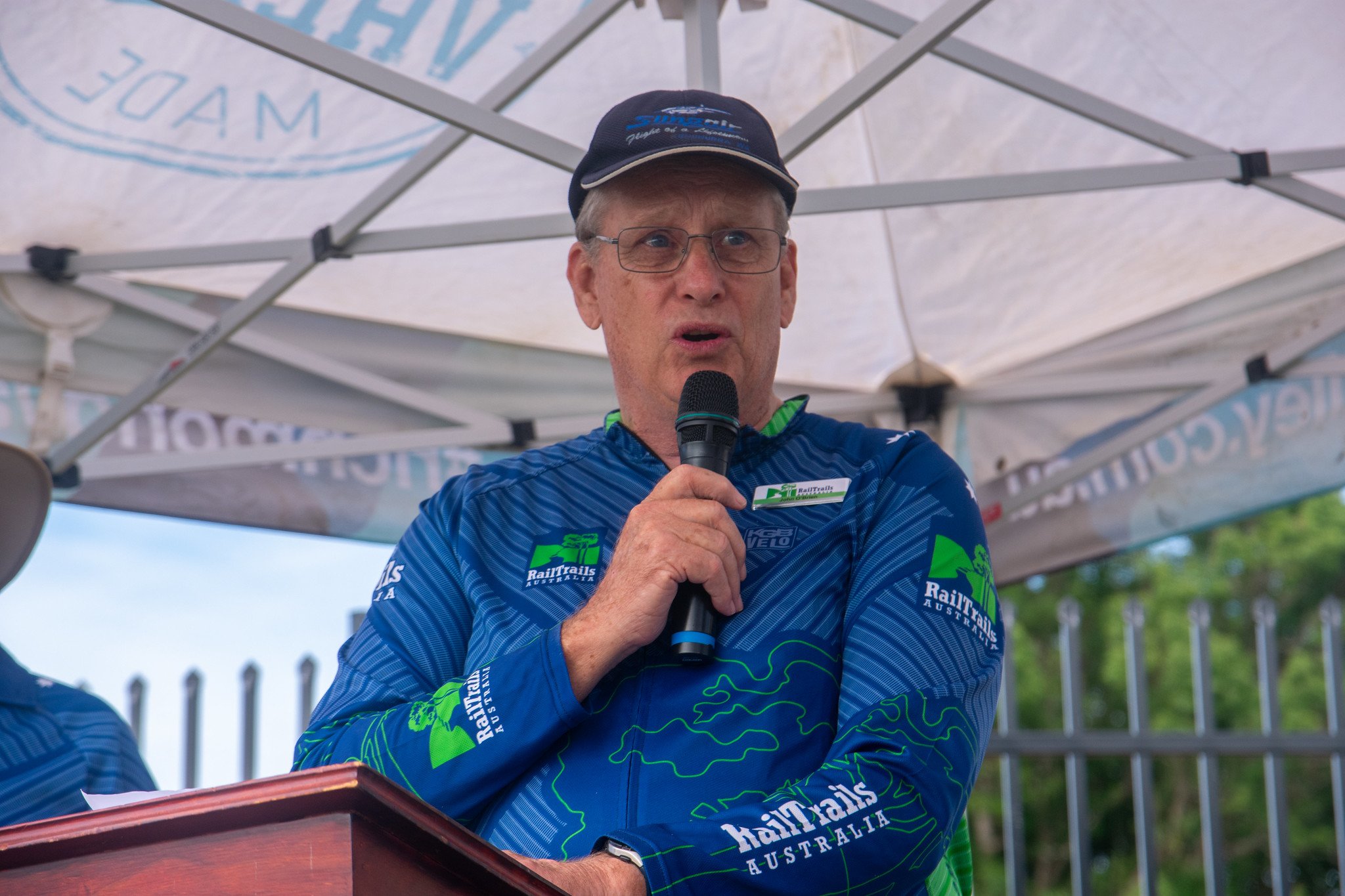
John O’Brien from Rail Trails Australia talked about the tenacity of those who had fought for the idea of the trail over many years, to create ‘fantastic community assets that can be used by anyone at any time’, and thanked everyone involved.
‘We know that it’s a long and frustrating process, and it needs people that have got motivation, passion, courage, conviction and determination,’ he said. ‘These people have got all of those wonderful qualities.’
Mr O’Brien spoke about the transformation of Tumbarumba in southern NSW, which has seen more than 60,000 visitors to its rail trail since it opened two years ago, and the 140,000 users of the Murwillumbah trail in just over twelve months.
He said the completion of the entire trail would be a major national and international drawcard for the Northern Rivers.

Restoring faith
Tim Coen from Rail Trails for NSW echoed these sentiments, and thanked former member for Ballina Don Page (who was also present) for giving the keynote address at a function in NSW Parliament House, ten years ago, to get the idea of rail trails in NSW into people’s minds, and overcome the legislative hurdles.
‘NSW has been really slow in comparison to the rest of Australia,’ he said. ‘Overseas, the USA has 42,000 kilometers of rail trail, so they’re not a passing fad.
‘I want to thank all of the politicians and members of parliament in NSW and the local government areas who’ve worked across parties and in a sensible fashion to realise that rail trails are essentially a local issue, and are good for their communities.
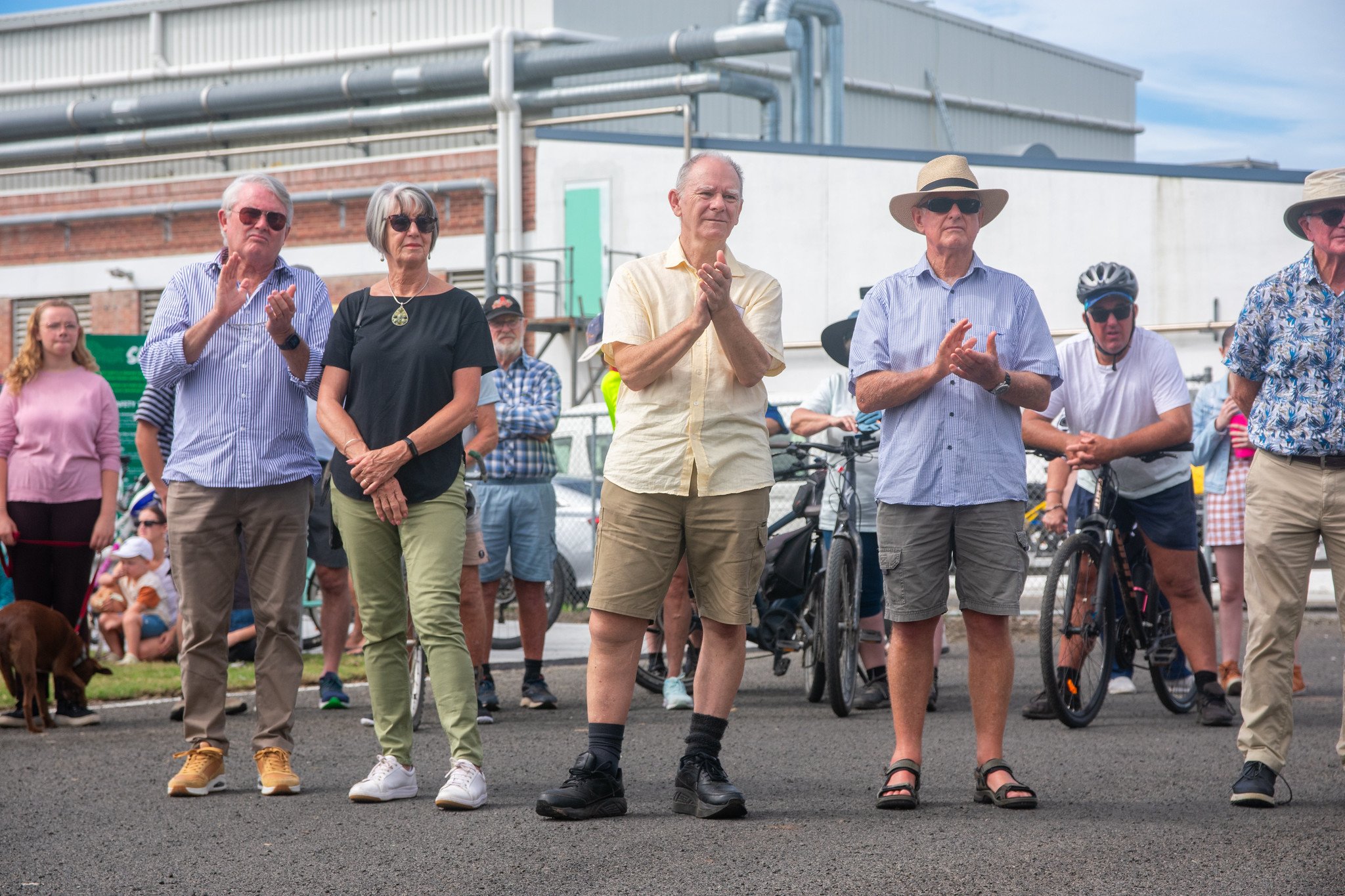
‘You’ve restored my faith in parliamentary democracy!’ he said.
Mr Coen also asked those present to lobby for easier access of bikes on to trains in NSW, without 20 kg limits (effectively prohibiting e-bikes) and the need to box up bicycles, which he said was preventing many families and others from enjoying rail trails.
Pat Grier, the President of the Northern Rivers Rail Trail Supporters Group, said that with the growth of e-bikes, rail trails were only going to increase in popularity, and that when completed, the Northern Rivers Rail Trail was going to be one of the best in the world.
Mr Grier thanked all who had fought for the trail, and said the latest section was going to be a ‘game-changer’ for Richmond Valley. ‘This is your day, Casino. Enjoy your rail trail and enjoy every bit of the new energy that it will bring to the Casino region.’

Bats
Dr Elizabeth Williams is a senior wildlife ecologist who was educating rail trail users on the weekend about the threatened bats that live in the Naughtons Gap tunnel. She talked to the Echo in between fending off joking complaints from cyclists who don’t like going over hills.
As she explained, Richmond Valley Council have built a sealed overpass over the old railway tunnel, to protect the bat roosts which have established since the trains stopped coming through. ‘This tunnel has got two main species of microbats in it,’ said Dr Williams, noting there are two vulnerable stages for populations ‘so they don’t die’.
‘One is breeding roosts, or maternity roosts, which is where they birth and raise their young. The other one is called an overwintering roost. And that’s where they go to hibernate in winter, when there’s not as much food around.

‘Microbats eat insects,’ she explained, ‘and in winter, when it’s cooler, there’s not as many insects around. So they go into a light form of hibernation during winter. And they use this area for both those purposes.
‘There’ll be some that are here all year round, but as it’s approaching winter, bats from two or three hundred kilometers around will come to this particular tunnel to go into hibernation over winter, and then start departing again in spring.’
Dr Williams said there two major species represented, the little bent wing and the large bent wing (both threatened), as well as other bat species using the tunnel sporadically.
It’s important for the bats’ survival that they not be disturbed, not just because of their importance in the ecology, but also to humans, with bats eating many mosquitoes every night as well as major agricultural pests such as helicoverpa moth.
She said many people had been stopping at Naughtons Gap and talking about their own local microbat populations at home, showing growing awareness of the importance of these species.

What next?
It’s obvious that many sections of the rail trail have only just been finished, with room for small improvements, such as a bin at the Bentley end (and a sign about what happened there with the historic Bentley blockade), but there’s no doubt the Richmond Valley Rail Trail is a significant and impressive piece of infrastructure.
Hopefully it heralds a new era for Casino, where the region focuses more on environment-based economic activity rather than destructive plans such as gasfields and incinerators. If the opening was anything to go by, the local community seems very supportive of the idea of a rail trail, with the usual smiles from riders young and old going up and down the track, despite the threat of rain.
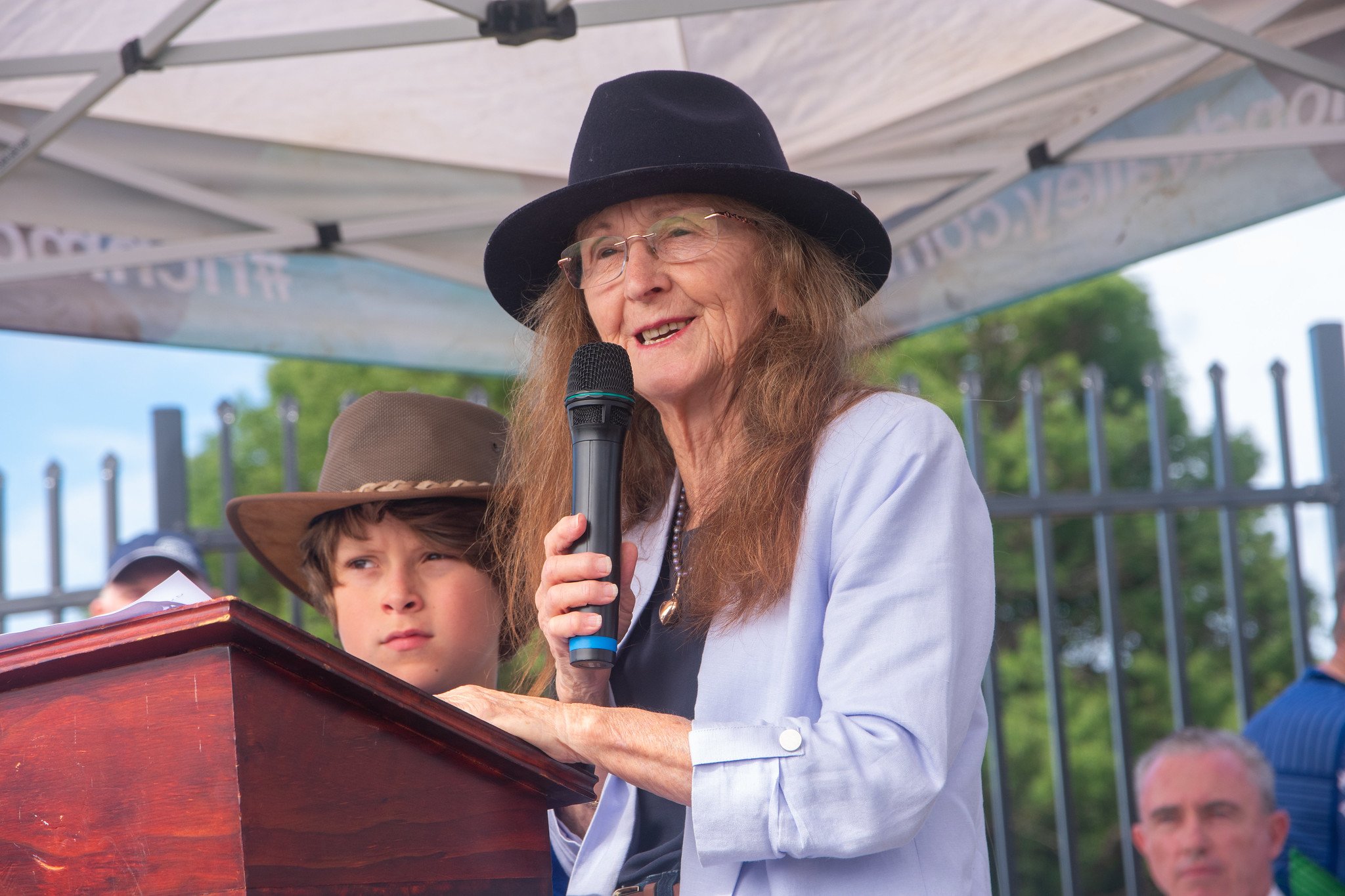
Long time rail trail supporter and former Lismore mayor Jenny Dowell OAM told The Echo it had been a ‘long slog’ to get to the point of opening the Tweed and Richmond Valley sections, but she was thrilled with the progress.

‘After the success of the Tweed section, it’s now got a momentum all of its own, and this section has been beautifully done by the Richmond Valley Council. We look forward to it linking up to Lismore.
‘Some of the opponents along the way have now embraced it and particularly the businesses,’ she said.
‘I don’t think anyone who’s been on it will ever say this is a bad idea. So it’s really great to see.’
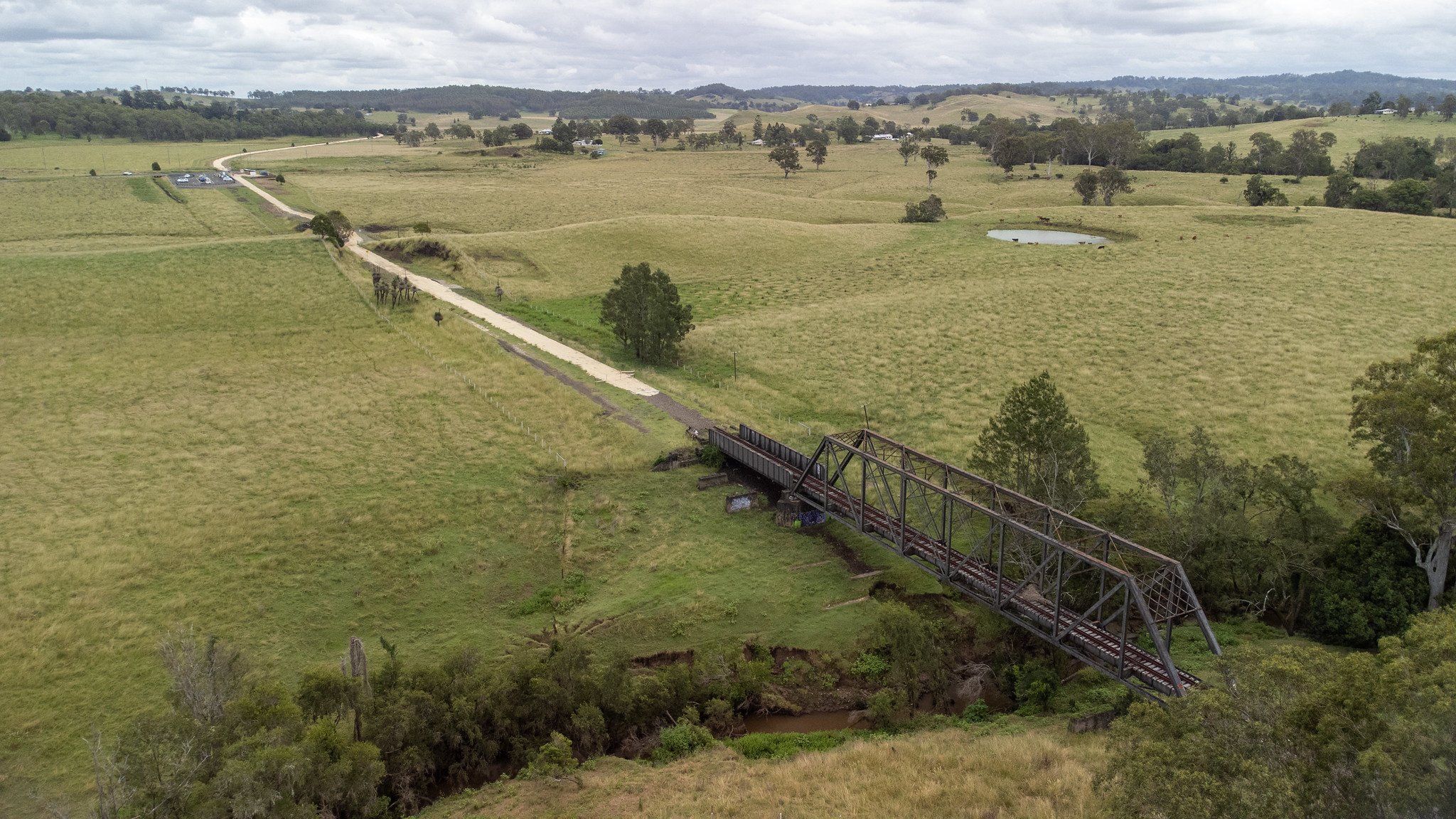
From the air over the Bentley bridge terminus, it’s clear that Lismore Council workers have already made substantial progress on the next section, which will put extra pressure on Byron Shire Council to build their piece of the puzzle sooner rather than later, and complete the Northern Rivers Rail Trail.




 For four decades The Echo has printed the stories some people loved, some people hated, and some pretended not to read. If you want us to keep telling the truth, the real truth, not the sugar-coated version. We’ll need your support to keep the presses rolling.


